A New Beginning

The rapidly shrinking, sinking and stinking Rapidshare has blocked my account and deleted hundreds of my files. Is this the end of A.O.O.F.C? Watch this space, & thanks for all your support and encouragement. Keep on rockin' in the free world. Paul

A.O.O.F.C
recommends
Mizar6

babydancing


Get this crazy baby off my head!

29.9.07

Dr. John


drjohn-drjohnplaysmacrebennack1982


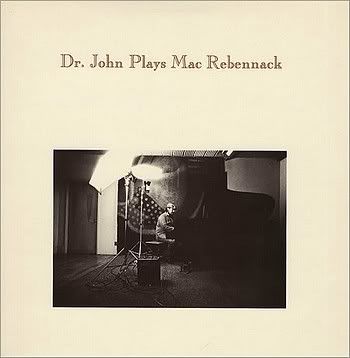
Dr. John - Dr. John Plays Mac Rebennack - 1982 - Demon Records UK

Dr. John was always respected as a consummate pianist, but he didn't make a solo, unaccompanied piano record until 1981's Dr. John Plays Mac Rebennack. The wait was well worth it. His music had always been impressive, but this is the first time that his playing had been put on full display, and it reveals that there's even more depth and intricacies to his style than previously expected. More importantly, the music simply sounds good and gritty, as he turns out a set of New Orleans R&B (comprised of both originals and classics) that is funky, swampy and real. © Thom Owens, All Music Guide

TRACKS / COMPOSERS

Side 1
Dorothy - Dr. John, Mac Rebennack
Mac's Boogie Woogie - Dr. John, Mac Rebennack
Memories of Professor Longhair - Roy Byrd
The Nearness of You - Hoagy Carmichael, Ned Washington
Delicado - Jack Lawrence, Waldir Azevedo
Side 2
Honey Dripper - Joe Liggins
Big Mac - Dr. John, Mac Rebennack
New Island Midnight - Mac Rebennack
Saints - Mac Rebennack
Pinetop - Stuart Saunders Smith

CREDITS

Dr. John (Keyboards), Vocals),
Victor Giordano (Engineer),
Bernie Grundman (Mastering),
Matt Walters (Mastering Supervisor),
Mac Rebennack (Piano),
Mac Rebennack (Vocals),
Jack Heyrman (Producer),
Eddie Levine (Producer),
Dean Roumanis (Engineer),
Nancy Jean Anderson (Adaptation),
Ed Levine (Producer),
Michael Tearson (Liner Notes)

25.9.07

Terry Evans


terryevans-walkthatwalk2000


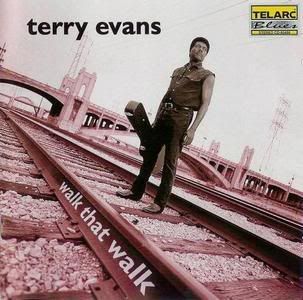
Terry Evans - Walk That Walk - 2000 - Telarc

A terrific Blues-Soul album from the great blues vocalist, Terry Evans. Evans has given vocal support to legends like John Lee Hooker, Ry Cooder and John Fogerty, to name just three. Evans is a superb songwriter, and this is a true blues roots original. Check out the brilliant drumming from the legendary Jim Keltner. An excellent album, VHR by A.O.O.F.C

TRACKS

1. Walk That Walk
2. Story Of My Life, The
3. Stone's Throw Away, A
4. Dancin' With Your Belly Up
5. Don't Give Up
6. Let's Have A Ball
7. I'll Get Over You
8. I Want To Go Back
9. Credit Card Blues

PERSONNEL

Terry Evans - vocals, acoustic guitar
Jeff Alviani -- keyboards
Gil Bernal -- tenor saxophone
Phil Bloch -- tambourine
Ry Cooder -- guitar
Kenny Dew -- bass
Willie Green Jr. -- vocals
Jim Keltner -- drums
John "Juke" Logan -- harmonica
Jesse Samsel -- guitar
Ray Williams -- vocals

REVIEWS

Terry Evans has one of the most identifiable voices in blues and roots music, providing vocal support for the likes of John Lee Hooker, Ry Cooder and John Fogerty. In recent years, Evans has come to the forefront as a concert headliner with a stunning series of well-received recordings. Telarc is pleased to announce the label debut of the celebrated vocalist with the release of Walk that Walk, which includes guitar master Ry Cooder and the great session drummer Jim Keltner.
Walk that Walk draws on a rich musical legacy. Born in Vicksburg, Mississippi (Willie Dixon’s hometown), Terry Evans’ first exposure to music was in the church choir. He headed out to Los Angeles in 1962 and soon made his mark with a group called the Turnarounds. In the '70s, Evans performed with singer Bobby King as a soul duo, and eventually they became Ry Cooder’s principal back-up vocalists. Evans' breakthrough came during the movie Crossroads, where he sang on "Down in Mississippi" and the title piece during the film.
Voice-wise, Evans sounds almost as good on Walk that Walk as he did in the '60s, when he rolled out "The Birds and the Bees" and it broke nationally. He writes excellent songs and hires top-of-the-line backup names. Evans whoops it up on the harp-spiced "The Story of My Life," sets a spiritual tone on "Don’t Give Up," and wails in "Credit Card Blues." The album is rounded out with raspy, festive covers of “A Stone’s Throw Away,” “Dancin’ With Your Belly Up” and “Let’s Have A Ball.”
Produced by Joe Harley, Evans’ longtime producer, Walk that Walk features Cooder and Keltner on all nine tracks. Evans is also joined by keyboardist Jeff Alviani, saxophonist Gil Bernal, bassist Kenny Dew, harpist John “Juke” Logan, guitarist Jesse Samsel, and vocalists Willie Green, Jr. and Ray Williams. © Telarc International Corporation
Terry Evans is a bluesman from Vicksburg, Mississippi, the hometown of Willie Dixon. His new CD, Walk That Walk, finds the singer and guitarist carrying on in the tradition of masters like Dixon. Evans' breakthrough took place in the late '80s when he sang "Down in the Mississippi" and the title piece for the film Crossroads. © JAZZIZ Magazine Copyright © 2000, Milor Entertainment, Inc.
Unexpectedly catchy and fun. Sometimes the mix feels off, but there's soul here too often missing in modern blues. © laze , © 2001-2007 ADDreviews

BIO

Terry Evans has become a soulful, gospel-flavored vocalist fronting a band, but his career took many steps to reach that pinnacle. Like many blues artists, his first exposure to music was in church, where he sang in the junior choir. As is often the case, his parents allowed him to sing only gospel, but on the sneak, he listened to blues artists such as Elmore James, Little Walter, Albert King, and B.B. King.
His first break was as a member of a Southern vocal group, the Knights. From there, he moved to Southern California and began picking up guitar and writing songs. Among the songs he wrote were "Love Is a Precious Thing," which was recorded by Pops Staples, and "Hop, Skip, and Jump," recorded by Louie Jordan.
In the '70s, he performed as a duo with Bobby King, performing on the chitlin circuit to purvey their brand of Stax-styled soul and gospel. A hard-working performer, Evans continued with King while at the same time working as a background vocalist for Ry Cooder, both on Cooder's albums and in the touring band. Evans' breakthrough came during the movie Crossroads, where he sang lead on "Down in Mississippi" and the title piece during the film.
In 1993, Evans released his first solo album, Blues for Thought, on Pointblank. While providing backing vocal tracks for Lloyd Jones' Trouble Monkey, he attracted the attention of record producer Joe Harley, who then signed Evans to Audioquest. Evans recorded two fine albums with Harley, Puttin' It Down and Come to the River. Walk That Walk followed in early 2000; Mississippi Magic was issued a year later. © Char Ham, All Music Guide

Ian Dury & The Blockheads


iandury&theblockheads-lucianatten1980


Ian Dury & The Blockheads - "Lucianatten" 13-12-1980

Fantastic concert with Ian Dury & The Blockheads. Amazing band and Ian in good form This concert was broadcast directly for both TV and Radio in Sweden [1st generation cassette]. Please make allowances for sound quality, & track ends. Track 1 sounds incomplete. Nevertheless, these recordings from Ian Dury are rare, and it is still a very good account of Ian & The Blockheads in action.

TRACKS

1.Billy Jean And Me
2.Clever Trevor
3.Sink My Boat
4.Superman's Big Sister
5.Yes And No (Patricia)
6.Uncoolohol
7.Delusions Of Grandeur
8.What A Waste
9.I Wanna Be Straight
10.Fucking Ada
11.Oh! Mr. Peanut
12.Plaistow Patricia
13.Hit Me With Your Rhythm Stick
14.Sweet Gene Vincent
15.Sex Drugs And Rock And Roll

BAND

Ian Dury, vocals
Charley Charles, drums
Norman Watt-Roy, bass
Davey Payne, sax
Mickey Gallagher, organ
Wilco Johnson, guitar
John Turnball, guitar
Don Cherry, trumpet [Clarification needed on trumpet player]

ABOUT THE ARTIST

At the age of seven, Ian Dury was stricken with polio. After spending two years in hospital, he attended a school for the physically handicapped. Following high school, he attended to the Royal College of Art, and after his graduation, he taught painting at the Canterbury Art College. In 1970, when he was 28 years old, Dury formed his first band, Kilburn & the High Roads. The Kilburns played simple,'50s rock & roll, occasionally making a detour into jazz. Over the next three years, they became a fixture on England's pub-rock circuit. By 1973, their following was large enough that Dury could quit his teaching job. Several British critics became dedicated fans, and one of them, Charlie Gillett, became their manager. Gillett helped the band sign to the Warner subsidiary Raft, and the group recorded an album for the label in 1974. Warner refused to release the album, and after some struggling, the Kilburns broke away from Raft and signed with the Pye subsidiary Dawn in 1975. Dawn released Handsome in 1975, but by that point, the pub-rock scene was in decline, and the album was ignored. Kilburn & the High Roads disbanded by the end of the year. Following the dissolution of the Kilburns, Dury continued to work with the band's pianist/guitarist, Chaz Jankel. By 1977, Dury had secured a contract with Stiff Records, and he recorded his debut with Jankel and a variety of pub-rock veterans -- including former Kilburn Davey Payne -- and session musicians. Stiff had Dury play the 1977 package tour Live Stiffs in order to support his debut album New Boots and Panties!!, so he and Jankel assembled the Blockheads, recruiting guitarist John Turnbull, pianist Mickey Gallagher, bassist Norman Watt Roy and drummer Charley Charles. Dury and the Blockheads became a very popular act shortly after the Live Stiffs tour, and New Boots and Panties!! became a major hit, staying on the U.K. charts for nearly two years; it would eventually sell over a million copies worldwide. The album's first single, "What A Waste," reached the British Top Ten, while the subsequent non-LP single "Hit Me With Your Rhythm Stick" climbed all the way to number one. In May 1998, Dury announced that he had be diagnosed with colon cancer in 1995 and that the disease had spread to his liver. He decided to release the information the weekend of his 56th birthday, in hopes of offering encouragement for others battling the disease. For the next year, he battled the disease while keeping a public profile -- in the fall of 1999, he was inducted into Q magazine's songwriting hall of fame, and he appeared at the ceremony. Sadly, it was his last public appearance. Dury succumbed to cancer on March 27, 2000. He left behind a truly unique, individual body of work. © Stephen Thomas Erlewine, All Music Guide

Corea/Gadd/McBride


coreagaddmcbride-supertrio2006


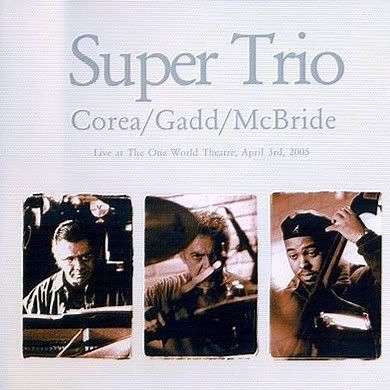
Corea/Gadd/McBride - Super Trio - 2006 - Stretch/Universal Japan

2006 Japan-only release of this breathtaking trio of Chick Corea, Steve Gadd, and Christian McBride. All songs recorded live at the World Theater in Austin, Texas April 2005. A masterful jazz CD from three jazz legends. Incredible musicianship, and seven brilliant compositions from the legendary Chick Corea. I don't know if this album is available outside Japan, but if you come across it, buy it.

TRACKS

1 Humpty Dumpty
2 The One Step
3 Windows
4 Matrix
5 Quartet #2
6 Sicily
7 Spain

All songs composed by Chick Corea

PERSONNEL:

Chick Corea: piano;
Steve Gadd: drums;
Christian McBride: bass.

REVIEWS

The extraordinary Super Trio, one of Japan’s best-selling jazz albums this year, features Chick Corea, Steve Gadd and Christian McBride in a masterful performance. © 2007 Chick Corea www.chickcorea.com/catalog/product_info.php/products_id/69

He may be in his mid-sixties, but pianist Chick Corea hasn’t slowed down in the least. In the past five years there’s been a monumental three-week run at New York’s Blue Note, focusing a bright light on acoustic ensembles past and present and beautifully documented on the ten-DVD set Rendezvous in New York (Image Entertainment, 2005). Corea re-formed his powerhouse Elektric Band for an album—To the Stars (Stretch, 2004)—and tour. He reunited with members of Paco de Lucia’s band for a tour documented on the double live CD Rhumba Flamenco (Chick Corea Productions, 2005), available only at shows and on Corea’s website. The Ultimate Adventure (Stretch, 2006) hearkened back to the days of high concept albums like My Spanish Heart (Polydor, 1976) without sounding the least bit retro.
Why Super Trio is only being released in Japan is a mystery. This live set revisits material from Now He Sings, Now He Sobs (Solid State, 1968), Light as a Feather (Polydor, 1972), The Mad Hatter (Polydor, 1978), Friends (Polydor, 1978) and Three Quartets (Warner Brothers, 1981), focusing as much on Corea the composer as Corea the pianist. In the same way that recent trios led by guitarist Pat Metheny have drawn from a broad cross-section of writing from his entire repertoire, Super Trio is a reminder of how many memorable tunes Corea has written—many still becoming part of the collective musical unconscious.
Still, it’s not as if the trio doesn’t exercise broad liberty with the material. Take the open-ended version of “Matrix,” one of Corea’s earliest compositions, for example. Bassist Christian McBride’s opening solo, free though it may be, insidiously alludes to the familiar theme without giving away the store. Corea and drummer Steve Gadd join in on the free play; while Corea may have for the most part left the more obfuscated cerebralism of his pre-Return to Forever group Circle behind, it’s still part of his vernacular. The trio takes its time, stretching the source material every which way, never completely coalescing for the melody—instead, dancing around it for nearly fourteen minutes and proving just how malleable Corea’s writing can be.
Elsewhere the trio’s approach is more straightforward, but a playful exuberance makes the hard-swinging “Humpty Dumpty” and the more relaxed “The One Step” and “Windows” proof that the traditional format of head-solos-head need not be inherently confining. As vividly interactive as Keith Jarrett in his standards trio, but with an original songbook and more attention to form, Corea has always been a responsive player, but this trio may be the most informal-feeling group he’s had in years. Risk-taking may be a given, but the players are so finely attuned to one another that it never feels that way.
“Sicily” and “Spain” round out the set, referencing Corea’s strong Latin roots. There are plenty of sparks and moments of intensity, but Super Trio is ultimately an extremely approachable album that never sacrifices its sense of adventure and complete commitment. © John Kelman, May 3, 2006 , © 2007 All About Jazz

Puppet Jazz


puppetjazz2005

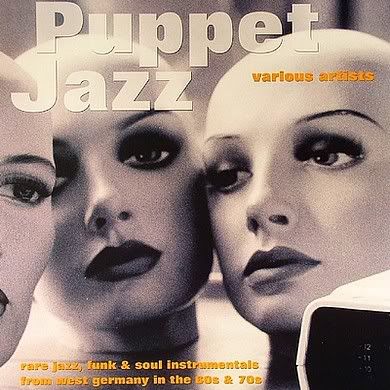
Puppet Jazz -- Rare Jazz, Funk, & Soul Instrumentals From West Germany In The 60s & 70s - 2005 - Sonorama (Germany)

Here is an absolutely superb collection of phasered funky & groovy tracks of the 60's & 70's from various German music libraries. Rarity of the work aside, though, the tunes are totally great - and really hard-hitting in a heavily electric vibe. Most numbers have really heavy drums coming into play with fuzzed out guitars, tripped out keyboards, and some occasional larger arrangements as well -- and there's often this cool flanged-out production on the tunes that further enforces the spacey quality of their grooves, in a way that makes for a really unique batch of tracks! . An absolute top quality compilation and an absolute must-own!

TRACKS

01. Don't Play That Game 1 - Klaus Weiss
02. UFO Invasion - Gerhard Narholz
03. Intercity - Fred Rabold
04. Brass Glitter - Ambros Seelos
05. Wake Up In The Morning - Edgar Schlepper
06. Sax On The Rocks - Gus Brendel
07. BL Special - Berry Lipman
08. Madison Square 1 - Eugen Illin
09. Last Time - Joe Haider
10. Watch Out 3 - Klaus Weiss
11. Exotic Drums - Berry Lipman
12. Beach Buggy - Bob Elger
13. Soul Lady - Klaus Esser
14. Easter Afternoon - Ady Zehnpfennig

REVIEW

Heavy funk from the German scene of the 70s -- and a whopping batch of tunes that were never issued to the public at large! Most of the work on this set is from obscure sound library sources -- recordings that were done by top-shelf players of the time, but only for use in broadcast media, and never distributed properly on record. Rarity of the work aside, though, the tunes are totally great -- and really hard-hitting in a heavily electric vibe. Most numbers have really heavy drums coming into play with fuzzed out guitars, tripped out keyboards, and some occasional larger arrangements as well -- and there's often this cool flanged-out production on the tunes that further enforces the spacey quality of their grooves, in a way that makes for a really unique batch of tracks! Titles include "Wake Up In The Morning" by Edgar Schlepper, "Sax On The Rocks" by Gus Brendel, "Brass Glitter" by Ambros Seelos, "Intercity" by Fred Rabold, "UFO Invasion" by Gerhard Narholz, "Don't Play That Game" by Klaus Weiss, "Madison Square" by Eugen Illin, "Last Time" by Joe Haider, "Watch Out 3" by Klaus Weiss, "Exotic Drums" by Berry Lipman, and "Soul Lady" by Klaus Esser.

Chicken Shack


chickenshack-thecollection1986


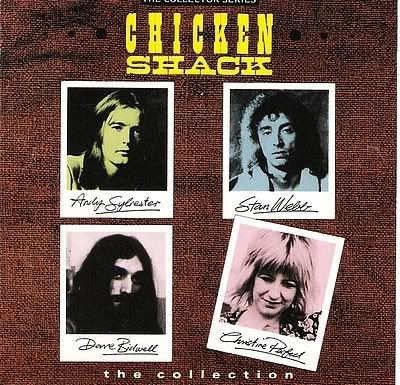
Chicken Shack - The Collection - 1986 - Castle

This British blues-rock group is remembered mostly for their keyboard player, Christine Perfect, aka Christine McVie, who would join Fleetwood Mac after marrying John McVie and changing her last name. Although they were one of the more pedestrian acts of the British blues boom, Chicken Shack was quite popular for a time in the late '60s, placing two albums in the British Top 20. The front person of Chicken was not Perfect/McVie, but guitarist Stan Webb, who would excite British audiences by entering the crowds at performances, courtesy of his 100-meter-long guitar lead. They were signed to Mike Vernon's Blue Horizon label, a British blues pillar that had its biggest success with early Fleetwood Mac. Chicken Shack was actually not far behind Mac in popularity in the late '60s, purveying a more traditional brand of Chicago blues, heavily influenced by Freddie King. Although Webb took most of the songwriting and vocal duties, Christine Perfect also chipped in with occasional compositions and lead singing. In fact, she sang lead on their only British Top 20 single, "I'd Rather Go Blind" (1969). But around that time, she quit the music business to marry John McVie and become a housewife, although, as the world knows, that didn't last too long. Chicken Shack never recovered from Christine's loss, commercially or musically. Stan Webb kept Chicken Shack going, with a revolving door of other musicians, all the way into the 1980s, though he briefly disbanded the group to join Savoy Brown for a while in the mid-'70s. © Richie Unterberger, © 2007 All Media Guide, LLC. All Rights Reserved


This is an excellent compilation CD, and is a good representation of Chicken Shack's music. Check out their great 1968 album, " 40 Blue Fingers, Freshly Packed And Ready To Serve ." If you can find it, listen to the 1970 Christine Perfect self titled solo album, which features a great version of Fleetwood Mac's "When You Say."

TRACK INFO.

1.The Letter
Running Time: 4:26
2.When The Train Comes Back
Running Time: 3:31
3.Lonesome Whistle Blues
Running Time: 3:02
4.You Ain't No Good
Running Time: 3:35
5.Baby's Got Me Crying
6.The Right Way Is My Way
7.Get Like You Used To Be
8.A Woman Is The Blues
9.I Wanna See My Baby
Date Performance: 1969, Running Time: 3:31
10.Remington Ride
11.Mean Old World
12.San-Ho-Zay
Date Performance: 1968-02-05, Running Time: 3:03
Comments: Recorded at CBS Studio, New Bond Street, London.
13.The Way It Is
14.Tears In The Wind
Date Performance: 1969-05-11, Running Time: 2:41
Comments: Recorded at Morgan Studios, Willesden, London. Chart: Billboard UK Top 50/40 Singles Peak Position: 29 Peak Dates: Sep 27, 1969 Weeks On Charts: 6
15.Maudie
16.Some Other Time
17.Andalucian Blues
18.Crazy 'Bout You Baby
Date Performance: 1969, Running Time: 3:03
19.Close To Me
Date Performance: 1969, Running Time: 2:40
20.I'd Rather Go Blind
Date Performance: 1969-02-12, Running Time: 3:14
Comments: Recorded at CBS Studio, New Bond Street, London. It's unknown who plays the Tenor/Alto/Baritone Saxes.


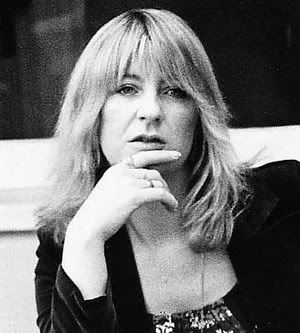
christineperfect-portrait

Christine McVie © Fleetwood Mac Photos © 2007 www.yottamusic.com/artistsFleetwood-Mac


ABOUT THE BAND

Along with late 60's early 70's blues based bands such as Savoy Brown, Fleetwood Mac and John Mayall's Bluebreakers, Chicken Shack was a big part of the genre. Originally formed in 1965, Chicken Shack started out as, more or less, a house band at the Star Club in Hamburg, Germany. They signed a recording contract with the newly formed Blue Horizon label in '67. That same year, former Sound Of Blue vocalist/keyboardist Christine Perfect, who was at one time considered one of the U.K.'s finest blues vocalist, joined. With the release of their debut album, 1968's Forty Blue Fingers Freshly Packed And Ready To Serve, and their 1969 follow up, O.K. Ken, Chicken Shack was in the forefront of the British Blues boom of the late 60's. Although Perfect would leave the group in the summer of '69 to join Fleetwood Mac (she would marry bassist John McVie), Chicken Shack would continue with a good live reputation as at this point their shows were mostly based around the guitar and soulful theatrics of Stan Webb who would keep the group together through many personel changes but by 1973, Chicken Shack had run it's course as Webb would join Savoy Brown. After staying with Savoy Brown for one album, Webb formed Broken Glass which at one time included guitarist Robbie Blunt (later with Robert Plant) and drummer Keef Hartley. Webb would reform Chicken Shack under his own name in '77. Like John Mayall's Bluesbreakers and Savoy Brown, many musicians would pass through the various formations of Stan Webb's Chicken Shack through out the 80's. Through the 90's, Webb's Chicken Shack line up has remained pretty much intact as his devoted fans and fans of traditional British blues remain faithful.


BIO (Wikipedia)


Chicken Shack was a British blues band, primarily of the late 1960s, consisting of Christine Perfect (vocals and keyboards), Stan Webb (guitar and vocals), Andy Sylvester (bass guitar), and Alan Morley (drums). The band was formed in 1967 and reputedly named themselves after the chicken coop in Kidderminster where they rehearsed. Their first concert was at the 1967 National Blues and Jazz Festival at Windsor and they were signed by the Blue Horizon record label in the same year. Chicken Shack enjoyed modest commercial success, with Christine Perfect being voted Best Female Vocalist in the Melody Maker polls, two years running. Christine Perfect left the band in 1969 when she married John McVie of Fleetwood Mac. Pianist Paul Raymond, bassist Andy Sylvester, and drummer Dave Bidwell all left in 1971 to join Savoy Brown. Although the band went through several subsequent incarnations, it never equalled its earlier successes. However, Webb remains as its only constant band member.

Scarlet Runner


scarletrunner-groovethang2007


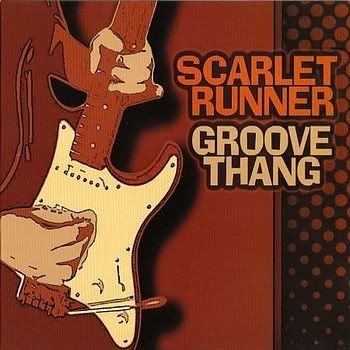
Scarlet Runner - Groove Thang - 2007 - Grooveyard Records

“Groove Thang”, featuring the awesome Jason Leroy, is an outstanding blues/rock album. It includes “guest” Craig Erickson on two exceptional jams, including the “title” track and am extended 13 minute version of the classic Hendrix - “Who Knows/Power of Soul” jam where Jason and Craig pay a superb tribute to Jimi. Jason Leroy, from Waterloo, Iowa, is a tremendously talented blues/rock guitarist, reminiscent of S.R.V., Johnny Winter, Rory Gallagher, Joe Bonamassa, Walter Trout, Craig Erickson, and Jeff Healey, and that's saying something.! Go and buy this album. It's a classic example of power blues rock. If you can find it, check out the Runner's "South Chain Gang" album, from 1996. Superb stuff.

TRACKS

1. Peace O' Mine
2. Let Me Be
3. Manic Depression
4. South Chain Gang
5. Take The Fall
6. Wrong Side
7. Me
8. Grinder
9. State Of Affairs
10. Crazy Chimpanzee
11. Groove Thang
12. Use Me Up
13. Dimples
14. Who Knows - Power Of Soul

BIO

Scarlet Runner is a Blues/Rock band comprised of Jason Christensen (18 in 1997) guitar and vocals, Jack Christensen (16 & little brother) bass/vocals, & Luke Rathe (18 & lifetime friend) drums/vocals. The band has been playing together since 1993.
Jason is an absolute show stopper, and along with his stunning and soulful guitar work and vocals, employs many jaw dropping antics right out of the Hendrix/Vaughan bag of tricks. Jason is the Midwest Regional winner of the Jimi Hendrix Electric Guitar Competition that was held at Buddy Guy's Legends in Chicago, and is awaiting being flown to Madison Square Garden to compete for the National Voodoo Chile Award that will be held during the Hendrix festival sponsored by the Hendrix family.
Jack plays bass with a driving force that keeps the band pulsating forward while Luke's tirades on the drums, as well as his grasp of tempo at any speed, is what makes this band Scarlet Runner. The band tours throughout seven states surrounding Iowa and is expanding their playing base all the time. They have played on shows with such blues greats as Koko Tayler, Ian Moore, and The Fabulous Thunderbirds, just to name some. The band has also played many shows with Texas blues rocker Chris Duarte who has, along with his band, befriended the boys and passes along valuable pointers as well as encouragement.
Scarlet Runner has played many notable clubs like The Grand Emporium in KC, The Zoo in Lincoln, NE, and The Blues Saloon in St. Paul. They have also played for crowds as large as 50,000 for the third straight year (headlining the last two) at the My Waterloo Days Laser Show and played with such bands as Rare Earth, Edgar Winter and Starship at the Wadina Rock Festival 25th anniversary concert. They have also played the huge Sturgis bike rally in S.D. The band was named semi-finalist in Musician Magazine's Best Unsigned Band Contest and also took first place in the tri-state area in the Dubuque, Iowa's battle of the bands. They were also voted Best Band In The Cedar Valley the last two years in a row in a readers poll of the Waterloo Courier.
In Oct. of 96 Scarlet Runner independently released a full length compact disc entitled "South Chain Gang" with 10 original songs as well as a cover of Hendrix's " Manic Depression". The Hendrix song was recorded in one take for the purpose of using it to send in for the Hendrix Competition but was dubbed too good to leave off the disc by the producer. The disc is receiving air play all over the U.S. and is being seriously looked at by different labels.
Scarlet Runner has many influences including, but not limited to, Stevie Ray Vaughan, Hendrix, Buddy Guy, Albert King, Ian Moore and Chris Duarte. They have compiled these influences and thrown in their own unique style to create a new powerful and aggressive musical approach.
The above bio was provided by the band. Go to web page at www.tooblue.net/scarlet.htm Copyright © 1997 by Ray M. Stiles, www.mnblues.com/profile/bio_srunner.html

24.9.07

Boston Blackie/Otis "Big Smokey" Smothers


bostonblackieotisbigsmokeysmothers-chicagosessionsvol1


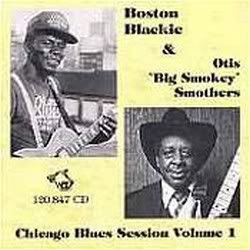
Boston Blackie/Otis "Big Smokey" Smothers - Chicago Blues Session, Vol. 1 - 1998 - Wolf Records

First class Chicago blues album. Has anybody got any info on Boston Blackie? There is a Beanie Joe "Boston Blackie" Houston, a Boston Blackie, aka Bennie Joe Houston, born on 11/6/43, in Panola, AL, and a Milton Houston, aka Boston Blackie, born in Panola, AL. They were all guitarists/vocalists. I would love to set the record straight on the musician on this album. Any info appreciated. Check out more albums in this great series of Chicago blue's session albums.

TRACKS / PERFORMERS

1. I Can't Judge Nobody - Otis Smothers
2. Hello Little Schoolgirl - Otis Smothers
3. Sad Sad Day - Otis Smothers
4. Do The Thing - Otis Smothers
5. ABC Blues - Boston Blackie
6. Louise - Boston Blackie
7. Hey Baby - Boston Blackie
8. How Much More Long - Boston Blackie
9. Give Me Back That Way - Otis Smothers
10. Blues All Day Long - Otis Smothers
11. I've Been Drinking Muddy Water - Otis Smothers
12. ABC Blues Take 2 - Boston Blackie
13. Find Me Another Babe - Boston Blackie

CREDITS

Beanie Joe "Boston Blackie" Houston, (vocals, guitar)
Otis "Big Smokey" Smothers (vocals, guitar)
Eddie "Big Town Playboy" Taylor (guitar)
Luther Adams (guitar)
Birmingham Jones (harmonica)
Willie Kent (bass)
Michael Riley (bass)
Tim Taylor (drums).
Cleo Williams (drums)

CHICAGO BLUES SESSION VOL. 1 features tracks by Boston Blackie recorded in 1992 and by Otis "Big Smokey" Smothers in 1984.
Recorded at Odyssey Sound Studio, Chicago, Illinois on August 8, 1984 and ACME Recording, Chicago, Illinois on January 29, 1992. Includes liner notes by JoAnne Larson, Richard Shazvin & Sam Burkhardt.
Producer: John Primer; Willie Kent
Engineer: Ed Cody; Paul Smith

BIO (Otis "Big Smokey" Smothers)

The Chicago blues scene boasted its own pair of Smothers Brothers, but there was nothing particularly amusing about their tough brand of blues music. The older of the two by a decade, Otis "Big Smokey" Smothers was first to arrive in the Windy City from Mississippi in the mid-'40s. Howlin' Wolf liked the way he played enough to invite him into the Chess studios as his rhythm guitarist on several 1956-57 sessions (songs included "Who's Been Talking," "Tell Me," "Going Back Home," and "I Asked for Water"). Federal Records found Smothers's simple shuffle sound immensely appealing in 1960, recording 12 tracks by the good-natured bluesman with labelmate Freddy King handling lead guitar duties (King, Federal's parent logo, even issued a Smothers LP that's worth a pretty penny today). A four-song 1962 session that included "Way Up in the Mountains of Kentucky" and an updated version of the Hank Ballard & the Midnighters classic "Work with Me Annie" ("Twist with Me Annie") completed his Federal tenure. Apart from a 1968 single for Gamma ("I Got My Eyes on You"), Smothers didn't make it back onto wax until 1986, when Red Beans Records, a small Chicago outfit run by pianist Erwin Helfer and guitarist Pete Crawford, brought him back to the record racks with an LP called Got My Eyes on You that showed his style hadn't changed a whit with the decades. Smokey Smothers was a beloved Chicago traditionalist until the very end. © Bill Dahl, All Music Guide

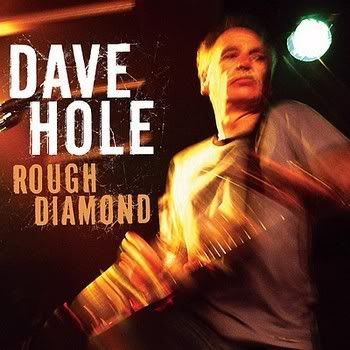
Dave Hole


davehole-roughdiamond2007


Dave Hole - Rough Diamond - 2007 - Blind Pig

From Perth in western Australia, where the water goes down the drain in the opposite direction, and Dave Hole plays slide guitar over the top -- both figuratively and literally! The album contains some original rockers, plus covers from Robert Johnson, Buddy Holly, Elmore James and more. It grooves, rocks and slides and it’s a pleasure to discover all the little guitar inventions that Dave put in each and every song. A great blues rock album, and highly recommended by A.O.O.F.C. Try and listen to his " Slow Fuse Blues " album.

TRACKS

04:48 Rough Diamond Child
05:54 White Trash Girl
06:23 Something Inside Of Me
04:53 Can't Stop Loving You
04:13 Vintage Wine
05:16 Yours For A Song
04:35 Since I Met You Baby
04:09 I'll Get To You
06:25 I'm A King Bee
03:10 Think It Over
03:37 Rambling On My Mind

CREDITS

Dave Hole - Guitar, Vocals, Production
Roy Daniel - Bass
Bob Patient - Keyboards
Ric Eastman - Drums
John Villani - Engineering, Mixing
Don Bartley - Mastering
Peter Vroon - Photography
Al Brandtner - Design
Recorded at Northbridge Sound Studios, Perth, Australia.

REVIEWS

One of the great blues guitar heroes has come from that noted home of the blues, Perth, Australia, to share a Rough Diamond or two. Dave Hole, a slide guitar master, originates from Perth and for 20 years he paid his dues in the clubs of his native land. The dues-paying paid off, though, because by the time he burst onto the international scene, Hole was ready -- and he was equipped. He's a good writer. His original songs soar, with neat but natural metaphors and good progressions, and his solos will blow you away. Hole never seems to play what you're anticipating; he takes it in a different direction, playing against, rather than to, your expectations. When he covers the classics of the blues, such as "Since I Met You, Baby" or Elmore James' "Something Inside of Me" -- rather than going at them the way so many British companies go after Shakespeare, with way too much reverence and a respect for the past that will not allow them to invent -- he approaches them almost as though they were new compositions, "Since I Met You, Baby" benefits most from this approach. Rather than a standard song about the triumph of love, Hole makes it sound like a ray of sunshine that has poked through on a cloudy day, one that he hopes will remain. He pulls every bit of blues out of Robert Johnson's "Rambling on My Mind" and bring out all of the rock that lurks inside Buddy Holly's "Think It Over." If you have any feeling for contemporary blues, you have to hear Dave Hole. review © Michael Scott Cain, 9 June 2007, Rambles.NET
Dave Hole, an Australian artist, is well known for his guitar mastery. Since his recording debut fifteen years ago, Dave's records and live performances have drawn raves from countless international publications, and garnered legions of fans. "Nothing interferes with Hole's searing guitar when he is in full flight," said Rolling Stone magazine, while Guitar World added, "Hole produces solo upon blistering solo that is exhilaratingly relentless." His newest recording, Rough Diamond, amply reaffirms his title as the reigning master of the slide guitar. His fret-melting guitar riffs are infused with the same spirit as those of such blues and rock slide legends as Duane Allman, Johnny Winter, and Elmore James. © 1996-2007 Guitar Nine Records All Rights Reserved
After seven house-rocking albums for Alligator, Dave Hole moves to the Blind Pig label--America's other established blues indie--for this solid, if somewhat predictable, release. In certain respects, the journeyman Australian slide guitarist is comparable to stalwarts such as George Thorogood, since his discs are nearly interchangeable yet none disappoint. Both artists also rely heavily on well-chosen covers. The slide demon taps into tracks from obvious inspirations such as Elmore James, Slim Harpo, and Robert Johnson, along with rearranged tunes written by the far less obvious likes of Willy Deville ("White Trash Girl"), Ivory Joe Hunter ("Since I Met You Baby"), and even Buddy Holly ("Think It Over"). But Hole's originals are plenty sturdy, as demonstrated by the opening riff-rocker "Rough Diamond Child" and the atypically tender ballad "Yours for a Song." Still, it's the sizzling solos that drive these tunes, and Hole's scorching tone--something like a mix of James and Rory Gallagher--torches everything it touches. He makes the guitar sing, howl, moan, or cry depending on the mood, but never lets his molten leads overwhelm the songs. The album-closing version of "I'm a King Bee" stings like the titular bug as Hole buzzes and burns through a showcase that shifts from grinding to gentle and back. The no-frills, three-piece backing band provides able accompaniment--that is, they stay out of the way--as Hole's passionate playing proves that the blues can be powerful and potent, even from a continent away. © Hal Horowitz, Amazon.com

BIO

Dave Hole is a real self-taught man because it was difficult to get any blues records on a regular basis in Australia when he was a child. At first, only Eric Clapton and Jimi Hendrix albums were easily available, so he listened to their records over and over again, absorbing all he could from these blues masters.
Then, either by accident or by fate, Hole broke his little finger in a football game. The only way he could continue to play without pain was to play slide guitar and to put the slide on his index finger and hang his hand over the top of the guitar neck. When his finger healed, Hole never turned back.
After self producing his debut album in 1991, a review appeared in the American "Guitar Player" magazine in April of that year, followed by a July 1991 feature story which launched Hole to stardom. Then Alligator Records president Bruce Iglauer took a chance and signed the only non U.S. based artist in the label’s 30-year history.
It wasn’t just the critics who were paying attention. Metallica’s Kirk Hammett named Dave Hole as one of his favourite guitarists, saying, "His slide playing kills me." And when veteran rock and blues guitarist Gary Moore heard « Short Fuse Blues », he was so impressed he invited Dave to join him on two European tours.
Now, here is « Rough Diamond » the new album of the australian slide guitar master ! Dave cut it in Perth, his australian hometown, at Northbridge Sound Studios. © Bluesweb.com | Dixiefrog 2006

23.9.07

Geoff & Maria Muldaur


geoff&mariamuldaur-sweetpotatoes1971


Geoff & Maria Muldaur - Sweet Potatoes - 1971 - Reprise Records

In the midst of leaving the Jim Kweskin Jug Band and beginning the juggernaut that would be the solo career of Maria Muldaur, the happily singing and swinging couple made several sides which made expert use of a loose-knit group of players who had grown into masters of the folk revival arts. At times the choice of material on this album is unfortunately lazy; "Havana Moon" was a song that not even Chuck Berry himself could complete without boredom setting in, and the efforts here don't pay off much better. At the same time, the players here really don't need much more than the most basic framework from which to jump off and they are hard at it, pushing the music forward with a sense of purpose that inevitably helped it earn its hard-fought respectability. As a whole, Sweet Potatoes is something of a masterwork, rich and revealing, possessing the contagious enthusiasm of young musicians finding a personal voice in the rich traditions of the past as well as the relaxed sophistication that develops when these players are no longer novices. The Geoff and Maria Muldaur combination, when it was working, was also very special, a challenging partnership that also was something of an inviting nucleus to the players with the talent to be drawn into the fold. This album contains some of the better playing of harmonica man Paul Butterfield, removed from the hyper-drive excess of his blues bands. "Kneein' Me" and "Cordelia" are among the song highlights. © Eugene Chadbourne, All Music Guide

A rare blues folk album from the seventies. It's mosly a very good album. The tracks, "I'm Rich" , and "Kneein' Me," both written by Geoff Muldaur, are excellent. Chuck Berry's "Havana Moon" is probably the weakest track on the album. It was never one of Berry's best songs. Even so, Maria Muldaur gives it a new twist, and her version of the obscure song works quite well. Check out Maria Muldaur's back catalogue for some brilliant albums. She is a living legend.

TRACKS

1.Blue Railroad Train by Alton Delmore
2.Havana Moon by Chuck Berry
3.Lazybones by Hoagy Carmichael & Johnny Mercer
4.Cordelia by Geoff Muldaur
5.Dardanella by F. Fisher, F. Bernard, J. Black
6.I'm Rich by Geoff Muldaur
7.Sweet Potatoes by Jeff Gutcheon
8.Kneein' Me by Geoff Muldaur
9.Lover Man (Oh Where Can You Be) by R. Ramirez, J. Davis, J. Sherman
10.Hard Time Killin' Floor by Nehemiah James

BAND

Geoff Muldaur Vocals, Piano, Guitar, Luzan, Organ, Horns
Maria Muldaur Vocals, Tambourine
Amos Garrett Electric Guitar, Trombone, Vocal on track 3
Bill Keith Pedal Steel
Billy Mundi Drums, Luzan, Percussions
John Kahn Bass

GUESTS

Paul Butterfield Harmonica
Jeff Gutcheon Piano
Bobby Notkoff Violin
Trevor Lawrence Bariton Sax
Peter Ecklund Trumpet
Gene Dinwiddie Tenor Sax
Munc Blackburn Alto Sax
Junior Turlock Bass
Stu Brotman Bowed Bass, Bass Trombone
Billy Wolf Bass on track 10
Joe Boyd Producer on track 10

In the early 1960s Maria became part of the Even Dozen Jug Band with John Sebastian, Stefan Grossman, Joshua Rifkin, and Steve Katz, which recorded an album for Elektra in 1964. After the group broke up, Muldaur became part of the Jim Kweskin Jug Band in Boston. While with the group Muldaur met and married bandmate Geoff Muldaur. The couple recorded two favorably reviewed albums, Pottery Pie and Sweet Potatoes, with Reprise while living in Woodstock, New York, during the same time that Bob Dylan, The Band, Paul Butterfield, Janis Joplin's Full Tilt Boogie Band, and other noteworthy music makers were living there.

BIO (Maria Muldaur)

Best known for her seductive '70s pop staple "Midnight at the Oasis," Maria Muldaur has since become an acclaimed interpreter of just about every stripe of American roots music: blues early jazz gospel folk country R&B and so on. While these influences were certainly present on her more pop oriented '70s recordings (as befitting her Greenwich Village folkie past), Muldaur truly came into her own as a true roots music stylist during the '90s, when she developed a particular fascination with the myriad sounds of Louisiana. On the string of well-received albums that followed, Muldaur tied her eclecticism together with the romantic sensuality that had underpinned much of her best work ever since the beginning of her career.

Muldaur was born Maria D'Amato on September 12, 1943, in New York. As a child, she loved country & western music and began singing it with her aunt at age five; during her teenage years, she moved on to R&B early rock & roll and girl group pop and in high school formed a group in the latter style called the Cashmeres. Growing up in the Greenwich Village area, however, she naturally became fascinated with its booming early-'60s folk revival and soon began participating in jam sessions. She also moved to North Carolina for a while to study Appalachian-style fiddle with Doc Watson Back in New York, she was invited to join the Even Dozen Jug Band a revivalist group that included John Sebastian David Grisman and Stefan Grossman they had secured a recording deal with blueswoman Victoria Spivey s label and she wanted them to add some sex appeal. The young D'Amato got a crash course in early blues particularly the Memphis scene that spawned many of the original jug bands and counted Memphis Minnie as one of her chief influences.

Elektra Records bought out the Even Dozen Jug Band s contract and released their self-titled debut album in 1964; however, true to their name, the band's unwieldy size made them an expensive booking on the club and coffeehouse circuit and they soon disbanded. Many of the members went off to college and, in 1964, D'Amato moved to the Boston-area town of Cambridge, home to another vibrant folk scene. She quickly joined the Jim Kweskin Jug Band and began an affair with singer Geoff Muldaur the couple eventually married and had a daughter, Jenni who would later become a singer in her own right. When the Kweskin band broke up in 1968, the couple stayed with their label (Reprise and began recording together as Geoff & Maria Muldaur They moved to Woodstock, NY, to take advantage of the burgeoning music scene there and issued two albums -- 1970's Pottery Pie and 1971's Sweet Potatoes -- before Geoff departed in 1972 to form Better Days with Paul Butterfield a move that signaled not only the end of the couple's musical partnership, but their marriage as well.

Initially unsure about her musical future, Muldaur s friends encouraged her to pursue a solo career, as did Reprise president Mo Ostin Muldaur went to Los Angeles and recorded her self-titled debut album in 1973, scoring a massive Top Ten pop hit with "Midnight at the Oasis." Showcasing Muldaur s playfully sultry crooning, the Middle Eastern-themed song became a pop radio staple for years to come and also made session guitarist Amos Garrett a frequent Muldaur collaborator for years to come. Muldaur s next album, 1974's Waitress in a Donut Shop featured a hit remake of her Even Dozen era signature tune, "I'm a Woman." Three more Reprise albums followed over the course of the '70s, generally with the cream of the L.A. session crop, but also with increasingly diminishing results.

Around 1980, Muldaur became a born-again Christian; she recorded a live album of traditional gospel songs, Gospel Nights for the smaller Takoma label in 1980, and moved into full-fledged CCM with 1982's There Is a Love recorded for the Christian label Myrrh However, this new direction did not prove permanent, and for 1983's Sweet and Slow Muldaur recorded an album of jazz and blues standards (many with longtime cohort Dr. John on piano) that created exactly the mood its title suggested. 1986's jazzy Transbluecency won a year-end critics' award from the New York Times Muldaur spent the rest of the '80s touring, often with Dr. John and also began acting in musicals appearing in productions of Pump Boys and Dinettes and The Pirates of Penzance In 1990, she recorded an album of classic country songs, On the Sunny Side that was specifically geared toward children; it proved a surprising success, both critically and among its intended audience.

Partly inspired by Dr. John s New Orleans obsessions, Muldaur signed to the rootsy Black Top label in 1992 and cut Louisiana Love Call which established her as a versatile stylist well-versed in the blues gospel New Orleans R&B Memphis blues and soul The album won wide acclaim as one of the best works of her career, offering a more organic, stripped-down approach than her '70s pop albums, and became the best-selling record in the Black Top catalog. Her 1994 follow-up, Meet Me at Midnite was nominated for a W.C. Handy Award. Muldaur next cut a jazzier outing for the Canadian roots label Stony Plain 1995's Jazzabelle She subsequently signed with Telarc and returned to her previous direction, making her label debut with 1996's well-received Fanning the Flames 1998's Southland of the Heart was a less bluesy outing recorded in Los Angeles and was released the same year as a second children's album, Swingin' in the Rain a collection of swing tunes and pop novelties from the '30s and '40s. 1999's Meet Me Where They Play the Blues was intended to be a collaboration with West Coast blues piano legend Charles Brown but Brown s health problems prevented him from contributing much (just one vocal on "Gee Baby, Ain't I Good to You" ; thus, the project became more of a tribute.

Muldaur moved back to Stony Plain for 2001's Richland Woman Blues a tribute to early blues artists (particularly women) inspired by a visit to Memphis Minnie s grave. Featuring a variety of special guest instrumentalists, Richland Woman Blues was nominated for a Grammy for Best Traditional Blues Album. The children's album Animal Crackers in My Soup: The Songs of Shirley Temple appeared in 2002. The next year saw the release of Woman Alone with the Blues a collection of songs associated with Peggy Lee on Telarc Records Love Wants to Dance followed in 2004, also on Telarc The mostly acoustic Sweet Lovin' Ol' Soul was issued by Stony Plain in 2005, followed by Heart of Mine: Love Songs of Bob Dylan on Telarc in 2006. Songs for the Young at Heart was also released in 2006. © Steve Huey, All Music Guide

BIO (Geoff Muldaur)

Guitarist Geoff Muldaur, one of many artists to emerge from the folk, blues, and folk-rock scenes centered in Cambridge and Woodstock, was already a well-known blues performer at the time he met up with old-time folk enthusiast Jim Kweskin. Sharing the bill at a 1963 concert in Boston, the two shared many musical interests, and when Kweskin was approached by Vanguard Records, he brought Muldaur into his group the Jim Kweskin Jug Band. This association led to many successful albums and marriage to the group's fiddle player Maria D'Amato (later Maria Muldaur). Four years and five successful albums later, the couple migrated to Woodstock, NY, where they became part of a new musical community that included Bob Dylan, the Band, Paul Butterfield, and many other notable artists. They divorced in 1972, and Geoff began producing local and national blues artists, as well as making his own recordings. He also composed scores for film and television, earning an Emmy in the process, and his definitive recording of "Brazil" was featured in Terry Gilliam's film of the same title. Muldaur has toured Britain, Germany, and Ireland, and appeared at Carnegie Hall, Royal Festival Hall, the Kennedy Center, "A Prairie Home Companion," the San Francisco Blues Festival, and the Winnipeg and Edmonton Folk Festivals. After breaking away from his solo recordings and performances in the late 80s, Geoff returned to the studio for 1998's The Secret Handshake and 2000's Password while a live performance during this resurgence, Beautiful Isle of Somewhere, was released in 2003. His blues-folk stylings are born of respect for music's history, from the perspective of a contemporary artist very much of his own era. © Zac Johnson, All Music Guide

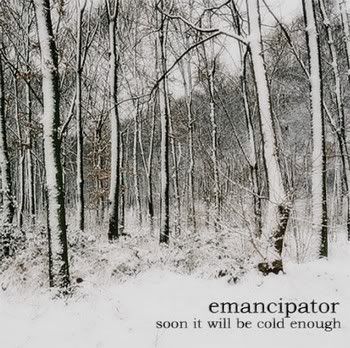
Emancipator


emancipator-soonitwillbecoldenough2007


Emancipator - Soon It Will Be Cold Enough - 2007 - Hydeout Productions ?

Do you like beautiful electronic epic instrumental hiphop beats?, then check out 'Soon It Will Be Cold Enough,' an album of beautiful, densely layered melodies, epic instrumentation, and brilliant tribal beat drum programming. A.O.O.F.C would welcome more info on Emancipator, musicians, record label, etc . If you are aware of any more albums, please post info.

TRACKS

1. Eve (5:43)
2. Soon It Will Be Cold Enough to (2:52)
3. First Snow (5:11)
4. Wolf Drawn (3:17)
5. Anthem (5:35)
6. Smoke Signals (3:45)
7. When I Go (5:34)
8. Periscope Up (2:58)
9. With Rainy Eyes (4:58)
10. Good Knight (5:05)
11. Lionheart (6:19)
12. Maps (4:20)
13. Father King (6:09)
14. The Darkest Evening of the Year (2:11)

CREDITS

Emancipator - Guitars / Keyboards / Samples / Production
Cindy Kao - Violin / Additional Vocals
Thao Nguyen - Vocals on "Soon It Will Be Cold Enough to Build Fires," "When I Go," and "Good Knight."

REVIEWS

Some albums just feel so good, so cool, you can’t help but feel good while listening to them.
Emancipator’s Soon It Will Be Cold Enough is such an album. Incorporating hints of jazz, electronica, trip-hop and down-tempo into its violins, keys, various samples and the occasional female voice, this 19-year-old college student has put together a release worthier of the attentions of a record label.
Taking a liking to music at an early age, the quality and professionalism of the production is in stark contrast to the fact this artist can’t even legally buy booze yet. “Eve” sweeps in with some modified harmony vocals then shows off both Emancipator’s piano skills as well as the beautiful violins of Cindy Kao, whose work is peppered throughout the 65-minute epic. “Soon It Will Be Cold Enough To Build Fires” plays around with some lovely acoustic guitars, a sampled horn and some left over vocal cuts from another track.
The rhythm of programmed drums and wash of beautiful violin on “Anthem” reminds me a little of Moby and DJ Shadow, the tribal beat opening and subsequent electronic bass on “Good Knight” feels like some of Bobby Cochran’s (Hands Upon Black Earth) best work, the driving bass and Kao’s violin on “Lionheart” feel like the soundtrack to dusk, while the voice of Thao Nguyen on “When I Go” sings “off key,” as she puts it, but really her style is addictive, sexy and the sound of her lovely speaking voice when she says, “You are nourishing. That’s what he said” gives me a chill.
The amount of work that went into this album is amazing. As Emancipator himself states, “ …instrumentation on the album was either played and recorded by myself, or was programmed from scratch using individual ‘oneshots,’ which are basically just recordings of single notes being played. Many of the melodies or bass lines were constructed in this way – by pitch shifting and moving around individual sounds like sound legos.”
The fact that this is funded not by a record label, but by a college student who does this in his spare time, is admirable. Pop onto his site you can even download some remixes (including his mash up remix pairing Sigur Ros with Mobb Deep. Hearing Mobb Deep rap “I’m only 19 but my mind is old” has so much added weight when melded like this). And, to boot, the music is damn cool. Highly recommended. John Dunphy , 16/4/07 © 2002-2006 Matthew Rowe. www.musictap.net/Reviews/EmancipatorColdEnoughCD.html

I’m not usually much taken with press releases, but I have to say Emancipator’s list of achievements is quite impressive
‘Emancipator escaped from the Underground Railroad Chain Gang in the 11th century. He invented the hot air balloon, with which he chartered the Amazon River. He invented wine.
Emancipator found the formula for the crystallization of ice during a quiet Japanese winter. He perfected the art of agriculture. He can climb trees faster than you.’
And not least amongst his achievements, in 2007 Emancipator released a pretty cool chill out album in the vein of Sigur Ros, Bent et al.
At first listen, ‘Soon It Will Be Cold Enough’ is a fluid amalgam of seminal lounge artists. The first track, ‘Eve’, for example, contains icy droplets of keyboard a la Mike Oldfield combined with wordless vocals that are melodically very similar to Royskopp’s ‘So Easy’, only here they are muffled and swathed in effects until they sound like winter wind.
‘Eve’ is followed by ‘Soon It Will Be Cold Enough to Build Fires’ which is, ironically, a much warmer track that throws in brief, soft snatches of brass and cut up vocals with the same sense of playful mischief as Nightmares on Wax, and creates a gently euphoric track.
‘Smoke Signals’ is a soft hopscotch of birdsong and electric guitar that skips and fizzes along while tracks such as ‘Anthem’ and ‘Lionheart’ contain entrancing threads of violin, at times with melody and tone as harsh as Chinese folk, at others more Western, pseudo-classical and occasionally dancing somewhere in between.
Thao Nguyen provides lazily sensual vocals for example on ‘When I Go’ where she sounds reminiscent of Roisin Murphy, an irresistible mix of ‘come hither’ allure and smoky, drawling indifference.
And by now, I seem to have covered the album in post-it notes pointing out perceived influences which does it a great disservice because throughout its fourteen songs, and complimenting its crisp, winter theme, there is a freshness to it all that comes not just from the clean production and sweet melodies, but from the sense that this is a small, windblown project hanging faint in the ether without marketing budget or the taint of faustian pacts with ad agencies involving car or telecommunication companies.
As a result, it’s a precious thing - a case of synchronicity between songs and themes and presentation. A small winter gem. © Irfan Shah, 08/01/2007, © CRUD MUSIC MAGAZINE/
2-4-7-MUSIC.COM 2006

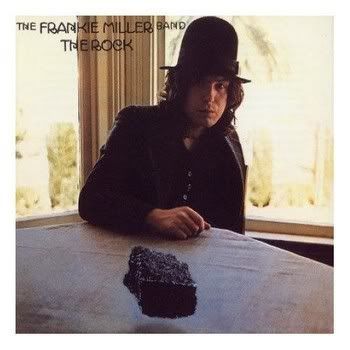
Frankie Miller


frankiemiller-therock1975


Frankie Miller - [IMPORT] [EXTRA TRACKS] [ORIGINAL RECORDING REMASTERED] - 2003 - Eagle Rock/Eagle

Frankie Miller was one of the hottest young singers to emerge during the golden age of seventies' rock. There were many great pop and rock singers hitting the headlines during those happy days. Rod Stewart, Paul Rodgers and Joe Cocker were all prime examples of successful artists who had their musical roots firmly ensconced in soul and the blues. Then Frankie was discovered singing on the thriving London pub rock scene in the summer of 1971, it seemed like he would soon take pride of place among the ranks of megastars. He had all the right qualifications. A powerful, raspy voice, cheeky good looks and a feisty attitude. He was determined to get to the top with the aid of the best possible backing bands and producers. However, the music business is always a hard nut to crack and, despite his best efforts, Frankie never quite got into the big league. Even so, at the peak of his career he scored at least two palpable hits and unleashed a succession of fine albums which reflected his impeccable tastes in good-time rock and soul. © www.alexgitlin.com/index.htm
This is a very good R&B/Soul/Rock album, reminiscent of the great John Fogerty in many ways. Check out Frankie's album, 'Once In A Blue Moon' (1972), where he is backed by Brinsley Schwarz. Frankie also sang with Bees Make Honey and Ducks Deluxe. If anybody has any info on albums by these groups, please post. It would be very much appreciated.

TRACKS

01.Fool in Love
02.Heartbreak
03.Rock
04.I Know Why the Sun Don't Shine
05.Hard on the Levee
06.Ain't Got No Money
07.All My Love to You
08.I'm Old Enough
09.Bridgeton
10 Drunken Nights in the City
11 Loving You Is Sweeter Than Ever (Single A-Side) - Not on 1975 album
12 I'm Old Enough (Single B-Side) - Not on 1975 album

Tke album was originally released on Chrysalis and/or Repertoire in 1975, and one version contained the tracks, A Fool In Love (live), Hard On The Levee (live), Sail Away (live), Drunken Nights In The City (live), & Walking The Dog (With Rory Gallagher live). It's a pity they were not included on this CD issue. If you have any info on the 1975 album, please post info.

CREDITS

Elliot Mazer Producer
Stu Perry Percussion, Drums
Chris Stewart Bass
Mick Weaver Keyboards
Chrissy Stewart Guitar (Bass)
Frankie Miller Guitar, Guitar (Rhythm), Vocals, Main Performer
Chris Welch Liner Notes
Henry McCullough Guitar, Vocals (Background)

BIO

Blue-eyed soul singer Frankie Miller made his name on the English pub rock circuit of the early '70s, and spent around a decade and a half cutting albums of traditional RB, rock roll, and country-rock. In addition to his recorded legacy as an avatar of American roots music, his original material was covered by artists from the worlds of rock, blues, and country, from Bob Seger and Bonnie Tyler to Lou Ann Barton and the Bellamy Brothers. And Miller himself scored a surprise U.K. Top Ten smash in 1978 with "Darlin'," giving his likable, soulful style the popular airing many fans felt it deserved all along.
Frankie Miller was born November 2, 1949, in Glasgow, Scotland; he began singing with local bands beginning in 1967, in a style influenced by American soul singers like Sam Cooke, Ray Charles, and Otis Redding. After a few years, he moved to the more fertile music scene in London, where he soon met ex-Procol Harum guitarist Robin Trower in the summer of 1971. Impressed with Miller's talents as a raw soul belter in the vein of a Rod Stewart or Joe Cocker, Trower offered him a job as lead vocalist of his new band Jude. It wasn't to be Miller's big break, though; internal conflicts split the group apart by the following year, and Miller returned to the London pub rock circuit. During 1972, he made frequent appearances at the
-Tally Ho in Kentish Town, often sitting in with Brinsley Schwarz, and signed a solo record deal with Chrysalis. Using the Brinsleys as a backing band, Miller recorded his debut album, Once in a Blue Moon, that year. Though it wasn't a hit, it was reviewed respectably; more importantly, when Miller sent a copy to New Orleans RB legend Allen Toussaint, he was impressed enough to produce Miller's next album. Miller traveled to New Orleans in 1973 to record High Life with an authentic Toussaint-led backing band, resulting in one of his most acclaimed and artistically satisfying albums.
Upon returning to England, Miller assembled a Stax-style backing band -- dubbed simply the Frankie Miller Band -- featuring guitarist Henry McCullough, keyboardist Mick Weaver, bassist Chrissy Stewart, and drummer Stu Perry. This group traveled to San Francisco to record The Rock (named after Alcatraz), which was released in 1975. The band dissolved not long after, and Miller put together a new outfit called Full House, featuring guitarist Ray Minhinnett, keyboardist Jim Hall, bassist Charlie Harrison, and drummer Graham Deacon. They issued the aptly titled Full House in 1977, which, oddly enough, became fairly popular in Sweden. However, once again, Miller's backing band imploded, and he was back on his own for 1978's Double Trouble, which produced his first British Top 30 hit in "Be Good to Yourself." Late that year, Miller scored a runaway Top Ten hit in the U.K. with "Darlin'," a single included on his 1979 LP Falling in Love (aka Perfect Fit). (Typical of Miller's luck in the record business, his best-known song wasn't an original.) 1980's Easy Money was recorded in Nashville, and some of 1982's Standing on the Edge was recorded at Alabama's legendary ~Muscle Shoals Sound Studios. During this period, Miller also had a Scottish hit with his cover of Dougie McLean's "Caledonia." 1986's Dancing in the Rain was his final studio album.
In August 1994, Miller suffered a devastating brain hemorrhage that left him in a coma for five months. Unable to walk or talk upon his emergence, Miller rehabilitated himself enough to begin writing songs again; at a late-'90s benefit concert in Edinburgh, Miller's new collaboration with Will Jennings, "The Sun Goes Up, the Sun Comes Down," was performed by Bonnie Tyler, Paul Carrack, and Jools Holland. © Steve Huey, All Music Guide, © 2007 All Media Guide, LLC

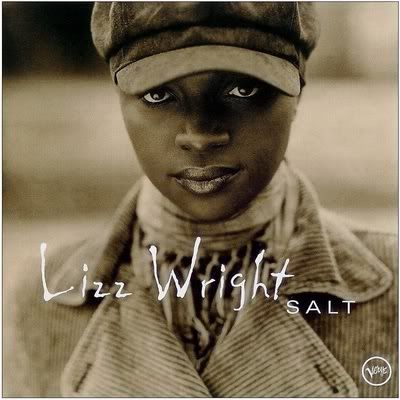
Lizz Wright


lizzwright-salt2003


Lizz Wright - Salt - 2003 - Verve Resords

Vocalist Lizz Wright delivers jazz that harks back to such luminaries as Nina Simone and Abbey Lincoln on her debut Verve release, Salt. Still in her early twenties, Wright has a warm, dusky voice reminiscent of Cassandra Wilson and similarly to Wilson seems interested in tackling an eclectic mix of jazz standards, traditional folk, and R&B. Early on, a folky afterglow-Latin version of "Afro Blue" takes center stage followed by the gorgeous "Soon as I Get Home," which betters the version from The Wiz. Wright fairs equally well as a songwriter with about half the album filled with her soaring, bluesy ballads. There is a melancholy yet positive '70s vibe that eminates from songs like "Fire," which resonates lyrically as well as melodically much like the personal/sociopolitical writing of another of Wright's obvious inspirations, Terry Callier. Perhaps a little too low-key to register very high on the pop radio scale, but invested with enough sanguine emotionality and chops to make Salt easily recommended to fans of the neo-soul movement. © Matt Collar, All Music Guide

Check out her " Dreaming Wide Awake " album. It is also worthwhile listening to the work of Oleta Adams and Jill Scott, for a similar jazz/R&B/soul sound.

lizzwright-portrait2


TRACKS

01.Open Your Eyes, You Can Fly [05:07]
02. Salt [03:26]
03. Afro Blue [05:51]
04. Soon As I Get Home [04:26]
05. Walk with Me, Lord [04:06]
06. Eternity [03:34]
07. Goodbye [03:57]
08. Vocalise/End Of The Line [04:32]
09. Fire [04:14]
10. Blue Rose [04:05]
11. Lead The Way [04:23]
12. Silence [02:43]

CREDITS

Brian Blade - acoustic guitar
Sam Yahel - Hammond B-3 organ
Adam Rogers - acoustic, electric & bottleneck guitars
John Hart - acoustic guitar, guitar
Derrick Gardner - trumpet
Lizz Wright - vocals
Terreon Gully
Jeff Haynes - percussion
Crystal Garner
Sarah Adams
Vincent Gardner - trombone
Myron Walden - alto saxophone
Ron Carbone
Doug Weiss - acoustic bass
Kenny Banks - acoustic piano, Fender Rhodes piano

REVIEWS

The release of the long-anticipated debut from this talented, 20-something, Georgia-bred chanteuse shows that Norah Jones isn't the only "it girl" out there. Wright's cool contralto, which was previously heard on Joe Sample's The Pecan Tree, is a southern stew cooked with ample helpings of soul, jazz, R&B, and gospel. This CD, equally produced by Tommy LiPuma, John Cowherd, and drummer Brian Blade, features mostly mid-tempo renditions of a jazz-fusion ditty, a spiritual, a Broadway tune, a Latin number, light classical, and original compositions. Wright's vocal weight and fluent delivery echoes the talents of Lalah Hathaway, whether she’s putting her own sepia spin on Flora Purim's '70s gem "Open Your Eyes, You Can Fly," Mongo Santamaria's "Afro Blue" (with pianist Danilo Perez), or "Soon As I Get Home" from The Wiz. Though this record is a promising debut from Wright, one gets the sense that she’s a soul singer at heart, as evidenced by the down-home title tune. One thing's for sure: the road to Lizz Wright's future is wide open with no barriers in sight. © Eugene Holley, Jr. © 1996-2007, Amazon.com
A sweet young jazz singer -- steeped in the traditions of Dee Dee Bridgewater and Dianne Reeves, striking out on her own in a really solid debut album! The set's got a warm, jazzy feel -- lots of keyboards and piano in the backings, but done in a way that lifts up the voice of Lizz on a pillow of soul and spirituality. Tracks build from slow beginnings to a rich array of tones and colors -- done in a style that's emotive, but subtly so. Titles include nice covers of "Open Your Eyes You Can Fly" and "Afro Blue" -- plus "Soon As I Get Home", "Salt", "Fire", "Eternity", "Lead The Way", and "Silence". © 1996-2007, Dusty Groove America, Inc.

“My eyes burn, I have seen the glory of a brighter sun,” sings Lizz Wright. Lizz Wright’s musical recording Dreaming Wide Awake (2005), produced by Craig Street for Verve, is itself a bright light and it has become one of my favorite recordings of the last several years: the intelligence, honesty, and intimacy in Wright’s singing are what are most impressive, although I am fascinated by her understanding and presentation of musical tradition: of communal properties, of understood and accepted forms and meanings.

In an earlier recording by Lizz Wright, Salt (2003), produced by Tommy LiPuma, Brian Blade, and Jon Cowherd for Verve, Wright signaled her interest in various traditions—jazz, Broadway, and even classical: she announced herself a serious singer. In Salt’s “Open Your Eyes, You Can Fly,” a song of encouragement by the well-known jazz musician Chick Corea and Neville Porter—with the lines “see only what you want to see” and “open your eyes, you can fly” (lines that can suggest vision and adventure, or the self-delusion of a very false confidence)—Wright gives an open-hearted, fully voiced performance that is hard to turn away from. The next song, the title song “Salt,” with lines such as “How can you lose your song, when you’ve sung it so long, How can you forget your dance, when that dance is all you’ve ever had?” is an affirmation of culture, an affirmation that reminds me of Toni Morrison, who counseled women not to forget their ancient properties. “You can’t separate the two…just like the salt that’s in the stew,” sings Lizz Wright, who wrote the song “Salt,” a jazz ballad, which she sings passionately.

“Afro Blue,” a song written by Mongo Santamaria and Oscar Brown Jr., is a song made familiar by Abbey Lincoln, and it is the third song on Wright’s Salt album: with the song, its fame, and its quick piano notes and seemingly irregular drumbeats that crest with a soft cascade of cymbals, Wright seems to be identifying with the more visionary aspects of jazz. “Soon as I Get Home,” written by Charlie Smalls, one of the writers of the musical “The Wiz,” a retelling of The Wizard of Oz story, is a gesture toward Broadway and popular music. The song is about being lost and found and even refers to the Wiz, and what he might offer. It has a delicate but firmly structured arrangement and a performance that is warm and intense. “Walk with Me, Lord” is a traditional spiritual—an expression of spirit, a calling to the narrator’s god—and Wright sings it in a full, dark voice. Wright handles the song easily, with tenderness and strength, so easily that one imagines it is no challenge whatever. In the first four or five songs on Salt, Lizz Wright establishes her talent, her knowledge, and her right to our attention. She knows the traditions that exist, and can master them—and so the question is, Will she be emboldened by them, or trapped by them? Will she add to them, or simply keep them alive?

In her own song “Eternity,” the sixth song on Salt, Wright uses, in her lyrics, nature imagery (imagery that is matched by the photographs taken of her for the recording’s jacket by Bill Phelps: similar photographs by Phelps accompany Wright’s Dreaming Wide Awake). In “Eternity” the singer asks, “What is the gift that you possess? What is this strange happiness?” and states, “If the answer is you, I’ll have to have you for eternity.” She follows that with a carefully handled civil song of parting written by Gordon Jenkins called “Goodbye,” before giving us a combination “Vocalise/End of the Line” by Rachmaninov, and John Edmonson and Cynthia Medley: it begins with humming, and ends with sung lyrics about a relationship’s end—it’s a sad song—and it has violas and cellos. (Elsewhere, John’s last name is spelled Edmondson.)

Another one of Wright’s original songs follows, “Fire,” and it too has elemental imagery; and it is about love and what people give each other. “Blue Rose,” by Wright with Kenny Banks, and featuring an acoustic guitar, seems to compare a woman to a morning glory lost in a tangle of vine. A song about being led by faith, grace, and love is Brian Blade’s “Lead the Way,” and Wright’s directness and the spareness of the arrangement diffuses the sanctimony, and this surprisingly emerges as one of the set’s stronger songs. Wright closes with her own “Silence,” which almost seems a modern hymn, and is sung in a strong declamatory tone—and there is a short, mysterious line “silence is a song.”

Lizz Wright’s Salt is a collection made with care—it is elegant and intelligent, qualities that I always want, always relish, and am glad to find in the recording, even as I wonder about the limits of tradition. © Daniel Garrett All contents copyright © 2001- 2007 all rights reserved ( About the reviewer: Daniel Garrett is a writer whose work has appeared in or on AllAboutJazz.com, American Book Review, Cinetext.Philo, The Compulsive Reader, IdentityTheory.com, Offscreen.com, PopMatters.com, Review of Contemporary Fiction, WaxPoetics.com, and World Literature Today. ) www.compulsivereader.com/html/index.php?name=News&file=article&sid=1297

lizzwright-portrait


BIO

Born on January 22, 1980, in Hahira, GA. Education: Attended Georgia State University. Addresses: Management--Direct Management, 947 North La Cienaga Blvd., Los Angeles, CA 90069, phone: (310) 854-3535, fax: (310) 854-0810. Website--Lizz Wright Official Website: http://www.lizzwright.net.
Since her 2002 breakthrough performance at a Los Angeles Billie Holiday tribute, Lizz Wright has been regarded as an important young talent in contemporary jazz. Wright inked a deal with seminal jazz label Verve soon after the Holiday performance. She released her debut album, Salt, in 2003, followed by Dreaming Wide Awake two years later. Her husky contralto voice and penchant for mixing jazz standards with pop, gospel, and soul numbers have earned her comparisons to such legends as Abbey Lincoln and Nina Simone, to young neo-soul singers like Jill Scott and Angie Stone, and to crossover artists like Norah Jones and Cassandra Wilson.
Wright was born on January 22, 1980, in the tiny south Georgia town of Hahira. The second of three children, she was raised in Hahira and in Kathleen, Georgia, by her parents, both ministers. Gospel music was a part of Wright's life from an early age, and she and her older brother and younger sister sang together in a gospel trio. Wright detailed her sheltered upbringing in a 2005 interview with Peter Culshaw of the London Daily Telegraph. "It was mostly Pentecostal and very strict," she told Culshaw. "Women were not allowed to wear colored nail varnish, do sports, or wear trousers. We had no television and I only heard the radio when my parents went out to a Bible study group. They liked a quiet, meditative house. I'd listen to radio dramas, which is where I got my love for storytelling. I had to create what I didn't have. I did listen to some pop music, but I didn't like it much."
Wright learned about jazz by listening to pianist Marian McPartland's weekly show on National Public Radio. "Marian's show was my first introduction to jazz and I loved it," she told George Varga of the San Diego Union-Tribune in 2004. "It was very ladylike and modern sounding to me, but still had a lot of colors and ideas from gospel and blues that I'd heard before. It's something that called out to me (because) it was sacred." The mixed-genre sound of contemporary gospel artists also made its mark. "The contemporary gospel movement really influenced me and that was mostly the artists out of Detroit, the Winan family, Hawkins family and Commission. These artists started taking on the sounds of R&B, soul, blues, and jazz, but still sang the gospel. It really got me through school. I wouldn't have made it with just quartet music or the spirituals," Wright said in a 2005 interview with Beatrice Richardson for JazzReview.com.
After high school, Wright studied music at Georgia State University in Atlanta, but dropped out when she decided her college education didn't merit the cost. She first drew attention in 1999, when she sat in on a jam session during the Atlanta Jazz Festival. After singing the two jazz standards she knew, the crowd asked for more. She responded with "Amazing Grace." One of the enthusiastic audience members was Ron Simblist, who introduced Wright to the gospel ensemble In the Spirit, which she joined in 2000. A friend of the wife of Verve Music Group president Ron Goldstein, Simblist also sent Goldstein some of Wright's recorded tunes. Simblist followed up with another demo a year later and helped secure Wright a deal. Around the same time, Wright appeared on the bill with Lou Rawls, Dianne Reeves, and others at Billie Holiday tributes in Los Angeles and Chicago. By all accounts, she stole the show. "Lizz Wright walked on stage at the Hollywood Bowl last summer a virtual unknown. Fifteen minutes later, she walked off a star," wrote Don Heckman in a 2003 article for the Los Angeles Times.
Wright began recording Salt in 2002, with John Clayton producing. Eventually, the sessions with Clayton were scrapped, however. "I had some more growing to do," Wright told Heckman in 2003. Veteran producer Tommy LiPuma, who has worked with numerous Grammy-winning artists, took over production duties, assisted by former Joni Mitchell and Wayne Shorter drummer Brian Blade. Salt was released in 2003. Due to the album's eclectic song selection, which included five originals written by Wright alongside jazz, Latin, and spiritual numbers, and even a song from the musical The Wiz, Wright immediately drew comparisons to crossover artists Norah Jones and Cassandra Wilson. "I don't fall in any of those traditional definitions of what a 'jazz singer' is," Wright told Varga. "But to me, jazz embraces a lot. It is a fusion, it is eclectic, and I don't know where it's going. But I definitely want to give back what I've gotten from jazz, which is a liberation (that results) from mixing things and seeing how they are connected."
Wright secured an opening slot on a tour with Ray Charles, and film director Spike Lee interrupted his own shooting schedule to direct the video for Salt's first single, the Chick Corea song "Open Your Eyes, You Can Fly." Salt became one of Billboard magazine's top ten contemporary jazz vocal albums of 2003, and the Associated Press named it one of the top ten albums of the year. Wright was named Best New Artist in the Jazz Times magazine readers' poll, and she performed at the Newport and Playboy jazz festivals. Still, some critics offered tempered praise. "Her only major failing at present is that the heady passion and sophistication she brings to her music is not yet matched by her abilities as a lyric writer, which sometimes veers toward mawkish sentiments and too obvious word rhymes. That weakness aside, her debut album impresses with its artistic maturity and welcome subtlety," wrote Varga.
Wright moved briefly to New York City, then settled in Seattle. She released Dreaming Wide Awake in 2005. Craig Street, who had worked on Jones's debut and Wilson's popular crossover album New Moon Daughter, produced the album, which was recorded in the Catskill Mountains with all the musicians playing together in one room. The album was hailed as a daring, honest effort. "'Awake' is a brave and naked album, wildly eclectic but always under control. It is at once slow-moving (like the rural South) and cosmopolitan (like New York and Seattle)," wrote Nick Marino in the Atlanta Journal-Constitution.
Wright told Heckman that she has not determined her next direction. "[I] can't tell you that I've even really found myself yet. I really just want to continue to keep learning more music," she said. "I want to maintain my spirituality, and I want to be in an environment where I can grow. If I can have those things, everything else will take care of itself." © Kristin Palm, Copyright © 2007 Net Industries - All Rights Reserved www.musicianguide.com/biographies/1608004759/Lizz-Wright.html

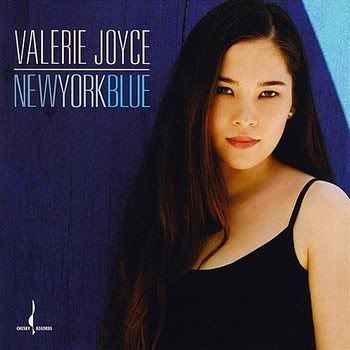
Valerie Joyce


vleriejoyce-newyorkblue

Valerie Joyce - New York Blue - 2005 - Chesky Records

Along with enchanting interpretations of familiar jazz standards...Valerie breathes new life into pop nuggets like Tracy Chapman's "Baby Can I Hold You Tonight," Jimi Hendrix's melancholic "Little Wing" and the Beatles' "Golden Slumbers." Elsewhere, she turns in a smouldering "Fever," soars sensuously over an undulating samba flavored "Blue in Green," and swings serenely on "Weaver of Dreams," which features some robust alto sax work from Lawrence Feldman. She also resurrects her own "Oasis," a lilting waltz-time original from Reverie that has her ethereal voice fairly floating into the stratosphere. Not since Cassandra Wilson's Blue Light 'Til Dawn has a vocalist cast such an entrancing spell as Valerie Joyce does on New York Blue. Check out her 2003 album, " Reverie. "

TRACKS

1. It Never Entered My Mind
2. Blue in Green
3. Baby Can I Hold You
4. Fever
5. Oasis
6. Every Time We Say Goodbye
7. Moon and Sand
8. Little Wing
9. Weaver of Dreams
10. It's Easy to Remember
11. Darn That Dream
12. I Fall in Love Too Easily
13. Golden Slumbers

CREDITS

Valerie Joyce - Vocals
Andy Ezrin - Piano
Lawrence Feldman - Alto & Tenor Saxophone
Eugene Jackson - Drums
Jon Hebert - Acoustic Bass, tracks 4, 8, 9, 10 & 11
Tim Lefebvre - Acoustic Bass, tracks 1,2,3, 5,6,7,12 & 13
All Arrangements - Andy Ezrin, Valerie Joyce
Produced by David Chesky
Executive Producer - Norman Chesky
Recording, Editing and Mastering Enginee r- Nicholas Prout
Recorded at St. Peter's Church, Chelsea, NYC June 28-29, 2005

REVIEW

A new name but a great talent all the same. Time after time my trusty CD player has been subjected to great sounding but musically dubious recordings from assorted audiophile labels, which given their experience should know better. Well not this time. Valerie Joyce is a young Japanese - American jazz singer and pianist who has the talent and inherent musicial breath of vision, and plain good taste to make it big. She has a smoky intimate voice that works extremely well with the after hours feel of her sophisticated jazz-cabaret- style. Expect to hear more of this Lady. Valerie is joined by arranger and pianist Andy Ezrin. His arrangements and playing provide an uncluttered and entirely sympathetic setting for the singer's voice. The band, Lawrence Feldman- with his lovely warm sax tones that compare with the likes of Stan Getz and Benny..is a standout, Jon Hebert on acoustic bass plays with an understated but sure hand, while Eugene Jackson is the very model of discreet rhythm provider on drums, are simply superb. Tracks include 'Blue In Green', 'Fever', 'Little Wing' and a lovely cover of 'Baby Can I Hold You'. Recommended. Fans of Jacintha, Peggy Lee and Cassandra Wilson will find a lot to enjoy here. November 2005 © Vivante Productions Limited www.vivante.co.uk

BIO

Valerie Joyce has been performing as a musician on the Seattle music scene since 1994. Born in Japan to an American father and Japanese mother, she was exposed to classical music through her mother's piano playing and extensive record collection. Her music education began early, enrolling in solfege classes at the age of six. She started piano lessons at the age of eight. She attended an international school in Yokohama. In 1991 Valerie moved to Tacoma, Washington to attend the University of Puget Sound where she majored in Music Business. She was awarded a classical piano scholarship there and studied piano with Dr. Steven Moore and Dr. Duane Hulbert for four years. At college she sang in the vocal jazz choir directed by Dr. Moore and in her junior and senior years played piano in the college jazz band directed by Syd Potter. As a pianist in the big band, she even had the opportunity to play and perform with Stanley Turrentine. She took jazz improvization classes during the summer at the University of Washington with Michael Brockman and attended the Port Townsend Workshop and studied with Jay Clayton.

To help satisfy her growing interest in jazz, Valerie also studied jazz voice and piano with Jerome Gray on the weekends. The first jazz records that she discovered were Thelonious Monk's ''Brilliant Corners'', Dexter Gordon's ''Our Man in Paris'' and Miles Davis' ''Kind of Blue'' and the soundtrack to the movie '''Round Midnight''. Valerie was hooked on Jazz. She soon discovered many other great jazz records. During her sophomore year, she auditioned for the Berklee College of Music in Boston, and won a vocal jazz scholarship, but decided to complete her liberal arts education at the University of Puget Sound.

After graduating, she moved to Seattle which had a more vibrant music scene. She worked full time during the day at an exporting company and freelanced as a musician by night. She played in solo, duo, trio and quartet formats and played in Jay Thomas's big band as a piano player for four years.

In 2002, Valerie recorded "Reverie", with Seattle area musicians Jay Thomas, Milo Petersen, Joshua Wolff, Paul Gabrielson, and Phil Sparks, under her own label VJI Music, a project that featured four of her original compositions and modern renditions of classic standards. In 2003 Valerie also recorded a world jazz music project that was produced by Michael Wolff, which featured Badal Roy on tablas, Victor Jones on drums, John B. Williams and Mike Richmond on bass and Alex Foster and Dan Jordan on saxophones and flute. In 2004, a radio personality in Puerto Rico read a cd review of Reverie (Jazz Improv Magazine) and contacted musician Carlos Franzetti, who introduced her to Chesky Records in New York. Valerie was signed to Chesky records in October of 2004, and recorded New York Blue, her first album for Chesky in June of 2005, with musicians Andy Ezrin, Gene Jackson, Tim Lefevre, Jon Hebert and Lawrence Feldman. The album was released in Italy, Germany, Japan in other Asian countries in January of 2006. The record has been released in the United States in April of 2006. © 2002-2007 - Valerie Joyce

22.9.07

Michel Petrucciani


michelpetrucciani-live1991


Michel Petrucciani - Live [LIVE] - 1991 - Blue Note Records

A brilliant jazz album. Bebop jazz played in a nineties style with electric bass and
keyboards. The album is full of Charlie Parker and Miles Davis influences, and is an inspired work by the late great Michel Petrucciani and his awesome back up musicians. Check out the albums, Live at the Village Vanguard (1984), and Power of Three (1986) with Wayne Shorter and Jim Hall.

TRACKS

1.Black Magic
2.Miles Davis Licks
3.Contradictions
4.Bite
5.Rachid
6.Looking Up
7.Thank You Note
8.Estate

All songs written by Michel Petruccianiexept "Estate" written by Bruno Martino
Rec in Nov. of 1991 at The Arsenal in Metz, France

PERSONNEL

Michel Petrucciani - Piano
Adam Holzman - keyboards
Steve Logan - bass
Abdou M'Boop - percussion
Victor Jones - drums

BIO (Wikipedia)

Michel Petrucciani (December 28, 1962, Orange, France – January 6, 1999, Manhattan), was a French Jazz pianist. Michel Petrucciani came from an Italo-French family of a musical background. His father "Tony" played guitar and his brother Louis played bass. Michel was born with osteogenesis imperfecta which is a genetic disease that causes brittle bones and in his case short stature. It is also often linked to pulmonary ailments. In his early career his father and brother occasionally carried him, literally, because he could not walk far on his own unaided. In certain respects though he considered it an advantage as it got rid of distractions, like sports, that other boys tended to become involved in. At an early age he became enthusiastic about the works of Duke Ellington and wished to become a pianist like him. Although he trained for years as a classical pianist, jazz remained his interest. He had his first professional concert at 13. At this point in his life he was still quite fragile so had to be carried to and from the piano. In general his size meant that he required aids to reach the piano's pedals, but his hands were average in length. By age 18 he helped form a successful trio. He moved to the US in 1982. In the US he is credited with leading Charles Lloyd to resume playing actively and in 1986 he recorded a live album with Wayne Shorter and Jim Hall. He also played with diverse figures in the US jazz scene including Dizzy Gillespie. In 1994 he was granted a LĂ©gion d'honneur in Paris. His own style was initially influenced by Bill Evans although some compare him to Keith Jarrett. He is often deemed to be among the best jazz pianists to ever come from France.On the personal side he had three significant relationships. His first marriage to Italian pianist Gilda ButtĂ  ended in divorce. He also fathered two children, one being a son named Alexandre. One of these children inherited his condition. He also had a stepson named Rachid Roperch. Michel Petrucciani died at 36 from a pulmonary infection. He was interred in Le Père Lachaise Cemetery in Paris.

Eddie Costa


eddiecosta-thehouseofbluelights1959


Eddie Costa - The House of Blue Lights - 1959 - Dot Records

"The House of Blue Lights", by the obscure, but brilliant jazz pianist and vibist, Eddie Costa is one of the best piano trio albums ever recorded. If you can find his 1956 albun," Guys And Dolls Like Vibes", give it a spin. A terrific musician, whose music deserves more exposure.

TRACKS

a. The house of blue lights 10:01
b. My funny Valentine 6:58
c. Diane 4:28
d. Annabelle 4:07
e. When I fall in love 4:07
f. What's to ya 9:26

PERSONNEL

Eddie Costa, p;
Wendell Marshall, b;
Paul Motian, dm
Recorded January 29th, 1959, N.Y.C.


eddiecosta-portrait


BIO (Wikipedia)

Eddie Costa, (August 14, 1930 - July 28, 1962), was an American jazz pianist and vibraphonist born in Atlas, Pennsylvania, now based in Pittsburgh. He recorded on vibraphones with pianist Bill Evans. One notable recording with Bill Evans was "Guys and Dolls Like Vibes", now reissued as "Bill Evans and Eddie Costa, Complete Quartet" on CD. Eddie Costa died in a car accident on New York's Westside Highway on July 28, 1962, cutting short a very promising career. Like Clifford Brown, Eddie's another jazz man who left the stage at too young an age.

MORE BIO INFO

Eddie Costa emerged from an unlikely background into a heralded -- if too brief -- career in jazz. Born in a rural coal mining town, Costa studied piano with his brother Bill and developed a taste for the swing greats; later, exposure to Bud Powell turned him to bop. Self-taught on vibes, Costa became known as an excellent sight reader, which produced a lot of studio work. On piano, his trademark sound was the emphasis of the middle and lower registers while nearly ignoring the top two octaves. In addition to recording as a sideman with Tal Farlow, Woody Herman, Johnny Smith, the Bob Brookmeyer-Clark Terry Quintet, and Bill Evans, Costa led his own trio and quintet dates. Sadly, most of Costa's recorded output remains unavailable on CD, with the notable exception of the VSOP reissue of his Quintet LP. Costa died when his car careened off of a busy New York parkway in 1962. © www.vervemusicgroup.com

21.9.07

Passport


passport-passport1970


Passport - Passport [aka Doldinger] - 1970 - Atlantic Records

The groups first recording, "Passport" was released in 1970, and featured Doldinger on sax and keyboards, together with an electric rhythm section consisting of Olaf Kubler on second sax and flute, Jimmy Jackson on organ, Lother Maid on electric bass and Udo Lindenberg on drums. The result of the recording became a wonderful mix of jazz-rock and 70s jazzy fusion/funk.

Tracklisting:

A1.Uranus (6:35)
A2.Schirokko (5:44)
A3.Hexensabbat (4:27)
A4.Nostalgia (5:13)

B1.Lemuria's Dance (4:37)
B2.Continuation (9:53)
B3.Madhouse Jam (5:47)

CREDITS

Artwork By [Illustration + Design] - Wandrey's Studio, Hamburg
Bass [Electric] - Lothar Meid
Composed By - Klaus Doldinger
Drums - Udo Lindenberg
Organ - Jimmy Jackson
Producer - Klaus Doldinger
Saxophone [Tenor], Flute - Olaf KĂ¼bler
Saxophone [Tenor], Saxophone [Alt], Saxophone [Soprano], Synthesizer [Moog], Piano [Electric] - Klaus Doldinger

REVIEW

Passport is the creation of saxophonist Klaus Doldinger who has stated that Passport is not so much a set group but a label and a name for his many projects. Doldinger, who had started out playing dixieland back in the 1950's, by the following decade was a modern tenor-saxophonist who also worked in the studios. His mind has always remained quite open and in 1970 he formed Passport so as to explore the combination of advanced jazz improvising with rockish rhythms. Passport matches Doldinger's reeds (tenor, soprano, flute and occasional keyboards) with an electric rhythm section. The group's first recording (1970's Passport) also included Olaf Kubler on second tenor and flute, organist Jimmy Jackson, electric bassist Lother Maid and drummer Udo Lindenberg. Soon the group went through the first of several complete turnovers. The mid-1970's version usually teamed Doldinger with keyboardist Kristian Schultze, electric bassist Wolfgang Schmid and drummer Curt Cress and by 1978 it had changed drastically again. However, no matter who was in the rhythm section, Klaus Doldinger's lead voice and his band's musical direction remained consistent through the years. Passport has made numerous recordings, particularly for Atlantic. © Scott Yanow © 2007 All Media Guide, LLC. All Rights Reserved

BIO

The master of the German jazz and fusion/funk scene, Klaus Erich Dieter Doldinger was born on the 12th of may in 1936 in Berlin, Germany. He was from an early age interested in music and started, by the age of eleven, to play the piano and to take piano lessons. He began studying music at Robert Schuman Conservatoire in Dusseldorf, and at the age of 16 he traded the piano for the clarinet. The step from the clarinet to the saxophone was not very far, and soon the sax became his first and also most creative instrument. Doldinger's biggest influences during this period was jazz and in perticular jazz musicians as Sidney Bechet and tenorsaxophone player, 'Lucky' Thompson. His great interest in jazz soon drove him into Germany's absolute Dixieland circuits, and during the 1950s he came to perform and play with the famous German Dixieland band, Dusseldorf Feet farmers among others.Doldinger was however looking for something more and deeper within his music. He wanted a more direct and a more personal contact with the music and with his audience and that was something that either the Dixieland, nor the traditional jazz, was able to offer him. He therefore gave his influences from slick, cool and intellectual saxophone players as Lee Konitz and Stan Getz free space within his playing. He also got more involved in blues, be-bop and hard bop. He soon started playing with artists like Kenny Clarke, Ron Ellis, Roland Kovac Quintet and Werner Giertz Combo. In the beginning of the 60s Doldinger had developed his sax skills, and he was now recognized as a very gifted and talented saxophone player, which resulted in several performances with legendary musicians as organ player Johnny Griffin, Benny Bailey and trumpet player Donald Byrd among others.In 1962 he formed his own group, the Klaus Doldinger Quartet. After playing many years with Ingfried Hofmann, Doldinger had developed such a "black" sound in his saxophone that he among American jazz critics was known as "the black tenor from the Southside of Chicago", without any of the journalists knowing his German background. In 1964 Doldinger went on his first tour abroad. In 1970 he took another big step in his own musical career and formed his now legendary fusion group Passport, and by doing so, he wrote international jazz history. His intentions with Passport was to explore the combination of more rock-like-rhythms with advanced jazz improvisation.