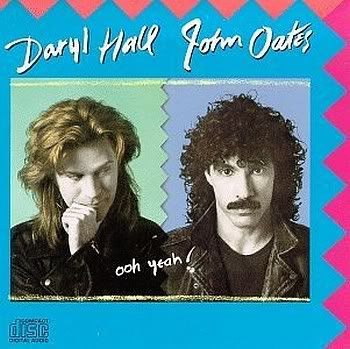
Hall & Oates - Ooh Yeah ! - 1988 - Arista Records (USA)
One of the duo's greatest albums encompassing a fusion of rock and roll , rhythm and blues, and soul styles. Buy their classic 1973 album, Abandoned Luncheonette.
TRACKS / COMPOSERS
01. Downtown Life - Daryl Hall, John Oates, Rick Iantosca, Sara Allen
02. Everything Your Heart Desires - Daryl Hall
03. I'm In Pieces - Daryl Hall, Janna Allen
04. Missed Opportunity - Daryl Hall, John Oates, Sara Allen
05. Talking All Night - Daryl Hall, John Oates
06. Rockability - Daryl Hall, John Oates, Sara Allen
07. Rocket To God - Daryl Hall
08. Soul Love - Daryl Hall, Holly Knight
09. Realove - Daryl Hall, John Oates
10. Keep On Pushin' Love - John Oates
CREDITS
Jerry Goodman (Vocals), Jerry Goodman (Violin (Electric)), Jerry Goodman (Electric Violin), Hall & Oates (Main Performer), Gary Wright (Assistant Engineer), Gary Wright (Mixing Assistant), Gary Wright (Assistant), Daryl Hall (Synthesizer), Daryl Hall (Bass), Daryl Hall (Guitar), Daryl Hall (Arranger), Daryl Hall (Guitar (Electric)), Daryl Hall (Keyboards), Daryl Hall (Vocals), Daryl Hall (Producer), Daryl Hall (Vibraphone), Daryl Hall (Performer), Daryl Hall (Synthesizer Bass), Al Smith, Janna Allen (Vocals), Janna Allen (Vocals (Background)), Bashiri Johnson (Percussion), Tony Beard (Drums), Jeff Bova (Synthesizer), Jeff Bova (Programming), Jeff Bova (Sequencing), Jeff Bova (Synthesizer Programming), Jimmy Bralower (Programming), Jimmy Bralower (Drum Programming), Jimmy Bralower (Sequencing), Pat Buchanan (Guitar), Pat Buchanan (Guitar (Rhythm)), Bob Clearmountain (Mixing), Sammy Figueroa (Percussion), James Hellman (Synthesizer), James Hellman (MIDI Technician), James Hellman (Keyboard Technician), James Hellman (Synthesizer Programming), Rick Iannacone (Percussion), Mike Klvana (Synclavier), Mike Klvana (Keyboard Technician), Keisuke Kuwata (Vocals), Rick Marotta (Drums), Sammy Merendino (Synthesizer), Sammy Merendino (Percussion), Sammy Merendino (Programming), Sammy Merendino (Timbales), Sammy Merendino (Drum Programming), Sammy Merendino (Sequencing), Narada Michael Walden (Arranger), Narada Michael Walden (Drums), Tommy Mottola (Direction), Tommy Mottola (Management), John Oates (Synthesizer), John Oates (Guitar), John Oates (Arranger), John Oates (Keyboards), John Oates (Programming), John Oates (Vocals), John Oates (Producer), John Oates (Performer), John Oates (Linn 9000), Lenny Pickett (Saxophone), Chris Porter (Mixing), Pael Presco (Guitar), Jimmy Ripp (Guitar), Mark Rivera (Saxophone), Philippe Saisse (Synthesizer), Philippe Saisse (Keyboards), Philippe Saisse (Synthesizer Programming), Danny Wilensky (Saxophone), Tom "T-Bone" Wolk (Bass), Tom "T-Bone" Wolk (Guitar), Tom "T-Bone" Wolk (Accordion), Tom "T-Bone" Wolk (Arranger), Tom "T-Bone" Wolk (Guitar (Bass)), Tom "T-Bone" Wolk (Keyboards), Tom "T-Bone" Wolk (Vocals), Tom "T-Bone" Wolk (Producer), Tom "T-Bone" Wolk (Vibraphone), Tom "T-Bone" Wolk (Synthesizer Bass), Tom T-Bone Walk (Producer), Mark Corbin (Mixing Assistant), Mark Corbin (Assistant), Randy Hoffman, Laura Levine (Photography), Laura Levine (Hand Tinting), Maude Gilman (Art Direction), Rick Iantosca (Tom-Tom), Rick Iantosca (Tom-Tom), Roger Tarkov (Mixing Assistant), Roger Tarkov (Assistant), Scott Forman (Mixing Assistant), Scott Forman (Assistant), Craig Vogel (Mixing Assistant), Craig Vogel (Assistant), Jeb Brien, Mike Scott (Engineer), Mike Scott (Mixing), Danny Wolensky (Saxophone), Vince Guttman (Drum Technician), Rob Klein, Jane Arginteanu, Brian Doyle, Mel Terpos (Guitar).
REVIEWS
Hall and Oates' early '80s albums, from VOICES to BIG BAM BOOM, represented a fusion of their soul and R&B roots with the energy of contemporary post-punk New Wave rock. OOH YEAH!, their last studio effort of the decade after a four-year layoff, leaned far more toward the R&B side of the equation, with only the occasional track rocking out, and then usually not for long.
For example, the opening "Downtown Life" begins as disco-ish dance/funk before sliding in and out of a big, anthemic rock bridge. Meanwhile "Keep on Pushin' Love" begins with a deadpan Lou Reed rap before climaxing with a big, wave-your-lighter inspirational chorus. Elsewhere, the album sounds like variations on the white-boy funk of David Bowie in his LET'S DANCE period, particularly on "Rockability," which matches scratchy rhythm guitar with a big synthesized bass line. © 2000-2007, Moonshadow eCommerce Inc. Patents Pending.
From 1980-1984, the Billboard chart could have been dubbed the Hall & Oates chart for their seemingly never ending assault of number one singles (amazingly, they never had a number one album). However, after Big Bam Boom and their live pre-sabbatical At the Apollo, Hall again embarked on his solo album for six/seven years and the overblown Three Hearts and its happy ending machine were born. When they returned on Arista in 1988, they delivered a very good album in Ooh Yeah. But the legendary Hall & Oates were treated as comeback artists. Pulling the rug from under their feet, critics slammed the album as the worst for a decade. A case of old news. Ooh Yeah is shock horror as good as H2O or Private Eyes, but the stigma of bad apple gave it a bad name. Ironically, Oates enjoyed U.S. Top Ten success at the time thanks to a collaboration with Icehouse on "Electric Blue," and with Hall, the lead single "Everything Your Heart Desires" managed an admirable number three. The album itself is more or less standard but shows a creative touch towards the end with its trilogy: "Soul Love," "reaLove," and "Keep On Pushing Love." © Kelvin Hayes, All Music Guide
So Daryl Hall and John Oates went out and got themselves a brand-new band and a brand-new record label. And guess what? They sound like the same old Daryl Hall and John Oates.
And that's not necessarily a bad thing. This is their first album in almost four years, and to hear it is to remember the desperately needed shot of soul they provided in the early Eighties, when black acts had a hard time getting on the radio. But by the time of Big Bam Boom, in 1984, their hits had become so ubiquitous that their sound had been glossed over to the point of embalmment.
Now they reunite with a refreshed attitude, if not a new context. Hall's voice regains the vigor that deserted him on later hits like "Out of Touch" and "Method of Modern Love." On Ooh Yeah!, Hall charges up "I'm in Pieces" – yet another doo-wop salute – and plunges into "Rockability" with the confidence of a man whose faith has been reaffirmed. And though there's a preponderance of slow love songs, they never sag: by stripping away a layer or two of the old polish, Hall finds a warmth that could melt the coldest drum machine.
Equally essential are Oates's confectionery harmonies. He tends to be overlooked, as Hall gets most of the lead vocals and writes most of the songs, but Oates is no Andrew Ridgeley. In fact most of Hall and Oates's best moments revolve around Oates's backup, not Hall's lead. When Oates does get a lead, he slides into it with a low, agitated breathiness, the change-up to Hall's high heater.
Oates even cops a sly, Lou Reed-like delivery on "Keep On Pushing Love," which is ironic, since Reed turns up in the lyrics to "Downtown Life," the victim of a cheap shot from Hall: "Velvet Lou was a neighbor of mine/Now he walks a dog in Jersey, Brother." This is especially unfortunate, because "Downtown Life" has got the kind of hooks that instantly implant themselves in your consciousness and then last through a season or two of heavy rotation. And in the end it's hard not to feel a little sorry for Hall anyway: he's trying to hold on to the culture and environment that he loves, and yet you still get the feeling it's all slipping away from him.
Hall turns off the nastiness on the rest of the album, and both he and Oates show that they have grown up a little. "Everything Your Heart Desires" is more of a plea than an indictment – no "Maneater" misogyny here. And in "Keep On Pushing Love," Oates writes about how a "homeless man on a frozen stoop ... gets the walk-on-by from the business suit." So at least they are up-to-date, if not ahead of the times.
Black music by black artists has come back in a big way since Hall and Oates have been gone, but that doesn't mean there's not room for them anymore. After all, the Rascals and the Righteous Brothers peacefully coexisted with Otis Redding and Wilson Pickett; there's no reason Hall and Oates can't continue to thrive during the heyday of Prince and Terence Trent D'Arby. ROB HOERBURGER, (Posted: Jun 30, 1988), © 2007 Rolling Stone
BIO (Wikipedia)
Hall & Oates is a popular music duo made up of Daryl Hall & John Oates. The act achieved its greatest fame in the late 1970s and early-to-mid 1980s. They specialized in a fusion of rock and roll and rhythm and blues styles which they dubbed "Rock and Soul". They are best known for their six #1 hits on the Billboard Hot 100: "Rich Girl", "Kiss on My List", "Private Eyes", "I Can't Go for That (No Can Do)", "Maneater", and "Out of Touch", as well as many other songs which charted in the Top 40. They last reached the pop top forty in 1990 and then slowly faded from public view, though they did not formally break up. They have continued to record and tour with some success. In total, the act had thirty-four singles chart on the US Billboard Hot 100. As of 2006, Hall and Oates have seven RIAA platinum albums along with six RIAA gold albums. A greatest hits compilation was released in 2001 from Bertelsmann Music Group. The BMG collection was expanded in 2004 and reissued the following year, after BMG merged with Sony. In 2003, Daryl Hall and John Oates were voted into the Songwriter's Hall of Fame. Forty years after they first met in Philadelphia -- and twenty years after they became the single most successful duo of all time -- Daryl Hall & John Oates continue to record and perform together their distinctive and enduring blend of soulful sounds. Starting out as two devoted disciples of earlier soul greats, Hall & Oates are soul survivors in their own right. They have become such musical influences on some of today’s popular artists that the September 2006 cover of Spin Magazine’s headline read: “Why Hall & Oates are the New Velvet Underground”. Their artistic fan base includes Rob Thomas, John Mayer, Brandon Flowers of the Killers, Ben Gibbard of Death Cab for Cutie and MTV’s newest hipsters Gym Class Heroes who dubbed their tour “Daryl Hall for President Tour 2007”.
Daryl Hall & John Oates first met back at Philadedelphia's Adelphi Ballroom in 1967. Both were attending Temple University, but they first discovered their shared passion for soul music during a show at which both of their groups -- The Temptones and The Masters, respectively -- were on a record hop bill with a number of then nationally known soul acts like the 5 Stairsteps and Howard Tate. When a gang fight broke out inside the Ballroom, the pair met each other in a service elevator while trying to get out.
Hall had already become a fixture in the Philly soul scene, recording a single with Kenny Gamble and the Romeos featuring future Gamble, Leon Huff and Thom Bell. Hall – now considered one of the great soul singers of his generation -- became a protégé of the Temptations at the young age of 17. Oates too had performed with a number of R&B and doo-wop groups on the Philadelphia scene, and recorded a single with famed Philly soul arranger Bobby Martin. In the early 1970’s Hall & Oates began performing as a duo, and a year later -- with the help of manager Tommy Mottola -- they signed to the legendary soul label Atlantic Records.
The group’s major label debut Whole Oats -- produced by legendary producer Arif Mardin who had already worked with The Rascals and Dusty Springfield -- combined the group’s soul and folk influences, but failed to make a significant commercial impact. That breakthrough would come with the duo’s following effort, 1973’s Abandoned Luncheonette, still considered one of the group’s finest albums by many of their admirers. Abandoned Luncheonette’s acoustic soul sound was groundbreaking and widely acclaimed, and the album’s stunning standout track “She’s Gone” would become a #1 R&B smash on the Billboard Magazine charts for Tavares in 1974, and eventually become a pop hit for Hall & Oates when it was re-released in 1976.
Hall & Oates took a rather dramatic turn with their third album, 1974’s War Babies, a rockier and more experimental song cycle recorded with producer Todd Rundgren. Leaving Atlantic, Hall & Oates signed with RCA Records and in 1975 released the Daryl Hall and John Oates (also unofficially known to fans as The Silver Album) which yielded the duo’s first critical and commercial smash “Sara Smile” .The group’s 1976 follow- up Bigger Than Both Of Us yielded the infectious “Rich Girl,” the group’s first #1 on the Pop Singles chart, and a track that once again artfully combining their rock and soul influences into a cohesive whole.
The group continued to experiment and expand their rock n’ soul sound with ambitious albums like 1978’s Along The Red Ledge (with David Foster as producer) and 1979’s X-Static. During that same period, Hall recorded and released on RCA his critically acclaimed first solo album Sacred Songs with experimental guitar innovator Robert Fripp. In 1980, Hall & Oates’ released the Voices album which would prove a true watershed moment in their illustrious career. Producing themselves for the first time, Hall & Oates created the template for a brightly infectious but still soulful sound that would help them become one of the dominant group’s of the Eighties. Voices included the group’s second #1 on the Pop Singles chart, “Kiss On My List,” as well as significant hits in “You Make My Dreams” and a cover of the Righteous Brothers’ “You’ve Lost That Lovin’ Feeling.” In addition, “Everytime You Go Away” from the Voices album became a #1 hit in America and around the world when later covered by British soul singer Paul Young in 1985.
1981’s Private Eyes album featured two more #1 hits, the title track and “I Can’t Go For That (No Can Do) ”and the Top Ten “Did It In A Minute.” This remarkable run continued with 1982’s H2O and more smashes in the form of "Maneater," “Family Man” and “One On One.” Two more hits -- “Say It Isn’t So” and “Adult Education” -- were included on the smash anthology Rock ‘n Soul, Pt. 1 that was released in 1983. Big Bam Boom continued the duo’s momentum with the help of another #1 hit, “Out Of Touch.”
Having achieved so much together -- including appearing on the “We Are the World” recording session, at Live Aid and performing and recording at the Apollo Theater along with former Temptations David Ruffin and Eddie Kendrick -- Hall & Oates took a hiatus to focus on individual efforts in the mid-Eighties. Hall recorded and released his second solo effort, Three Hearts in the Happy Ending Machine, produced by his now long time friend, Dave Stewart of the Eurythmics. The album would produce another hit for Hall in “Dreamtime”. The pair would then reunited to record their final 2 albums for Arista Ooh Yeah and Change of Season.
In the past decade, Hall & Oates have toured consistently and with considerable success around the world, and have continued to record both together and separately with impressive results including Hall’s third solo album, Soul Alone. Sensing the change in the business, they abandoned the major labels and released independently Hall’s fourth solo album, Can’t Stop Dreaming and the duo’s 1997’s Marigold Sky –– with both receiving considerable acclaim. Forming their own label, U-Watch Records, 2003’s Do It For Love rightly marked a major return to form with the album being embraced as the group’s finest in many years. It also had considerable commercial success with the passionate title track reaching #1 on the Billboard Adult Contemporary Charts, while “Forever For You” also hit the Top Ten on the same chart.
Most recently, Hall & Oates saluted their deep soul roots with 2004’s Our Kind Of Soul – an album that found them recording inventive re-workings of some of their favorite soul classics like the Spinners’ “I’ll Be Around” and the Four Tops’ “Standing in the Shadows of Love,” as well as three new originals with a decidedly classic soul feel, “Let Love Take Control,” and “Don’t Turn Your Back on Me”. 2004 also saw Hall & Oates’ body of work inducted together into the Songwriter’s Hall of Fame. In 2006, Hall & Oates released their first ever full Christmas album on U-Watch entitled Home For Christmas, a soulful seasonal effort highlighted by a cover of Robbie Robertson's “Christmas Must Be Tonight” and two moving originals-- “No Child Should Ever Cry At Christmas” written by John Oates and the albums title track written by Daryl Hall with Greg Bieck and longtime Hall & Oates player and collaborator T-Bone Wolk. The single “It Came Upon A Midnight Clear” became the #1 Holiday song of the 2006 season, The fortieth anniversary of their first meeting finds Daryl Hall & John Oates very much at the height of their powers making their own kind of soul, with a new generation of musicians recognizing not only their historic track record of success, but also their continuing influence and achievements.