A.O.O.F.C
recommends
Mizar6

babydancing


Get this crazy baby off my head!

Showing posts with label Seventies Jazz. Show all posts

5.9.11

Mark-Almond


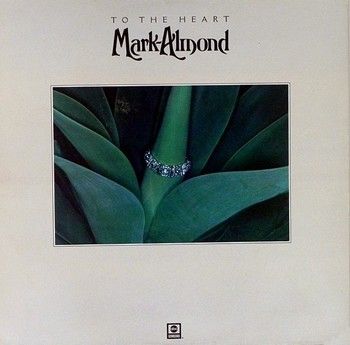
Mark-Almond - To The Heart - 1976 - ABC Records

A beautiful, subtle jazz album from Jon Mark and the late Johnny Almond. This is not jazz fusion, like many of Mark-Almond's albums, but contains six beautifully played mellow tracks. Jon Mark sings and plays classical guitar. Billy Cobham plays on five tracks. The late Tommy Eyre plays keyboards and composed "One More for the Road". Tommy played keyboards on the late Gerry Rafferty's classic "Baker Street". Try and listen to Mark-Almond's "Tuesday In New York" album, and The Johnny Almond Music Machine's "Patent Pending" album. [All tracks @ 320 Kbps: File size = 89.4 Mb]

TRACKS / COMPOSERS

1. Medley: New York State of Mind/Return to the City 6:44
2. Here Comes the Rain, Parts 1&2 10:08
3. Trade Winds 5:37
4. One More for the Road 6:48
5. Busy on the Line 4:56
6. Everybody Needs a Friend 5:56

All songs composed by Jon Mark & Johnny Almond except "New York State of Mind" by Billy Joel, "Return to the City" by Jon Mark, and "One More for the Road" by Tommy Eyre

MUSICIANS

Jon Mark - Classical Guitar, Vocals
Wolfgang Melz - Bass
Tommy Eyre - Piano, Electric Piano, Organ, Synthesizers
Billy Cobham - Drums on Tracks 1-5
Jimmy Gordon - Drums on Track 6
Milt Holland - Percussion
Johnny Almond - Baritone, Tenor and Soprano Saxophone, Flutes, Vibes
Jack Ellis - Trombone
Gary Barone - Flugelhorn
Greg Bloch - Violin, Electric Violin

BIO

British session musicians Jon Mark (vocals, guitar, drums) and John Almond (vocals, woodwinds, vibes, percussion) met while playing together in John Mayall's Bluesbreakers and left in 1970 to form Mark-Almond, sometimes referred to as the Mark-Almond Band. Prior to his career with Mayall, Mark and Mick Jagger co-produced Marianne Faithfull's early albums, with Mark later writing material for her and touring with her. He also toured with folksinger Alun Davies, and the two formed an ill-fated band called Sweet Thursday. Almond, meanwhile, had played in Zoot Money's Big Roll Band, the Alan Price Set, and Johnny Almond's Music Machine. Both joined the Bluesbreakers in 1969 and appeared on the albums Turning Point and Empty Rooms; they left in 1970 and recruited bassist Rodger Sutton and keyboardist Tommy Eyre. Mark-Almond built something of a following through touring, with their live shows often featuring lengthy instrumental jams. Their roster grew to seven members by 1973 before they disbanded that year. Mark, despite losing a finger in an accident, recorded the solo album Songs for a Friend in 1975. He and Almond reunited that year and released To the Heart in 1976; they got a deal with A&M in 1978 and released Other People's Rooms, but neither LP was successful and the duo broke up for good. © Steve Huey © 2011 Rovi Corporation. All Rights Reserved http://www.allmusic.com/artist/mark-almond-p4846/biography

BIO (WIKIPEDIA)

Mark–Almond were an English band of the late 1960s and early 1970s, who worked in the territory between rock and jazz. In 1970 Jon Mark and Johnny Almond formed Mark-Almond (also occasionally referred to as The Mark-Almond Band). The melancholy tones of saxophonist Almond were an integral part of the group's sound, and Almond frequently played flute as well, including the bass flute. Characterized by a blend of blues and jazz riffs, latin beats, and a mellow rock aesthetic, and in contrast to the heavier guitar-driven rock of his contemporaries, composer and band leader Mark worked at producing warm and melodic works. In 1963, Jon Mark (born in 1944), using his given name Jon Michael Burchell, and a former schoolmate, Alun Davies; singer-songwriter, folk guitarist and skiffle musician, (later of Cat Stevens' band), recorded as a duo, an album entitled Relax Your Mind, on Decca Records. Mark and Mick Jagger co-produced Marianne Faithfull's early recordings, with Mark recording on at least one album, and touring with Davies again, as supporting guitarists for Faithfull. Upon returning, both Mark and Davies travelled extensively throughout the UK, and France, busking until they secured a job entertaining on a Cunard Line cruise ship, crossing the Atlantic sixteen times. Tired of their voyages, both moved away in differing musical directions. Five years later, the two united in a five-piece band, the short-lived Sweet Thursday. The band had only one recording, the eponymous Sweet Thursday on Fontana Records. The band was composed of Jon Mark, Alun Davies, Nicky Hopkins, Harvey Burns, and Brian Odgers. However, the album was not promoted by their record label, and the bandmates never toured. Fontana later declared bankruptcy. Johnny Almond, born John Albert Almond on 20 July 1946 in Enfield, Middlesex, previously played in Zoot Money's Big Roll Band and the Alan Price Set. He had recorded a 1970 solo record for Deram Records, Johnny Almond's Music Machine, as well as performing considerable session work in England. The two began playing together as sidemen on John Mayall and Eric Clapton's Blues Breakers album in 1965, and can also be heard on the (post-Bluesbreakers) records The Turning Point and Empty Rooms. From that experience they decided to form Mark-Almond. Davies, though invited, was initially unreceptive. He had found a position as guitarist in Cat Stevens' band, and was "getting a buzz off Stevens' work." Davies did later join Mark-Almond for an album and tour. Mark-Almond's first two albums, Mark-Almond (1971) and Mark-Almond II (1972) were recorded for Bob Krasnow's Blue Thumb label, and were noted for their embossed envelope-style album covers. "One Way Sunday" was a hit for them in the United States and received radio airplay on album-oriented rock stations in Boston, Massachusetts in 1970. The group then recorded two albums for Columbia Records, Rising (1972) and the live album, Mark-Almond 73 (1973), by which time the group's members had grown to seven. In October 1972, Mark was involved in an accident in Hawaii and lost most of his left-hand ring finger. Mark was quoted later in Melody Maker as "climbed like a native and fell like an Englishman.". "What Am I Living For" from Mark-Almond 73 gained the group the most U.S. radio airplay they would get, but nevertheless they disbanded later that year. Mark released a solo record for Columbia Song For A Friend in 1975. He and Almond reunited in 1975 and released To the Heart on ABC Records (which had acquired Blue Thumb) in 1976, which featured the drummer Billy Cobham. Other notable musicians who have recorded or toured with Mark-Almond include drummer Dannie Richmond, violinist Greg Bloch, keyboardist Tommy Eyre and bassist Roger Sutton. Eyre and Sutton later teamed in Riff Raff. A&M Records signed the duo in 1978 and released Other Peoples Rooms, but the record did not sell as well as earlier releases. A number of European releases followed, but Mark-Almond disbanded again in the early 1980s. Mark-Almond reunited again in 1996 for a CD release, Night Music, which featured keyboardist Mike Nock and others. Mark moved to New Zealand in the mid 1980s, and released a number of successful solo New Age music recordings on his White Cloud record label, as well as collaborating with other artists on traditional Celtic and folk recordings and producing other artists. A release of Tibetan Monk chants Mark recorded and produced with his wife Thelma Burchell won a Grammy Award in 2004. Almond lived in the San Francisco Bay Area. He died on 18 November 2009 from cancer, aged 63

27.7.11

Louis Stewart


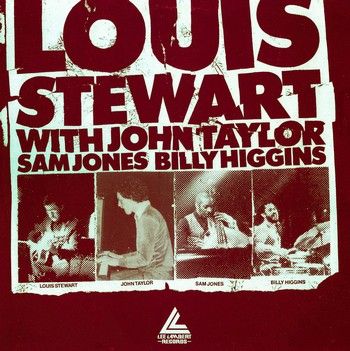
Louis Stewart - I Thought About You - 1979 - Lee Lambert

If you've never heard of the veteran Irish jazz guitarist, Louis Stewart, then check this album out. Louis is one of the world's greatest jazz guitarists. He is up there with players of the calibre of Larry Coryell, John McLaughlin, the late Emily Remler, Jeff Golub, and many more. On "I Thought About You" with the late bassist Sam Jones, pianist John Taylor, and the late drummer Billy Higgins he covers six great tracks. Mercer & Van Heusen's "I Thought About You" is covered with expert ease, as is the great saxophonist Jimmy Heath's "Smiling Billy". The legendary Thelonious Monk's "Straight, No Chaser" is given a masterful makeover, and Chick Corea's "Litha" is given the same treatment. The late, great bassist Sam Jones' own composition, "Unit 7" is a perfect track, and covered with incredible flair, superb technique, and style by the quartet. The late Belgian pianist, François "Francy" Boland & the late bassist Jimmy Woode's beautiful "Mood Indigo" like "November Girl" is played with a wonderful, delicate subtlety. Louis' guitar work on this track is superb. The album is HR by A.O.O.F.C. [All tracks @ 320 Kbps: File size = 121 Mb]. Graham @ LS/ITAY said that "Somewhere there is an ideal parallel universe where stuff like this remains available, while the other 99% of rubbish that the record companies spew out disappears instantly into a black hole". Try and listen to Louis Stewart's "Paradoxical Intervention" album, and check out his "Solo Guitar: Out On His Own" album on this blog.

TRACKS / COMPOSERS

A1 I Thought About You - James Van Heusen, Johnny Mercer
A2 Litha - Chick Corea
A3 Smiling Billy - Jimmy Heath

B1 Unit 7 - Sam Jones
B2 November Girl - Francy Boland, Jimmy Woode
B3 Straight, No Chaser - Thelonious Monk

MUSICIANS

Guitar - Louis Stewart
Bass - Sam Jones RIP
Piano - John Taylor
Drums - Billy Higgins RIP

SHORT BIO (WIKI)

Louis Stewart (born Waterford, Ireland, 5 January 1944) is an Irish jazz guitarist, and the recipient of an honorary doctorate from Trinity College Dublin. He began his international career in 1968, when he was awarded the special jury prize at The Montreux International Jazz Festival (and turning down a scholarship to Berklee College of Music, Boston). Shortly thereafter he began working with Benny Goodman, an association that lasted three years, and gave way to an extended period of prominence with the late English saxophonist/flautist Tubby Hayes. As a member of Ronnie Scott's quartet and quintet for several years, Louis began recording as leader in the mid-1970s, making albums with Sam Jones and Billy Higgins, with Peter Ind, and later, with Red Mitchell, saxophonist Spike Robinson, pianist Bill Charlap, and now, more recently again, a new CD, recorded in Venice with alto great Peter King. In the 70s Louis began his lengthy association with George Shearing (with whom he has toured America, Brazil and the European summer jazz festival circuit; and recorded eight albums - several in trio with Danish bass master Niels-Henning Orsted-Pedersen, and in quintet with vibist Steve Nelson and drummer Dennis Mackrel). He began working with Canadian genius-orchestrator and arranger, Robert Farnon, in 1976, and at least ten albums resulted: with singers Joe Williams, Carol Kidd and two with Eileen Farrell, two with Shearing and with trombone legend J.J. Johnson, on all of which he is a prominently featured soloist. In 1994, as a member of the Shearing trio, Louis featured for a week opposite Tommy Flanagan's trio in The Blue Note. This led to a still active association with Peter Washington and Lewis Nash which has included a week-long engagement, as leader, at the Village Vanguard (with Richard Wyands in the piano chair, and, for that particular week, Kenny Washington, drums, substituting for Lewis Nash). Continuing to make Dublin his home, Louis performs regularly in Germany and Norway, where, in the national theatre, Oslo, his James Joyce/Ulysses inspired concert piece "JoyceNotes" has been produced and recorded to acclaim.

MORE

Louis Stewart, the recipient of an honorary doctorate from Trinity College Dublin, began his international career in 1968 when he was awarded the special jury prize at The Montreaux International Jazz Festival. Shortly thereafter he began working with Benny Goodman, an association that lasted three years, and gave way to an extended and prominent period with the late, great, English saxophonist/flautist Tubby Hayes. As a member of Ronnie Scott's quartet and quintet for several years, Louis began recording as leader in the mid-'70s, making albums with Sam Jones and Billy Higgins, with Peter Ind, and later, with Red Mitchell, saxophonist Spike Robinson, pianist Bill Charlap, and now, more recently again, a new CD, recorded in Venice with alto great Peter King ("Angel Eyes"). In the 70s Louis began his lengthy association with George Shearing (with whom he has toured America, Brazil and all of Europe; and recorded eight albums - several in trio with Danish bass master Niels-Henning Orsted-Pedersen, and in quintet with vibist Steve Nelson and drummer Dennis Mackrel). He began working with Canadian genius-orchestrator and arranger, Robert Farnon in 1976, and at least ten albums resulted: with singers Joe Williams and Eileen Farrell, with Shearing and with trombone legend J.J. Johnson, on all of which he is a prominently featured soloist. In 1994, as a member of the Shearing trio, Louis featured for a week opposite Tommy Flanagan's trio in The Blue Note, New York. This led to an association - still active - with Peter Washington and Lewis Nash which has included a week-long engagement, as leader, at the legendary Village Vanguard, NYC (with the masterful Richard Wyands in the piano chair, and, for that particular week, Kenny Washington, drums, substituting for Lewis Nash). Continuing to make Dublin his home, Louis performs regularly in Germany and Norway, where, in the national theatre, Oslo, his James Joyce/Ulysses inspired concert piece "JoyceNotes" has been produced to acclaim. © http://www.louisstewart.net/bio.htm

24.7.11

Louis Stewart


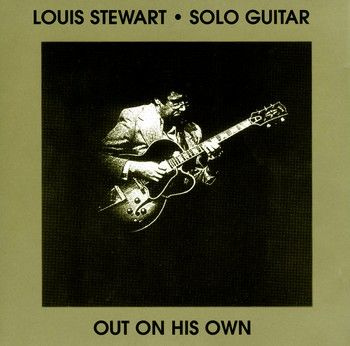
Louis Stewart - Solo Guitar: Out On His Own - 1977 - Livia Records

If you've never heard of the Irish jazz guitarist, Louis Stewart, then check this album out. Louis is one of the world's greatest jazz guitarists. He is up there with players of the calibre of Larry Coryell, John McLaughlin, the late Emily Remler, Jeff Golub, and many more. On "Out On His Own" he covers many of the great jazz standards with incredible flair, superb technique, and a unique style. Solo jazz guitar doesn't get better than this, and this magnificent album is VHR by A.O.O.F.C. N.B: Rar file is @ 320 Kbps + 120 Mb. Try and listen to his "Paradoxical Intervention" album

TRACKS / COMPOSERS

1. Blue Bossa - Kenny Dorham
2. Windows - Chick Corea
3. Darn That Dream - Van Heusen
4. Wave - A.C.Jobim
5. She Moved Through the Fair - Trad.
6. Make Someone Happy - Steyne, Green
7. I'm All Smiles - Leonard, Martin
8. Stella by Starlight - Young, Washington
9. Lazy Afternoon - Morros
10. Invitation - Kaper
11. I'm Old Fashioned - Kern
12. General Mojo's Well Laid Plan - Swallow
13. What's New? - Haggard, Burke
14. I'll Remember April - Raye, de Paul, Stone [Bonus Track]
15. Spring Is Here - Rodgers, Hart [Bonus Track]
16. Blues - Louis Stewart [Bonus Track]

All instrumentation by Louis Stewart. Louis also plays accompanying tracks on Tracks 1, 6, 7, 8, 10, & 12. Tracks 14-16 were not on original 1977 Irish LP issue

SHORT BIO (WIKI)

Louis Stewart (born Waterford, Ireland, 5 January 1944) is an Irish jazz guitarist, and the recipient of an honorary doctorate from Trinity College Dublin. He began his international career in 1968, when he was awarded the special jury prize at The Montreux International Jazz Festival (and turning down a scholarship to Berklee College of Music, Boston). Shortly thereafter he began working with Benny Goodman, an association that lasted three years, and gave way to an extended period of prominence with the late English saxophonist/flautist Tubby Hayes. As a member of Ronnie Scott's quartet and quintet for several years, Louis began recording as leader in the mid-1970s, making albums with Sam Jones and Billy Higgins, with Peter Ind, and later, with Red Mitchell, saxophonist Spike Robinson, pianist Bill Charlap, and now, more recently again, a new CD, recorded in Venice with alto great Peter King. In the 70s Louis began his lengthy association with George Shearing (with whom he has toured America, Brazil and the European summer jazz festival circuit; and recorded eight albums - several in trio with Danish bass master Niels-Henning Orsted-Pedersen, and in quintet with vibist Steve Nelson and drummer Dennis Mackrel). He began working with Canadian genius-orchestrator and arranger, Robert Farnon, in 1976, and at least ten albums resulted: with singers Joe Williams, Carol Kidd and two with Eileen Farrell, two with Shearing and with trombone legend J.J. Johnson, on all of which he is a prominently featured soloist. In 1994, as a member of the Shearing trio, Louis featured for a week opposite Tommy Flanagan's trio in The Blue Note. This led to a still active association with Peter Washington and Lewis Nash which has included a week-long engagement, as leader, at the Village Vanguard (with Richard Wyands in the piano chair, and, for that particular week, Kenny Washington, drums, substituting for Lewis Nash). Continuing to make Dublin his home, Louis performs regularly in Germany and Norway, where, in the national theatre, Oslo, his James Joyce/Ulysses inspired concert piece "JoyceNotes" has been produced and recorded to acclaim.

MORE

Louis Stewart, the recipient of an honorary doctorate from Trinity College Dublin, began his international career in 1968 when he was awarded the special jury prize at The Montreaux International Jazz Festival. Shortly thereafter he began working with Benny Goodman, an association that lasted three years, and gave way to an extended and prominent period with the late, great, English saxophonist/flautist Tubby Hayes. As a member of Ronnie Scott's quartet and quintet for several years, Louis began recording as leader in the mid-'70s, making albums with Sam Jones and Billy Higgins, with Peter Ind, and later, with Red Mitchell, saxophonist Spike Robinson, pianist Bill Charlap, and now, more recently again, a new CD, recorded in Venice with alto great Peter King ("Angel Eyes"). In the 70s Louis began his lengthy association with George Shearing (with whom he has toured America, Brazil and all of Europe; and recorded eight albums - several in trio with Danish bass master Niels-Henning Orsted-Pedersen, and in quintet with vibist Steve Nelson and drummer Dennis Mackrel). He began working with Canadian genius-orchestrator and arranger, Robert Farnon in 1976, and at least ten albums resulted: with singers Joe Williams and Eileen Farrell, with Shearing and with trombone legend J.J. Johnson, on all of which he is a prominently featured soloist. In 1994, as a member of the Shearing trio, Louis featured for a week opposite Tommy Flanagan's trio in The Blue Note, New York. This led to an association - still active - with Peter Washington and Lewis Nash which has included a week-long engagement, as leader, at the legendary Village Vanguard, NYC (with the masterful Richard Wyands in the piano chair, and, for that particular week, Kenny Washington, drums, substituting for Lewis Nash). Continuing to make Dublin his home, Louis performs regularly in Germany and Norway, where, in the national theatre, Oslo, his James Joyce/Ulysses inspired concert piece "JoyceNotes" has been produced to acclaim. © http://www.louisstewart.net/bio.htm

22.12.10

George Benson


.

George Benson - Beyond The Blue Horizon - 1971 - CTI Records

Back in the late 60s, George Benson was considered the natural successor to Wes Montgomery. Bensons mastery of funk, his smooth tone and fluent harmonic conception marked him out as the next big thing in jazz guitar. Except it didnt quite turn out that way of course; the mid 70s saw George recasting himself as a smooth jazz soul balladeer who happened to play a bit of guitar. Much like Nat King Cole a couple of decades earlier, Benson was able to make the transition from jazz to commercial success, and who can blame him (bet hes got a better pension plan than Jim Hall...). Anyway, rewind to 1971 and here's George in full flight with Miles Davis alumni Ron Carter and Jack DeJohnette, organist Clarence Palmer and the obligatory brace of latin percussionists. Unlike the occasional cocktail vibe of some of his other CTI releases, Benson is on fiery form throughout, adopting a trebly, occasionally biting tone, soaked with blues, juicy Wes like octave phrases and speedy bop runs. His solo on "The Gentle Rain" (written by Luis Bonfa, better known for "Black Orpheus") is a peach; nibbling out bluesy chromatics and exaggerated vibrato, sometimes firing off rapid chordal volleys. "Ode to a Kudu" is a restrained chordal outing, somewhere between Joe Pass, BB King and James Blood Ulmer. The latters skewed Delta Blues harmolodics are evoked in "Somewhere in the East", where a spot of retuning gives the guitar a sour, oud like sound (even though the melody hints at "Strangers in the Night"). Bensons at his most exploratory here (especially on the bonus longer out take included here). Palmers bass pedals take care of most of the bass parts, while Carter yends to stick to odd glissed phrases with the bow (which is sometimes not a great idea), or high pizzicato figures shadowing Bensons guitar. Hes at his best holding down the bottom end on the second take of the lovely "All Clear", or the opening "So What", where he gets a long duet in with the ever reliable DeJohnette, who seems happiest when Ron is in swinging mode. Palmer is restrained throughout, opting for a soft, warm tone, but theres no doubt whose show this is. A reminder that though Georges career switch may have made him considerably richer, it left the jazz world a bit poorer. Recommended. © Peter Marsh 2002-11-20 http://www.bbc.co.uk/music/reviews/3qvr

Having taken Benson along with him when he founded CTI, Creed Taylor merely leaves the guitarist alone with a small group on his first release. The payoff is a superb jazz session where Benson rises to the challenge of the turbulent rhythm section of Jack DeJohnette and Ron Carter, with Clarence Palmer ably manning the organ. Benson is clearly as much at home with DeJohnette's advanced playing as he was in soul/jazz (after all, he did play on some Miles Davis sessions a few years before), and his tone is edgier, with more bite, than it had been for awhile. The lyrical Benson is also on eloquent display in "Ode to a Kudu" (heard twice on the CD, as is "All Clear"), and there is even a somewhat experimental tilt toward Afro-Cuban-Indian rhythms in "Somewhere to the East." A must-hear for all aficionados of Benson's guitar. © Richard S. Ginell © 2010 Rovi Corporation. All Rights Reserved http://www.allmusic.com/album/beyond-the-blue-horizon-r30386

Before George Benson became involved in his more vocal/smooth jazz style, he recorded some amazing jazz guitar albums. "Beyond The Blue Horizon" from 1971 is one such album, and is VHR by A.O.O.F.C. George Benson can play the most complex pieces effortlessly, and is up there with guitarists of the calibre of Jan Akkerman, Jeff Beck, and Robben Ford among others. If you would like to hear the early George Benson's superb jazz guitar, listen to his 1965 "It's Uptown" album. If you are more interested in his later smooth jazz/vocal style, then his "Give Me the Night" album is a superb example. Interestingly, the brilliant session guitarist Jon Herington (Steely Dan, etc,) has said that he regards George Benson as "the greatest guitarist on the planet". Check out Jon's "Pulse and Cadence" album on this blog

TRACKS / COMPOSERS

A1 So What? - M. Davis 9:05
A2 The Gentle Rain (from the movie of the same title) - L.Bonfa 9:05
B1 All Clear - G.Benson 5:15
B2 Ode To A Kudu - G.Benson 3:45
B3 Somewhere In The East - G.Benson 6:05
6 All Clear (Alt. Take) - G.Benson 5:45 [Bonus Track]
7 Ode To A Kudu (Alt. Take) - G.Benson 4:38 [Bonus Track]
8 Somewhere In The East (Alt. Take) - G.Benson 9:53 [Bonus Track] *

* N.B: Not included on all CD reissues

MUSICIANS

Guitar - George Benson
Bass - Ron Carter
Organ - Clarence Palmer
Drums - Jack DeJohnette
Percussion - Albert Nicholson, Michael Cameron

BIO

George Benson is simply one of the greatest guitarists in jazz history, but he is also an amazingly versatile musician, and that frustrates to no end critics who would paint him into a narrow bop box. He can play in just about any style -- from swing to bop to R&B to pop -- with supreme taste, a beautiful rounded tone, terrific speed, a marvelous sense of logic in building solos, and, always, an unquenchable urge to swing. His inspirations may have been Charlie Christian and Wes Montgomery -- and he can do dead-on impressions of both -- but his style is completely his own. Not only can he play lead brilliantly, he is also one of the best rhythm guitarists around, supportive to soloists and a dangerous swinger, particularly in a soul-jazz format. Yet Benson can also sing in a lush soulful tenor with mannerisms similar to those of Stevie Wonder and Donny Hathaway, and it is his voice that has proved to be more marketable to the public than his guitar. Benson is the guitar-playing equivalent of Nat King Cole -- a fantastic pianist whose smooth way with a pop vocal eventually eclipsed his instrumental prowess in the marketplace -- but unlike Cole, Benson has been granted enough time after his fling with the pop charts to reaffirm his jazz guitar credentials, which he still does at his concerts. Benson actually started out professionally as a singer, performing in nightclubs at eight, recording four sides for RCA's X label in 1954, forming a rock band at 17 while using a guitar that his stepfather made for him. Exposure to records by Christian, Montgomery, and Charlie Parker got him interested in jazz, and by 1962, the teenaged Benson was playing in Brother Jack McDuff's band. After forming his own group in 1965, Benson became another of talent scout John Hammond's major discoveries, recording two highly regarded albums of soul-jazz and hard bop for Columbia and turning up on several records by others, including Miles Davis' Miles in the Sky. He switched to Verve in 1967, and, shortly after the death of Montgomery in June 1968, producer Creed Taylor began recording Benson with larger ensembles on A&M (1968-1969) and big groups and all-star combos on CTI (1971-1976). While the A&M and CTI albums certainly earned their keep and made Benson a guitar star in the jazz world, the mass market didn't catch on until he began to emphasize vocals after signing with Warner Bros. in 1976. His first album for Warner Bros., Breezin', became a Top Ten hit on the strength of its sole vocal track, "This Masquerade," and this led to a string of hit albums in an R&B-flavored pop mode, culminating with the Quincy Jones-produced Give Me the Night. As the '80s wore on, though, Benson's albums became riddled with commercial formulas and inferior material, with his guitar almost entirely relegated to the background. Perhaps aware of the futility of chasing the charts (after all, "This Masquerade" was a lucky accident), Benson reversed his field late in the '80s to record a fine album of standards, Tenderly, and another with the Basie band, his guitar now featured more prominently. His pop-flavored work also improved noticeably in the '90s. Benson retains the ability to spring surprises on his fans and critics, like his dazzlingly idiomatic TV appearance and subsequent record date with Benny Goodman in 1975 in honor of John Hammond, and his awesome command of the moment at several Playboy Jazz Festivals in the 1980s. His latter-day recordings include the 1998 effort Standing Together, 2000's Absolute Benson, 2001's All Blues, and 2004's Irreplaceable. Three songs from 2006's Givin' It Up, recorded with Al Jarreau, were nominated for Grammy Awards in separate categories. Richard S. Ginell © 2010 Rovi Corporation. All Rights Reserved http://www.allmusic.com/artist/george-benson-p6098/biography

3.8.10

Dave Pike


Photobucket


Dave Pike - The Doors Of Perception - 1970 - Vortex

Although the music could be classified as "free jazz" or avant garde jazz, which sometimes deters people from listening to this kind of music, it's a great album full of experimental modal jazzed-out pieces with some heavy psychedelic soul jazz grooves from Dave Pikes vibraphone and marimba, and with just enough echo to make it "trippy". There's also fuzz bass and some rainstorm sound effects. Very accessible, listenable, and enjoyable. It is worthwhile listening to Dave Pike's "Pike's Groove" album


TRACKS

A1 Free Improvisation 3:06
A2 The Drifter 7:09
A3 The Doors Of Perception 3:29

B1 Ballad 5:30
B2 Anticipation 8:05

All music composed by Dave Pike

MUSICIANS

Electric Bass - Chuck Israel
Piano - Don Friedman
Drums - Arnie Wise
Alto Saxophone - Lee Konitz
Tenor Saxophone, Clarinet - Eddie Daniels
Marimba, Vibraphone - Dave Pike

REVIEWS

Friedman's hip piano work. "Ballad," on the other hand, is relatively straight, sweet, soft, and tender, but again features those spacy vibes. The whole joint gets taken out the door with "Anticipation," a hard bop number with great alto work from Konitz (albeit sounding a little warped by shifting primitive stereo effects) and Daniels that alternates between the latter's down-and-dirty blowing and the former's elegant phrasing. The rhythm section just dazzles, with Friedman doing some of his best work in both comping and soloing here. He's deep into the groove laid down by Wise and Israel — the latter of whom walks that line and gets good wood on his upright. When Pike enters with his bright vibes, the whole thing moves off into jazz via the Jetsons! While The Doors of Perception may not be every Pike fan's cup of what have you, it will certainly appeal to those who dug his sides for the German MPS label in the early '70s. The bottom line: there is so little of his work available on CD in America anyway that this one — particularly as a budget release — is well worth plunking down the cash for. © Thom Jurek © 2010 Rovi Corporation. All Rights Reserved http://www.allmusic.com/cg/amg.dll?p=amg&sql=10:dxfyxqrgldse


Groovily tripped-out work from vibist Dave Pike – and one of the few American albums that matches the experimental sound of his work for MPS! The session's often quite free and open – in a way that not only uses odd instrumental combinations and arrangements, but which also features some offbeat production by Herbie Mann that further abstracts the sound! Elements of Pike's earlier work shine through in a few of the more straightforward groovers, but his new European-endowed sense of hipness wins in the end – thanks to a good deal of modal grooves, psychedelic elements, and even a bit of fuzzy Fender bass! Other players include Lee Konitz on alto sax, Don Friedman on piano, Chuck Israel on bass (electric and acoustic), and Eddie Daniels on tenor and clarinet – and titles include "Free Improvisation", "The Drifter", "Ballad", "The Doors Of Perception", and "Anticipation". © 1996-2010, Dusty Groove America, Inc. http://www.dustygroove.com/item.php?id=2y6wfmww4v

BIO (WIKIPEDIA)

David Samuel Pike (born March 23, 1938 in Detroit) is a jazz vibraphone player. He learned drums at the age of eight and is self-taught on vibes. He has also played marimba, particularly with Herbie Mann. Lionel Hampton, Milt Jackson, and Cal Tjader were early inspirations for him. He began putting an amplifier on his vibes when working with flautist Herbie Mann in the early 1960s. There are several other works he did inspired by Brazilian jazz, Latin jazz, or world music. By the late 1960s, Pike's music became more exploratory, contributing a unique voice and new contexts that pushed the envelope in times remembered for their exploratory nature. "Doors of Perception," released in 1970 for the Atlantic Records subsidiary Vortex Records and produced by former boss Herbie Mann, explored ballads, modal territory, musique concrete, with free and lyrical improvisation, and included musicians like alto saxophonist Lee Konitz, bassist Chuck Israels (of Bill Evans and Ornette Coleman fame) and the vastly underrated pianist Don Friedman whose artistry was up to the task of finding new spaces in the jazz idiom. Pike's move to Europe and tenure at MPS/Saba records produced some of the most original jazz of the period. With the collaboration of Volker Kriegel (guitar), J. A. Rettenbacher (acoustic and electric bass), and Peter Baumeister (drums), he formed the Dave Pike Set. The group recorded 6 brilliant records from 1969-1972 that spanned the gamut from funky grooves to free, textural territory. The group, though short-lived, created a unique identity and textural palette. Kriegel's compositional and instrumental (playing acoustic, classical, and electric guitar as well as sitar) contributions to the group helped set the Dave Pike Set's sound apart, organically incorporating influences from jazz, soul jazz, psychedelia, avant garde music, and world (Indian, Brazilian, Latin and Middle Eastern sounds) music.

15.2.10

Mike Nock


Mike Nock - Magic Mansions - 1977 - Laurie

"Mike Nock has a remarkable sensitivity for intense compositions, outstanding for their clear thoughtfulness." - AUDIO Magazine, GERMANY, "Finely crafted jazz scoring." - Down Beat (USA), ".. a gifted writer, Nock's compositions are full of un-expected twists and turns." - CODA Magazine (Canada - Dec '99)

An obscure, but excellent album from New Zealand jazzman, Mike Nock, produced by Teo Macero. Players include Charlie Mariano, Al Foster and Ron Mclure. The tracks were recorded in N.Y.C., NY, USA, on May 3rd, and 4th,1977. Mike Nock, is certainly not a household name in jazz, although he spent over twenty-five years working in the USA with jazz musicians like Michael Brecker, Yusef Lateef, Dionne Warwick, and Coleman Hawkins. He is primarily a jazz composer, but is now becoming better known working with pianists like Michael Kieran-Harvey, Simon Tedeschi, and Michael Houstoun. His compositions include choral pieces, electronic soundscapes, and film and dance music. "Magic Mansions" is a good example of classic jazz, and synth jazz fusion. His "Open Door" album should be heard. For music of a similar genre, check out the late Charlie Mariano's "Reflections" album @ CHARMARI/REFS

TRACKS

1.A1: Magic Mansions 6:29
2.A2: Twister 6:12
3.A3: Enchanted Garden - Bennie Maupin, Mike Nock 5:22
4.A4: Hybris 3:45

5.B1: Blackout 7:24
6.B2: Everglad 7:05
7.B3: Mambucaba 7:35

All tracks composed by Michael A. Nock, unless otherwise stated

MUSICIANS

Mike Nock - Keyboards, Piano
Ron McClure - Bass, Guitar
Al Foster - Drums
Nacho Mena - Percussion
Charlie Mariano - Sax (Soprano), Flutes
Lyn Williamson - Vocals

BIO (WIKI)

Mike Nock (born September 27, 1940 in Christchurch, New Zealand). He began studying piano at 11 and by 18 had gigs in Australia. He headed a trio that toured England in 1961 and then attended Berklee College of Music. He was a member of Yusef Lateef's band from 1963 to 1965. During 1968-70 Nock was involved with fusion, leading the Fourth Way. After a few years he became a studio musician in New York (1975-85) and then returned to Australia. His 1987 album Open Door with drummer Frank Gibson, Jr. was named that year's Best Jazz Album in the New Zealand Music Awards. He currently lives in New South Wales where he teaches at the Conservatorium of Music in Sydney and performs with both his trio and big band. One of his most recent releases is a live recording with saxophonist Dave Liebman.

MORE ABOUT MIKE NOCK

Mike Nock has long been one of the top modern jazz keyboardists to emerge from his part of the world. Nock began taking piano lessons from his father when he was 11. He began gigging four years later and at 18 moved to Australia. After heading a trio that toured England in 1961, Nock went to the U.S. to attend the Berklee College of Music. After a year he dropped out of school to be the house pianist at a Boston club and had opportunities to work with Coleman Hawkins, Pee Wee Russell, Phil Woods and Sam Rivers among many others. Nock gained some recognition during his period as a member of Yusef Lateef's band (1963-65). He led his own combos, gigged for a short period with the Jazz Messengers and eventually moved to San Francisco where he worked with John Handy. During 1968-70 Nock was involved with fusion, leading the Fourth Way, a pioneer in the idiom. After a few years he became a studio musician in New York (1975-85) and then returned to Australia where he has been busy as both an educator (teaching at the N.S.W. Conservatorium of Music) and as a musician, occasionally revisiting the U.S. As a leader, Nock recorded as early as 1960 (Move which was recorded in Australia) and has made records for Capitol (with the Fourth Way), MPS, Improvising Artists (in a band called Almanac), Laurie, Enja, Timeless, Tomato and ECM. © Scott Yanow © 2010 Rovi Corporation. All Rights Reserved http://www.allmusic.com/cg/amg.dll?p=amg&sql=11:z7rvad1kv8w1~T1

16.3.09

Richard Davis


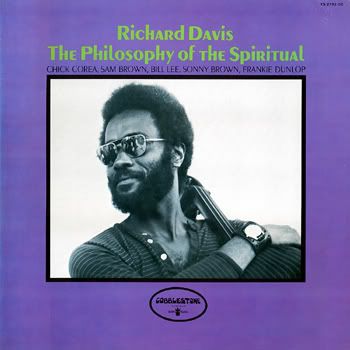
Richard Davis -The Philosophy of the Spiritual - 1971 - Cobblestone

Arguably the finest solo album Richard Davis ever recorded, with Bill Lee playing bass and cello alongside Davis, as well as composing four of the tunes. The players are amazing, including Chick Corea on piano, and together they create a sublime jazz recording, which is on a par with Brubeck's "Take Five", or Silver's "Song For My Father". Jazz as good as this is rare, especially from the early seventies. This album is like gold dust, so please forgive the "snap, crackle and pop"on the vinyl. If anybody is aware of a CD issue of this album, A.O.O.F.C would be extremely interested. If you can find Richard Davis "Live at Sweet Basil" album, give it a listen. If you think jazz is "highbrow" or inaccessible, listen to the albums "Song For My Father" by Horace Silver and Dave Brubeck's "Take Five". You may find yourself with a new perspective on jazz music.

TRACKS / COMPOSERS

SIDE A

1. Dear Old Stockholm - Anders Fryxell (Referred to by many as an old Swedish folk song. The original Swedish title, "Ack Värmeland Du Sköna"/"Värmlandsvisan", was originally written by the Värmlandian Anders Fryxell in his musical "Vermlandsflickan")
2.Monica - Bill Lee
3.Oh My God - Nadi Koma

SIDE B

1.The Rabbi - Bill Lee
2.Baby Sweets - Bill Lee
3.Juan Valdez - Bill Lee

MUSICiANS

Richard Davis - Bass
Chick Corea - Piano
Sam Brown - Guitar
Bill Lee - Bass
Sonny Brown - Drums
Frankie Dunlop - Percussion

N.B: Hi! QTN. Best I could do!

BIO

A superb bass technician who doesn't have as extensive a recorded legacy as expected, Richard Davis has a wonderful tone, is excellent with either the bow or fingers, and stands out in any situation. He has been a remarkable free, bebop and hard bop player, served in world class symphony orchestras, backed vocalists and engaged in stunning duets with fellow bassists. He does any and everything well in terms of bass playing; accompaniment, soloing, working with others in the rhythm section, responding to soloists, or playing unison passages. He combines upper register notes with low sounds coaxed through the use of open strings. Davis studied privately nearly 10 years in the '40s and '50s, while also playing with Chicago orchestras. He played with Ahmad Jamal, Charlie Ventura, and Don Shirley in the early and mid-'50s, then worked with Sarah Vaughan in the late '50s and early '60s, as well as Kenny Burrell. Davis divided his duties in the '60s between recording and performing sessions with jazz musicians and freelance work with symphony orchestras conducted by Leonard Bernstein and Igor Stravinsky. He recorded often with Eric Dolphy, including the unforgettable dates at the Five Spot. He also worked with Booker Ervin, Andrew Hill, Ben Webster, Stan Getz, Earl Hines, and the Creative Construction Company. Davis teamed with Jaki Byard and Alan Dawson on sessions with Ervin, and others like Rahsaan Roland Kirk. He also played with Van Morrison. During the '70s Davis worked with Hank Jones and Billy Cobham, and he was a member of the Thad Jones - Mel Lewis Orchestra in the '60s and '70s. Davis left New York in 1977 to teach at the University of Wisconsin in Madison, where he remained into the mid-'80s. He appeared at the Aurex Jazz Festival in Tokyo in 1982, playing in a jam session led by trombonists J.J. Johnson and Kai Winding, and at the 1984 Chicago Jazz Festival. Davis was featured in the 1982 film "Jazz In Exile." He's done relatively few recordings as a leader, though three Muse sessions are now available on CD. The superb The Philosophy Of The Spiritual which matched Davis and fellow bassist Bill Lee is not in print or on CD. © Ron Wynn, allmusic.com

24.6.07

Herbie Hancock


herbiehancock-sextant1972


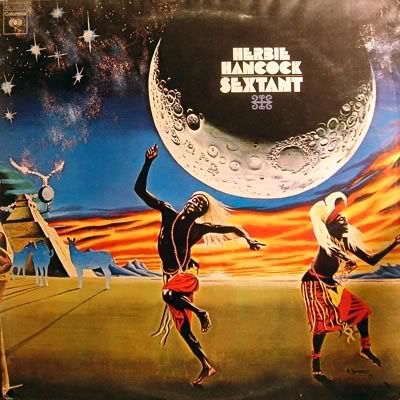
Herbie Hancock - Sextant - 1972 - Columbia

This album is one of the best progressive jazz rock recordings you will ever hear.Way ahead of it's time, it is a fabulous mix of jazz, funk and rock.Hancock pushed the synthesizer to the limit on this recording, and the three brilliantly original tracks demonstrate just how good a musician Hancock is.Hancock stated there was nowhere else for the line up to go after this album, and listening to Sextant, he was probably right. Hard to better an album as good as this.

TRACKS:

1. Rain Dance — 9:16
2. Hidden Shadows — 10:11
3. Hornets — 19:35

CREDITS

Herbie Hancock, piano, Fender Rhodes, Hohner D-6 clavinet, mellotron
Bennie Maupin, soprano sax, bass clarinet, piccolo, afuche, hum-a-zoo
Dr. Eddie Henderson, trumpet, flugelhorn
Julian Priester, bass trombone, tenor trombone, alto trombone, cowbell
Buster Williams, electric bass, acoustic bass
Billy Hart, drums
Dr. Patrick Gleeson, ARP 2600 and soloist
Buck Clarke, percussion

REVIEWS

This final offering from Herbie Hancock's Mwandishi band finds them pushing like Samson, ready to bring down the columns of jazz and rock to usher in a new era. Hancock obviously had learned much from his work over the years with Miles Davis, and much like Davis' work during his electric period, the music presented here are great abstract paintings, taking full advantage of the keyboard technology offered at the time.
Right from the start, "Rain Dances" can't help but grab your attention, with sequencer bubbles percolating away against ascending, metallic synth lines within a vast echo. Listening to this, you feel as if you've stumbled upon a mad professor's chemistry lab somewhere on an abandoned space station. As the piece progresses, Hancock provides chilly Fender Rhodes that bounces playfully against the more earthy strains of Williams' acoustic bass, until the legions of synths and sequencers rise up once and for all to drive the piece home. "Hidden Shadows" is probably the album's highlight for progressive fans, and for me, simply one of the greatest fusion tracks of all time. It is characterized by a loppy, infectious, funky 19/8 beat; brass lines tugging against the groove in a sighing, off-key manner; and a scampering, gleefully psychotic piano solo. Also, if you can imagine what a jaundiced mellotron calling out sickly on its deathbed sounds like, well it has that, too. Seriously, I've never heard the mellotron sound quite like it does here, and Hancock successfully coaxes a new flavor out of the instrument. Though each averaging ten minutes in length, both "Rain Dances" and "Hidden Shadows" seem to fly by each time I play them.
Out of the three, the side-long closer "Hornets" is the most obvious adherent to Davis' work. The rhythm is governed by a sparse line from bassist Williams, hi-hat-emphasized rock beat from Hart, and sharp Fender Rhodes punctuations. The foreground is driven at the start of the piece mainly by Henderson's trumpet flourishes and in its latter half by all sorts of keyboard overload from Hancock, including processed Rhodes and clavinet. That this pretty much fell by the wayside upon its initial release should surprise no one. Thankfully, time seems to have caught up with Sextant and nowadays it sees its artistic (and hopefully commercial) due. Back in 1973, however, Hancockwas feelin' the financial hurt and knew he would have to find something new. His answer was to bring this particular chapter to a close, retain Bennie Maupin, and form a new band that would integrate Sly Stone's brand of funk with jazz. The resulting product, Headhunters, would become a jazz landmark. As it stands, though, I dare say that this one is even more the jewel of the crown for progressive fans. review © Joe McGlinchey — 5-18-04 © ground and sky 1999-2007
In 1972, Herbie Hancock moved to his third recording label, switching from Warner to Columbia. He brought his band along with him, as Sextant was recorded by most of the same individuals who appeared on Mwandishi and Crossings. Sextant finds Hancock somewhere between the wild experimentation of Crossings and the jazz-funk of Headhunters. It is a tour-de-force of electric keyboard sounds and in this respect I think it stands head and shoulders above all its contemporaries that I've heard. Weather Report — the only other fusion band that emphasized electric keyboards to this extent — was nowhere near this level of sophistication on any of their first three albums, despite Joe Zawinul's reputation for being a pioneer of the devices.
Hancock worked with Miles Davis on his controversial 1972 ode to funk On the Corner, and Sextant — especially the 20-minute "Hornets" — comes off as being inspired by that project. As usual, whereas Davis could be harsh and abrasive, Hancock uses his timbres and rhythms to dazzle. Like large portions of On the Corner, "Hornets" is a sonic fiesta undercut by funky bass lines and insistent hi-hat patterns. Hancock knocks off some riffs on the electric piano over the rhythm section, but the track's real depth is provided by the cornucopia of sounds generated by the layers of other electric keyboards; this had to be one of the most futuristic-sounding albums ever made when it came out. Throughout much of the first half of the track either Eddie Henderson or Bennie Maupin can be heard soloing, although it is a lost, desperate kind of soloing that is artfully placed in the far corners of the mix, giving the familiar tones of the trumpet and sax the character of being in imminent danger of getting left behind wherever this ship is going. And indeed they do get left behind; they are absent on the remainder of the track and the keyboards completely take over.
The album's most original cut has to be the opener, "Rain Dance," in which synthesizers that sound like raindrops echoing through a dank chamber form a loose beat that is taken over by a repetitive, mechanical riff introduced later in the song. The synthesizer droplets and an array of other artificial gurgles and squonks play all over the vamp for the conclusion of the piece. Stylistically, this sounds to me like a precursor to ambient dub and some varieties of the drum & bass/IDM that I've heard. Awesome. "Hidden Shadows" launches a slow-motion funk riff and runs it for ten minutes while stoned horn charts and all manners of keyboard sounds contribute. It's funk on acid.
With Sextant, Hancock finished his Mwandishi period as strongly as he started it. In my opinion, Mwandishi, Crossings and Sextant amount to a very strong trio of electric jazz albums and represent the pinnacle of Hancock's electric phase. review © Matt P. — 6-21-05 © ground and sky 1999-2007