
A.O.O.F.C
recommends
Mizar6

babydancing


Get this crazy baby off my head!

11.12.12

Camel


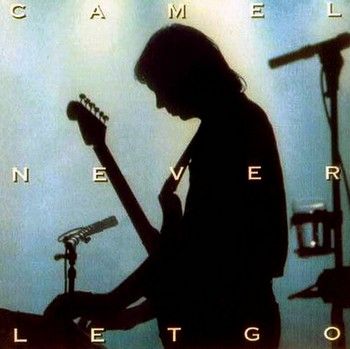
Camel - Never Let Go - 1993 - Camel Productions

Progressive rock bands like Camel have to be creative in their touring schedules, often traveling to Europe in order to find a substantial concentration of fans in a single place. So it was that Camel arrived with their 20th anniversary tour at Enschede, Holland. After their tenth anniversary tour (which found them promoting The Single Factor), few would have predicted a 20th, but the release of Dust and Dreams in 1991 suggested the band had found a second creative wind (or at least tapped into the original breeze last felt on Nude). Never Let Go confirms the point that Camel has plenty of life left in it. Spread out across two discs (the untangling of which is like disassembling a child's toy, a problem common to two-disc sets), this live show features two distinct sets. The first is a remarkable retelling of their earlier travels, recounting highlights from each of their releases up to Nude, in chronological order no less. It starts out deceptively simple, with Andrew Latimer strumming a slow version of "Never Let Go," which soon explodes into a spot-on rendition. With keyboardist Mickey Simmonds joining a returning Colin Bass and Paul Burgess, the new quartet does a marvelous job of capturing Camel in its various guises: from the instrumentals "Ice" and "Earthrise" to familiar songs like "Spirit of the Water" (sung by Bass) and "City Life." The second set is devoted to a pristine presentation of their recent opus, Dust and Dreams, in its entirety. Amazingly, the live performance concedes nothing in clarity to its studio counterpart, so no harm done if you bypass the original and hear it here instead. As a bonus, Camel closes with the instrumental "Sasquatch" (one of the few bright spots from The Single Factor) and a beloved mirage from the past, "Lady Fantasy." Among their live releases (which number more than a few), Never Let Go may be the one worth holding onto. Latimer's voice has grown a little thinner over the years (and it was pretty thin to begin with), but his guitar work gets sharper with age. Critically speaking, this gets two humps up. © Dave Connolly © 2012 Rovi Corp | All Rights Reserved http://www.allmusic.com/album/never-let-go-mw0000713430

Camel seem to be the kind of band that everybody has heard of, but not listened to. Camel were one of the the greatest archetypal progressive rock bands ever to emerge from England. The late Peter Bardens' brilliant keyboard-playing was a major force in Camel's success. Peter played with Peter Green, Mick Fleetwood, and had played keyboards with the legendary Van Morrison's "Them." Despite many album releases from 1972 onwards, Camel have never reached megastardom. But again, like so many other great bands, Camel have never bowed to commercialism, and for the last 40 years or so, through many different line-ups, continue to produce their own unique brand of wonderful music. This is Grade A progressive live rock from a band who deserve more accolades. This Official Bootleg album was recorded in one concert at Enschede, Holland, on September 5th, 1992, to coincide with Camel's 20th anniversary and the promotion of the band's "Dust and Dreams" album. The album arguably contains most of Camel's strongest songs from their early - mid career. Disc Two is a live version of the band's "Dust and Dreams" album. The guitar work from Andy Latimer is superb. Is this guy ever mentioned in any "Greatest Guitarist" lists"?. "Never Let Go" is HR by A.O.O.F.C. Listen to the band's brilliant "Nod & A Wink" album, and listen to their "Rain Dances" and "I Can See Your House From Here" albums. Read a more detailed bio of Camel @ http://en.wikipedia.org/wiki/Camel_(band) Support real music [All tracks @ 320 Kbps: 2 separate rar files: Pt.1 (Disc 1) = 134 Mb, & Pt.2 (Disc 2) = 163 Mb]

TRACKS / COMPOSERS

DISC ONE

1 Never Let Go - Andy Latimer 7:22
2 Earthrise - Peter Bardens / Andy Latimer 8:02
3 Rhayader - Peter Bardens / Andy Latimer 2:23
4 Rhayader Goes to Town - Peter Bardens / Andy Latimer 5:14
5 Spirit of the Water - Peter Bardens 3:03
6 Unevensong - Peter Bardens / Andy Latimer / Andy Ward 5:44
7 Echoes - Peter Bardens / Andy Latimer / Andy Ward 7:48
8 Ice - Andy Latimer 10:21
9 City Life - Susan Hoover 5:10
10 Drafted - Susan Hoover / Andy Latimer 4:12

DISC TWO

1 Dust Bowl - Andy Latimer 1:58
2 Go West - Andy Latimer 3:47
3 Dusted Out - Andy Latimer 1:36
4 Mother Road - Susan Hoover / Andy Latimer 3:44
5 Needles - Andy Latimer 3:31
6 Rose of Sharon - Susan Hoover / Andy Latimer 5:32
7 Milk 'N' Honey - Andy Latimer 3:28
8 End of the Line - Susan Hoover / Andy Latimer 7:27
9 Storm Clouds - Susan Hoover / Andy Latimer 3:16
10 Cotton Camp - Andy Latimer 2:28
11 Broken Banks - Andy Latimer 0:45
12 Sheet Rain - Andy Latimer 2:20
13 Whispers - Andy Latimer 1:06
14 Little Rivers and Little Rose - Andy Latimer 2:10
15 Hopeless Anger - Andy Latimer 4:54
16 Whispers in the Rain - Andy Latimer 3:56
17 Sasquatch - Andy Latimer 4:58
18 Lady Fantasy - Camel 15:28

BAND

Andy Latimer - Guitar, Keyboards, Flute, Vocals
Colin Bass - Bass, Keyboards, Vocals
Mickey Simmonds - Keyboards
Paul Burgess - Drums, Bells, Octopad, Tambourine

SHORT BIO

Camel never achieved the mass popularity of fellow British progressive rock bands like the Alan Parsons Project, but they cultivated a dedicated cult following. Over the course of their career, Camel experienced numerous changes, but throughout the years, Andrew Latimer remained the leader of the band. Formed in 1972 in Surrey, Camel originally consisted of Latimer (guitar, flute, vocals), Andy Ward (drums), Doug Ferguson (bass), and keyboardist Peter Bardens, previously of Them. By the end of 1973, the group signed with MCA and released their eponymous debut. In 1974, the band switched record labels, signing with Decca's Gama subsidiary, and released Mirage. In 1975, Camel released their breakthrough album The Snow Goose, which climbed into the British Top 30. The band's English audience declined with 1976's Moonmadness, but the album was more successful in America, reaching number 118 -- the highest chart position the band ever attained in the U.S. Following the release of Moonmadness, Ferguson left the band and was replaced by Richard Sinclair (ex-Caravan); at the same time, the group added saxophonist Mel Collins. Latimer and Bardens conflicted during the recording of 1977's Rain Dances and those tensions would come to a head during the making of 1978's Breathless. After Breathless was completed, Bardens left the band. Before recording their next album, Camel replaced Bardens with two keyboardists -- Kit Watkins (Happy the Man) and Jim Schelhaas (Caravan) -- and replaced Sinclair with Colin Bass. By the time Camel released their 1979 album, I Can See Your House From Here, rock & roll had been changed by the emergence of punk rock, which resulted in less press coverage for progressive rock, as well as decreased record sales. Camel suffered from this shift in popular taste -- I Can See Your House From Here received less attention than any of the band's releases since their debut. Latimer returned to writing concept albums with 1981's Nude. In 1982, drummer Andy Ward was forced to leave the band after suffering a severe hand injury. Camel's 1982 album, The Single Factor, was a slicker, more accessible affair than previous Camel records, but it failed to chart. Stationary Traveller (1984) was another concept album. After the release of the 1984 live album, Pressure Points, Camel entered a long period of hibernation that lasted until the early '90s. In 1985, Decca dropped Camel from its roster. Latimer wasn't able to find a new label because he was embroiled in a difficult legal battle with Camel's former manager Geoff Jukes; Camel eventually won the lawsuit in the late '80s. Throughout this period, Camel produced no new music. In 1988, Latimer sold his home in England and moved to California, where he founded the independent label Camel Productions. By the time Camel recorded their follow-up to Stationary Traveller in the early '90s, the band was, for most intents and purposes, simply Andrew Latimer and a handful of session musicians. Dust and Dreams (1991) was the first release on Camel Productions. In 1993, PolyGram released a double-disc Camel retrospective, Echoes. In early 1996, Camel released Harbour of Tears. © Stephen Thomas Erlewine © 2012 Rovi Corp | All Rights Reserved http://www.allmusic.com/artist/camel-mn0000943268

9.12.12

Anthony Gomes

LINK
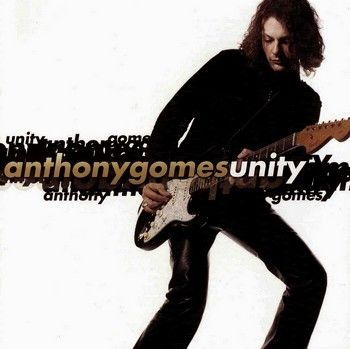
Anthony Gomes - Unity - 2002 - 33rd Street Records

Nashville's Anthony Gomes' follow-up to his Sweet Stringin' Soul CD of a couple of years ago is quite a blues record. While his second release showcased his considerable acoustic chops, Anthony lets loose with his Fender Stratocaster on his 33rd Street Records debut. That label is also home to Tommy Castro, and there are many similarities between Gomes' and Castro's work. They're both first-class guitar slingers that can write the blues as well as play them on screamin' Strats. Check out both versions of the funky title cut, or the Gospel-tinged "Going Down Slow," and you get the idea of Gomes' (as in homes) range up and down the fretboard. I liked Sweet Stringin' Soul for Anthony's command of acoustic blues, and I get up out of my chair when he tears it up on Unity. - Reviewed by Eric Steiner © 2002 - Eric Steiner http://www.cosmik.com/aa-october02/reviews/review_anthony_gomes.html

In 1998 Anthony Gomes earned Buddy Guy's Legends "Best Unsigned Blues Band" award. In 2003 he was voted Artist Of The Year in a Blues Wax magazine subscriber poll of over 70,000 members. BlueWaveBlog.com called him "one of the greatest guitar players on earth" and "future Grammy-winner. "Unity" is a great album of stylistic, high-energy, Texas and Chicago blues rock with lots of soul, R&B and some terrific funky grooves. The album is HR by A.O.O.F.C. Buy Anthony's great "Blues in Technicolor" album. Support real music and give great guitarists the recognition they deserve [All tracks @ 320 Kbps: File size = 123 Mb]

TRACKS

1. When The Walls Come Down
2. Upside (To The Downside)
3. Darkest Before The Dawn
4. Do Watchya Do
5. If You Could Rule The World
6. Blindog
7. Going Down Slow
8. Unity (Acoustiphonic Lo-Fi)
9. Unity
10. Trash Talkin' Jive
11. Lonely At The Bottom
12. Bad For You

All tracks composed by Anthony Gomes except "Lonely At The Bottom" by Anthony Gomes & Jim Peterik

MUSICIANS

Anthony Gomes - Guitar, Vocals
Biscuit Miller - Bass
Roosevelt "Hatter" Purifoy - Keyboards
Roger Femali - Drums
Glen Caruba - Percussion
Jimmy Bowland - Saxophone
Vinnie Ciesielski - Trumpet
Chris Rose -Trombone
Joan Collaso, Yvonne Gage - Backing Vocals

ABOUT ANTHONY GOMES

Canadian-born guitarist, singer, and songwriter Anthony Gomes is a critically acclaimed chart-topping artist who plays a style of modern electric blues that incorporates elements of rock, soul, R&B, and country. Born in 1975 in Toronto, Canada, to a Portuguese father and a Canadian mother, he began playing guitar in his early teens and moved to Chicago, IL, in the late '90s with hopes of establishing himself as a musician. After honing his craft on the Windy City club circuit, he moved to Nashville, TN, where he found a home for himself amid the city's renowned music scene. Gomes made his recording debut in 1998 on the Urban Electric label with Blues in Technicolor, followed by Sweet Stringin' Soul in 2000. In 2002 he switched to 33rd Street Records for Unity and proceeded to win the 2003 BluesWax Artist of the Year award. This accolade elevated Gomes to the top of the blues field, and consequently he was able to draw increasingly larger crowds to his live performances, which increased in frequency and scope. Though he didn't release another album until 2006, Gomes' endless touring kept him atop the blues field, as he continued to be nominated for BluesWax Artist of the Year awards several years in a row. Gomes' fourth album, Music Is the Medicine (2006), released on the Adrenaline Music label, was his first to chart, peaking at number four on the Billboard Top Blues Albums chart. During his supporting tour of the album, the February 27, 2007, show at the Triple Door in Seattle, WA, was recorded and subsequently released in 2008 as the album Live. It features his band, the New Soul Cowboys, comprised of David Karns (bass, vocals), Peter Lang (drums), and Dylan St. John (keyboards, vocals). The first of his albums to document his on-stage performance ability, Live was his greatest commercial success to date, reaching number one on the Billboard Top Blues Albums chart. © Jason Birchmeier © 2012 Rovi Corp | All Rights Reserved http://www.allmusic.com/artist/anthony-gomes-mn0000923481

BAND BIO

Here is a band that is moving rapidly into the future, but is experienced enough to learn from the masters of the past.Their music is a raw example of the old Delta-style blues mixed with some very original guitar phrasings. Anthony Gomes (lead singer and lead guitarist) formed a band that is infectious. They had their first public appearance in Chicago in April of 1997, and everyone in the industry was talking about the Anthony Gomes Band. In the spring of 1998 they took first place in Buddy Guy's Legends first annual "Best Unsigned Blues Band" competition, winning $10,000 in prizes. Guy himself was on hand to congratulate them. To be singled out as the top blues band in the Chicago area is a great honor that has helped gain them national and regional attention. Some of the national legends they have shared the stage with are Buddy Guy, Koko Taylor, Jimmy Johnson, Lucky Peterson, Eddie King, Smokin' Joe Kubek, Big Jack Johnson, Otis Clay, Eddie C. Campbell, Bar-Kays, Clarence "Gatemouth" Brown and Sugar Blue. In May of 1998, Anthony Gomes signed an endorsement deal with Fender guitars. In 1999, a custom model guitar was being manufactured to the artist's specifications. Gomes describes it as a cross between Albert Collins' and B.B.King's guitars, a set-neck, hollow-body Telecaster with Humbucking pickups on it. If you are searching for some of the hottest Delta-style blues music, blended with Texas blues guitar, done with a Jimi Hendrix finesse, and coming from a native Chicago blues band, then the Anthony Gomes Band is your answer. © Larry Belanger © 2012 Rovi Corp | All Rights Reserved http://www.allmusic.com/artist/anthony-gomes-band-mn0001358766

8.12.12

Steve Stevens

LINK
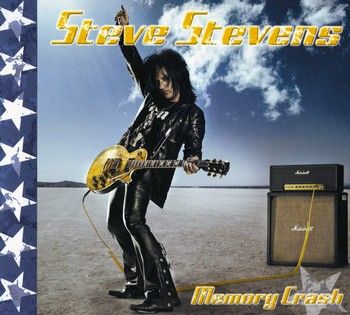
Steve Stevens - Memory Crash - 2008 - Magna Carta Records

The 1980s were littered with six-string shredders who pushed the instrument to the max in the realm of hard rock/heavy metal. But Johnny Thunders look-alike Steve Stevens (who gained great success and acclaim as the guitarist in Billy Idol's band) was the king six-stringer of the pop genre. And while he had reunited with Idol during the early 21st century, Stevens also managed to continue issuing solo albums on his own, as evidenced by the 2008 release Memory Crash. The mostly instrumental album certainly showcases Stevens' instrumental prowess, but also touches upon styles not usually associated with this mile-high-haired guitarist, including his love of vintage prog rock (namely, Yes). And there are flashes of Yes-like déjà vu, such as the Steve Howe-esque acoustic guitar included on the track "Prime Mover" (before leading into a carbon copy groove of Billy Cobham's "Stratus," off his classic 1973 release Spectrum). Elsewhere, you'll find a tune that would make Joe Satriani proud, "Hellcats Take the Highway," a kickass cover of Robin Trower's "Day of the Eagle" (which features a cameo by Doug Pinnick of King's X on vocals), and an album-closing acoustic ballad/love song, "Josephine." While he may not have racked up the amount of guitar magazine front covers as Steve Vai and Yngwie Malmsteen in the big '80s, Steve Stevens could certainly keep pace with the rest of the pack in the solo department. And this is proven once and for all with Memory Crash. © Greg Prato © 2012 Rovi Corp | All Rights Reserved http://www.allmusic.com/album/memory-crash-mw0000502191

With the exception of the balladic Track 10, this is a great guitar album from a very underrated musician. Try and listen to Steve's great "Flamenco A Go-Go" album [All tracks @ 320 Kbps: File size = 128 Mb]

TRACKS

1.Heavy Horizon 2:04
2.Hellcats Take the Highway 5:32
3.Memory Crash 5:06
4.Water on Ares 5:51
5.Day of the Eagle 5:46
6.Small Arms Fire 7:30
7.Cherry Vanilla 7:29
8.Joshua Light Show 1:52
9.Prime Mover 6:13
10.Josephine 6:22

All tracks composed by Steve Stevens except Track 5 by Robin Trower

MUSICIANS

Steve Stevens - Guitar, Bass (except Track 5), Vocals (Track 10)
Doug Pinnick - Bass (Track 5), Vocals (Track 5)
Brian Tichy - Drums, Percussion

BIO

One of the flashiest guitarists (both visually and instrumentally) to emerge from the '80s rock scene was Steve Stevens. Born in Brooklyn, New York, on May 5, 1959, Stevens first picked up the guitar when he was only seven years old, and later became an avid prog rock fan, especially the likes of Emerson, Lake & Palmer and Yes. Honing his craft while playing in Manhattan, Stevens recorded an unreleased album with his band, Fine Maribus, and also played as a session guitarist on Peter Criss' best forgotten second post-Kiss solo outing, 1982's Let Me Rock You (although Stevens did earn a songwriting credit for the track "First Day in the Rain"). It was also during the early '80s that Stevens hooked up with ex-Generation X singer Billy Idol, who had relocated to New York in hopes of launching a solo career. Idol found the perfect foil in Stevens, and with ex-Kiss manager Bill Aucoin backing them, Idol's career skyrocketed. Combining Idol's punk and Stevens' hard rock backgrounds with dance music, Idol became one of MTV's early video stars, as such albums as 1982's Billy Idol and 1983's Rebel Yell became blockbuster hits -- spurred on by Stevens' shredding guitar licks (and outrageous glam rock looks). It took an extended period for Idol and Stevens to offer a third album, 1986's Whiplash Smile, and although it was another big hit, Stevens longed to launch his own solo career, and exited Idol's band by the end of the decade. Stevens also remained an in-demand hired gun, as he guested on recordings by Michael Jackson (Bad), Ric Ocasek (This Side of Paradise), Thompson Twins (Here's to Future Days), and Robert Palmer (Don't Explain), among others. Additionally, Stevens appeared on the mega-selling 1986 soundtrack to the Tom Cruise movie Top Gun, for which he collaborated with keyboardist Harold Faltermeyer on "Top Gun Anthem" (which earned Stevens a Grammy Award for Pop Instrumental Performance that year). In 1989 Stevens formed his own group, Steve Stevens' Atomic Playboys, but despite all the hype, the band only lasted for a single release, Atomic Playboys. The early '90s saw Stevens keep up his busy schedule, as he attempted to form a new group with ex-Hanoi Rocks singer Michael Monroe, named Jerusalem Slim, which to the dismay of fans never got much further than the planning stages. In a strange twist of fate, Stevens then signed on to back ex-Mötley Crüe singer Vince Neil, the same man responsible for the dissolution of Monroe's previous band, Hanoi Rocks. Stevens hung in for an album, 1993's Exposed, and its supporting tour, before departing for greener pastures. Stevens finally got his chance to show off his lifelong appreciation of prog rock when he united with bassist Tony Levin and drummer Terry Bozzio in the bombastic outfit Bozzio Levin Stevens, issuing a pair of releases thus far -- 1997's Black Light Syndrome and 2000's Situation Dangerous. Around the same time, Stevens reunited with Idol, appearing alongside the singer on 2002's VH1 Storytellers, and also found time to issue another solo release, Flamenco A Go-Go. © Greg Prato © 2012 Rovi Corp | All Rights Reserved http://www.allmusic.com/artist/steve-stevens-mn0000754789

Bozzio Levin Stevens

LINK
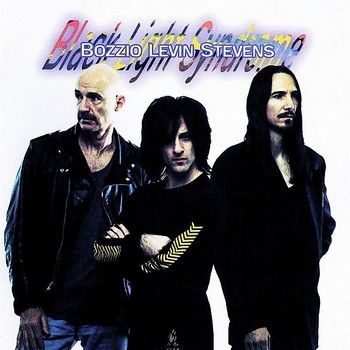
Bozzio Levin Stevens - Black Light Syndrome - 1997 - Magna Carta Records

This power trio has famous roots, and they've brought it all together masterfully. First cut "The Sun Road" starts off like a tune off of David Gilmour's first solo album and then vanishes into a driving, power-chorded surge of soulful rock. Next, "Dark Corners" is a massive rocker that pulls you under its powerful whirlpool of guitar/bass/drum frenzy. Stevens tortures the guitar into absolute submission without any predictable riffs. Levin looms everywhere, and Bozzio flows in a polyrhythmic jungle. Fine interactive tension and execution everywhere. This goes way beyond King Crimson's Red days. "Duende" opens with flamenco guitar firebursts, and slowly builds into a decent Spanish-flavored piece. Not my favorite, but well done. The title cut, "Black Light Syndrome," is obviously a play on "Bozzio Levin Stevens." It is a slower-paced dirge and filled to the brim with a variety of well-executed riffs, basslines, and drum tech. "Falling in Circles" is an early Floydscape dotted with Ronnie Montrose leads, a ballad of driving determination and resolve. Floods of Satriani, Wishbone Ash, Alvin Lee, Fripp, Buck Dharma, and even that Duane Allman tone. "Book of Hours" took me right back to Wheels of Fire's "Pressed Rat and Warthog," rainy-day dreamy afternoons with a fresh pot of designer coffee. Levin, Bozzio, and Stevens play off of one another precisely as one mind. On the last cut, "Chaos/Control," you hear that "E7 breakdown" from Hendrix's "Midnight" on War Heroes, and then a jazzy boogie in classic Frank Marino style is laid down. Stevens is a guitarist with a wide range of dynamics. © John W. Patterson © 2012 Rovi Corp | All Rights Reserved http://www.allmusic.com/album/black-light-syndrome-mw0000024495

A powerful progressive rock album from three of the greatest musicians in the rock/fusion genre. Listen to the trio's "Situation Dangerous" album [All tracks @ 320 Kbps: File size = 148 Mb]

TRACKS

1.The Sun Road 14:39
2.Dark Corners 8:32
3.Duende 7:26
4.Black Light Syndrome 8:45
5.Falling in Circles 9:08
6.Book of Hours 9:42
7.Chaos/Control 8:48

All tracks composed by Terry Bozzio, Tony Levin and Steve Stevens

MUSICIANS

Steve Stevens - Guitar
Tony Levin - Bass, Chapman Stick
Terry Bozzio - Drums

BIO

One of the more interesting bands to emerge on the Magna Carta label (a record co that specializes primarily in prog rock artists, especially collaborations/supergroups) is the aptly named Bozzio Levin Stevens. Featuring three players who many feel are at the top of their respective instruments in the rock world (drummer Terry Bozzio, bassist Tony Levin, and guitarist Steve Stevens), each member possesses quite a storied history. Bozzio first came to attention of rock fans as the drummer for Frank Zappa (appearing on such ‘70s-era classics as Zoot Allures, Zappa in New York, Sheik Yerbouti, etc.), before becoming a founding member of new wavers The Missing Persons, and a much sought after session man. Levin on the other hand, is primarily known as a session man (having played on such renowned albums as Paul Simon's Still Crazy After All These Years, John Lennon's Double Fantasy, Dire Straits' Brothers in Arms, etc.), but he's also been a long-standing member of Peter Gabriel's backing band, and was a member of King Crimson for an extended period as well. Like the others, Stevens has balanced his career between being a full time member of rock groups (he's best known as Billy Idol's right hand man on his best known albums, Billy Idol, Rebel Yell, and Whiplash Smile, as well as briefly working with Vince Neil), as well as session work (Michael Jackson's Bad, a Grammy award for his work on the Top Gun movie soundtrack, etc.). Never ones to pass on an opportunity to show off their immense instrumental prowess, the trio jumped at the chance to unite together and shred away. 1997 saw the release of the trio's debut album, Black Light Syndrome, which left prog rockers frothing at the mouth (especially since nearly all of the album's seven tracks either came close to reaching the ten minute mark). A supporting tour didn't happen, due to scheduling conflicts, but three years later, a sophomore effort was released, 2000's Situation Dangerous (an album that took only 14 days to record). It's anyone's guess as to when the trio will get around to issuing another recording -- as all three continue to have quite demanding recording schedules. © Greg Prato © 2012 Rovi Corp | All Rights Reserved http://www.allmusic.com/artist/bozzio-levin-stevens-mn0000096373

6.12.12

The Sidemen

LINK
The Sidemen - Dig In - 1999 - Kingnote

Unbridled enthusiasm seems to be in short supply these days. Oh, there's plenty of confidence and skill, and lots of "positive thinking." But straight up, do-what-I-gotta-do-because-I-can't-stop enthusiasm is a delight to be savored, and it's what makes talking to the Sidemen's Paul Reddick such a good time. For seven years Reddick has been singing and playing the harp for Toronto's Sidemen, who pump out hardcore roots blues with stunning fervor for a bunch of white boys. And despite the fact that they're currently hyping their third CD, Dig In (Kingnote/Festival), Reddick doesn't mince his words when he's talking about the band's raison d'être -- playing live. "We make the CD in order to play," says Reddick. "There's no question that it's about hit singles, because they don't play blues on the radio, except for college radio or the CBC. It's like, 'OK, let's make a record. Let's do something interesting that will be different from our live show -- and then let's play.' "Anyone who's seen the band's live show can attest to their energy. The foursome -- Kyle Ferguson on guitars, Vince Maccarone on drums, Reddick on vox and harmonica and new member Fergus Marsh on Chapman stick and bass -- whip it up with abandon. Traditionally, their approach on record has been to capture the energy and do some exploring. The independently produced Dig In doesn't stray too far from its rootsy home. Still, tape loops and funk grooves add a fresh dimension that's not always found in a genre that seems more than most to be stuck in the past. "Our approach has always been pretty aggressive," says Reddick. "There certainly seems to be a movement in blues to be traditionalist -- trying to sound like someone who's already done something, to take all your references from Howlin' Wolf and Muddy Waters and those guys." Unlike the Sidemen's first two records, recorded in two days and five days, respectively, Dig In unfolded over the course of an entire year. It gave the band a chance to savor a compendium of source material. The sound is fresh, like folks who are going to do something instead of folks who already have. "We put down lots of different sounds, and tried to have a lot of different source materials," says Reddick. "And then we improvised." The record features guest performances by violinist Hugh Marsh (the equally virtuosic brother of the band's Fergus Marsh, who's also Bruce Cockburn's longtime bassist), guitarist Michael Occhipinti and members of the horn section of NOJO. Reddick laughs and asks where to begin when asked about the skills and energy Fergus, who joined the Sidemen a year ago, brings to the band. "Well, he is a virtuoso. In the past, most of the fancy playing fell to Kyle and me. And now there's Fergus. What can I say? He's very heavy and he's very great. Kyle and I just look at each other and laugh when we watch him. It's ridiculous." Reddick contributes to a lot of the songs on Dig In, and he doesn't say whether he sweats over the songwriting process. But for at least one song, he almost bled. It seems he was caught without the tape recorder he usually carries to record riffs and songs as they come to him. Inspiration struck suddenly on the 401, and Reddick pulled over to a smalltown gas station, planning to hum the riff over the phone to his answering machine. But local bruisers had another idea. "These guys in an old Chevy started revving the engine really loud. So I got out and said, 'Can't you guys be quiet?' We almost got into a fight, but I had to keep humming so I wouldn't forget it. It was a good groove. I guess I should have been more polite. They wanted to kill me." With a new baby at home, Reddick might be a little old for fistfights. But then there's the beauty of never being too old to sing the blues. "Yeah, I feel like the older I get, the better I get," Reddick says. "Plus it's the type of music where you don't always make a living at it. We just do it because we love doing it." The Sidemen celebrate the release of Dig In at the Silver Dollar Thursday, Friday and Saturday (April 15-17). - from The Sidemen give it up live - BY & © CINDY MCGLYNN © 1991-2007 Toronto Star Newspapers Limited http://contests.eyeweekly.com/eye/issue/issue_04.15.99/music/indieeye.php

This is an exceptional effort, recalling British blues at its most inventive — skin-tight rhythm, blistering guitar, haunting harp and explosive keyboards built around a central figure with enough swagger to pull it all off. Surely one spin of "Bye Bye, So Long" captures a funked-up rock spirit that refuses to quit. Paul Reddick is a man of a hundred voices: Fred Neil ("You Will Know"), John Mayall ("Night Came Down"), Stevie Winwood ("Seven Angels") to name a few. Yet this album is such a collective of styles and influences, it’s a truly esoteric outing. There are some stiff moments, such as "That Train" and "When You Call" where Reddick sounds like David Clayton-Thomas wallowing on the lounge circuit. The band's version of Son Seals' "Bad Axe" falls flat in the middle of a dated-sounding electric violin solo. Yet, the still-experimental sounds of Fergus Marsh's Chapman Stick, and the unique horn arrangements take the band off into exciting new turf. The Sidemen's rhythm is king throughout this album and special attention must be given to the guitar muscle of Kyle Ferguson, who can't play enough. The pure blues feel of Homesick James' "Driving Dog" and Muddy Waters' "You Gonna Need My Help" reveals the Sidemen's untapped well and greatest potential, but Dig In suggests there's lots of room to move in what we've come to expect from this talented local band. By & © Eric Thom © http://exclaim.ca/Reviews/FolkAndCountry/sidemen-dig_in

A good roots blues and soul rock album with some great funky grooves throughout. Listen to The Sidemen's great "Rattlebag" album [All tracks @ 320 Kbps: File size = 112 Mb]

TRACKS / COMPOSERS

1. Seven Angels - Ferguson, Marsh, Reddick
2. Inside Information - Ferguson, Marsh, Reddick
3. You will Know - Reddick
4. Bye Bye, So Long - Ferguson, Marshak, Reddick
5. Night Came Down - Ferguson, Reddick
6. That Train - Marsh, Reddick
7. Bad Axe (Part II) - Son Seals
8. Goin' Downtown - Reddick
9. When You Call - Marsh, Reddick
10. It's Alright - The Sidemen, Marshak
11. Drivin' Dog - Homesick James
12. You Gonna Need My Help - McKinley Morganfield (Muddy Waters)

BAND

Kyle Ferguson - Guitars
Michael Occhipinti - Guitar
Fergus Marsh - Bass, Chapman Stick
Vince Maccarone - Drums, Percussion
Paul Reddick - Harmonica, Vocals
Hugh Marsh - Violin
Members of the horn section of NOJO

Robben Ford

LINK
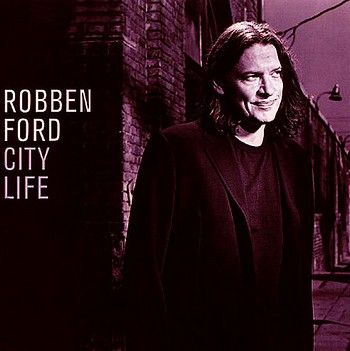
Robben Ford - City Life - 2006 - West Wind

Strictly speaking, this is not a true Robben Ford studio album. The tracks are a mix of traditional and improvisational jazz recorded in 1988 and 1992 in Seattle's London Bridge Studios. The material includes music originally recorded by artists like Screamin' Jay Hawkins, Johnny Hodges, Ornette Coleman, Charlie Parker, and others. Although Robben plays on all tracks, Bill Frisell plays guitar on five tracks. Charlie Haden plays bass on two tracks, and Anthony Cox plays bass on three tracks. Other musicians include Jerry Granelli on drums and Kenny Garrett on alto sax. The album is really a group effort. Tracks 4-8 are already available on Jerry Granelli's "A Song I Thought I Heard Buddy Sing" album. Also, this album was released in 1988 by Robben Ford under the title, "Blues Connotation". This is not a new Robben Ford release and is definitely not blues based. Having said that, the musicianship on this album is excellent and taken by itself a very good album, but don't be ripped off into buying this album if you already have the other two albums mentioned [All tracks @ 320 Kbps: File size = 127 Mb]

TRACKS / COMPOSERS

1. City Life - Jerry Granelli
2. One Day At A Time - Jerry Granelli & Charlie Haden
3. I Could See Forever - Denny Goodhew
4. Wanderlust - Johnny Hodges
5. Billie's Bounce - Charlie Parker
6. I Put A Spell On You - Screamin' Jay Hawkins
7. Blues Connotation - Ornette Coleman
8. Blues Connotation Reprise - Ornette Coleman

MUSICIANS

Robben Ford - Guitar on Tracks 1-8
Bill Frisell - Guitar on Tracks 4, 5, 6, 7, 8
Charlie Haden - Bass on Tracks 2, 3
Anthony Cox - Bass on Tracks 4, 5, 6
J.Granelli - Electric Bass on Track 7
Jerry Granelli - Drums, Synthesiser on Tracks 1, 6: Drums on Tracks 2, 3, 4, 5, 7, 8
Ralph Towner - Synthesiser on Track 2
Kenny Garrett - Alto Saxophone on Tracks 4, 5, 6, 7, 8
Julian Priester - Trombone on Tracks 2-8

5.12.12

John McLaughlin

LINK
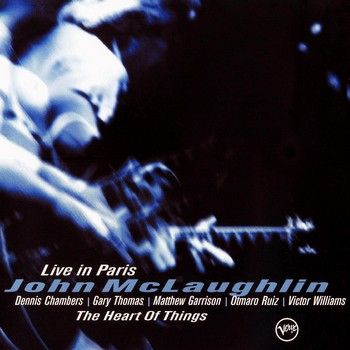
John McLaughlin - The Heart Of Things: Live In Paris - 2000 - Verve

"...A band of blowers without apology, and each gets a chance to show his stuff....affirming the fact that McLaughlin remains one of our greatest living guitarists..." - JazzTimes - 12/00, pp.100-1

John McLaughlin's 1997 The Heart of Things studio album and subsequent tour saw him returning to the sort of electric band format that most listeners associated with his days in the Mahavishnu Orchestra of the 1970s. This live album features the same group, with the exception of the keyboard player, as Otmaro Ruiz replaces Jim Beard, and three of the selections are drawn from the studio release. "Seven Sisters," which is actually shorter than the studio version, makes for a fairly mellow opening, while the new "Mother Tongue" is full of extremely rapid solos by McLaughlin, Ruiz, bass player Matthew Garrison, and Gary Thomas, who switches saxophones during the course of the nearly 13-minute tune. "Fallen Angels," another song from the studio release, is a slow, contemplative work, while "Divide" makes use of funk rhythms to support some noisy guitar work from McLaughlin and a solo full of electronic burps from Ruiz. The album's showpiece song is "Tony," a stately tribute to the late drummer Tony Williams that, appropriately enough gives drummer Dennis Chambers his chance to shine. One might complain that "Acid Jazz," the fiery closer, has nothing to do with the musical style that goes by that name, but McLaughlin obviously means to suggest an evolution of 1960s acid rock by the title, and he deliberately evokes Jimi Hendrix in playing that brings him as close to the Mahavishnu Orchestra sound as he has been in many years. It makes a powerful ending to an album that should be welcomed by long-time fans. (As if to emphasize that this was only one of his interests, however, McLaughlin simultaneously released both this disc and The Believer, an album with his Indian unit Remember Shakti, on October 3, 2000.) © William Ruhlmann © 2012 Rovi Corp | All Rights Reserved http://www.allmusic.com/album/the-heart-of-things-live-in-paris-mw0000070500

Guitar legend John McLaughlin has played every musical style over his long career, always creating innovative music. "The Heart of Things Live in Paris" recorded at La Cigale, Paris, on November 4th and 5th, 1998 is one of John's most dynamic albums in which he performs a no-holds barred performance of electronic fusion at it’s best, accompanied by brilliant musicians that include bassist Matthew Garrison, and Dennis Chambers on drums. John McLaughlin is one of the most versatile guitarists in music today, and like the magnificent Jan Akkerman has maintained his reputation as one of the world's greatest living guitarists. This album is HR by A.O.O.F.C. Listen to The Free Spirits Featuring John McLaughlin's wonderful "Tokyo Live" album. Support real music [All tracks @ 320 Kbps: File size = 175 Mb]

TRACKS

1 Seven Sisters 8:30
2 Mother Tongues 12:57
3 Fallen Angels 10:33
4 The Divide 16:41
5 Tony 13:56
6 Acid Jazz 14:53

All tracks composed by John McLaughlin except Track 4 by Gary Thomas

MUSICIANS

John McLaughlin - Electric Guitar
Matthew Garrison - Bass Guitars
Otmaro Ruiz - Keyboards
Dennis Chambers - Drums
Victor Williams - Percussion
Gary Thomas - Tenor & Soprano Saxophone

SHORT BIO

From Al DiMeola, Pat Metheny, and Mike Stern to John Scofield, Bill Connors, and Scott Henderson, John McLaughlin has been a strong influence on many of the top jazz/fusion guitarists of the last 30 years. McLaughlin's classic recordings of the 1970s have long been regarded as essential listening for anyone with even a casual interest in fusion, and if the British improviser had decided to retire in 1980, he still would have gone down in history as one of jazz-rock's most influential axemen. Born in Yorkshire, England on January 4, 1942, the guitarist is well known for his eclectic taste in music. McLaughlin was a child when he first fell in love with jazz and the blues, and he was just 11 years old when he began studying and playing the guitar. The 1960s found him playing jazz, rock, and blues in his native England, where he worked with Alexis Korner and Ginger Baker, among others, before moving to New York at the end of the decade. McLaughlin had a busy year in 1969 he recorded his debut album, Extrapolation, and started working with two seminal voices in early fusion: Tony Williams (who employed McLaughlin and organist Larry Young in his trailblazing group Lifetime) and Miles Davis. Never afraid to forge ahead, Davis had done a lot to popularize cool jazz and modal post-bop in the past and he continued to break new ground when he introduced fusion on his 1969 sessions In A Silent Way and Bitches Brew, both of which feature McLaughlin's playing. The guitarist was also featured on 1970's A Tribute To Jack Johnson, another Davis gem of the time. Like bebop in the 1940s and modal jazz in the early 1960s, fusion was controversial. Jazz purists felt that rock and funk rhythms had no place in jazz, but thankfully, McLaughlin disagreed and let his musical instincts guide him. After participating in Davis' and Williams' groundbreaking fusion combos, McLaughlin founded an influential group of his own in 1971: The Mahavishnu Orchestra, which boasted such greats as drummer Billy Cobham and keyboardist Jan Hammer. By the time Mahavishnu broke up in 1975, it had recorded several classic albums for Columbia (including Birds of Fire, Between Nothingness and Eternity, and Visions of the Emerald Beyond) and gone down in history as one of the 1970's most influential fusion outfits. In 1975, McLaughlin did the unexpected by founding Shakti, an acoustic group that employed traditional Indian musicians (including tabla player Zakir Hussain and violinist L. Shankar, Ravi Shankar's nephew) and underscored the guitarist's interest in India's music, culture, and religion. Shakti reminded listeners that McLaughlin was as appealing on the acoustic guitar as he was on its electric counterpart, and proved that he wasn't about to confine himself to playing any one style of music exclusively. Indeed, McLaughlin was heard in a variety of musical settings in the 1980's everything from a brief Mahavishnu Orchestra reunion in 1984 to an acoustic guitar summit with Al DiMeola and Paco de Lucia in 1982 to a classical album with the London Symphony Orchestra in 1988. McLaughlin was no less eclectic in the 1990s, when his Verve projects ranged from 1993's acoustic Time Remembered: John McLaughlin Plays Bill Evans (a tribute to the late pianist) to sessions featuring organist Joey DeFrancesco (1993's Tokyo Live and 1994's John Coltrane-minded After the Rain) to an acoustic McLaughlin/DiMeola/de Lucia reunion in 1996. It was in 1997 that McLaughlin reunited with Zakir Hussain and a reconfigured version of Shakti for several U.K. concerts that were documented on Verve's two-CD set Remember Shakti. "I'm a guitar player that's what I am primarily, that's what I'll always be," McLaughlin has been quoted as saying. "(And) I'm an eternal learner. I don't want to stop learning because I feel that no matter what I've done, I'm really just beginning again. I don't think I'll ever stop learning." © 1999 - 2012 Verve Music Group http://www.vervemusicgroup.com/johnmclaughlin/bio/

4.12.12

David Hines

LINK
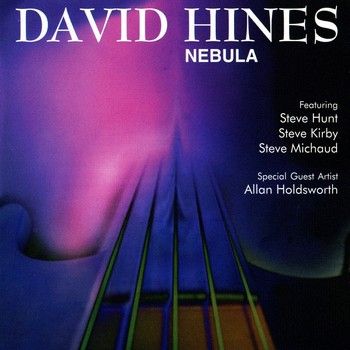
David Hines - Nebula - 2005 - Spice Rack Records

"In a time where technology and the sciences have evolved so dramatically, the acceptance and support for alternate forms of music must eventually rise to that more elevated level, as well." - David Hines

This is the first album as a leader by American bassist David Hines. Hines and his collaborators are all accomplished sidemen and session players in the jazz and fusion scenes and although they may not be household names, they bring a wealth of technical skill and academic pedigree to the recording of Nebula. Fusion guitar legend Allan Holdsworth sits in for two tracks, presumably to lend some name recognition to the project. Nebula is a fusion album that leaves no mystery as to Hines' primary sources of inspiration — it's a concerted effort to sound like it was made in the mid-1970s and is strongly influenced by Al DiMeola-era Return to Forever, though without as much flash or bombast. There are also shades of Weather Report, and I hear a bit of Holdsworth-era Gong as well, though that could simply be the result of Holdsworth's presence here. These are pretty lofty aims but the group does deliver, at least on the technical aspects. This is a tasteful, well-played album and the group moves fluidly through the tricky compositions. My chief complaint would be that I don't find any particular composition to be all that memorable — they're set at about the same tempo (except for "Lucia," which is slower and more lush), all use similar instrumentation and all do similar things. The album successfully transports the listener back into another era but, for me at least, it doesn't stay in my head when I'm not playing it. Still, if you've burnt out on your Return to Forever records and are craving a fusion fix, Nebula will give you something to chew on. And Allan Holdsworth devotees now have a new title to track down. review by & © Matt P. — 10-26-06 — © ground and sky 1999-2008 http://webcache.googleusercontent.com/search?q=cache:c-ukU1cI6DQJ:www.progreviews.com/reviews/display.php%3Frev%3Ddh-neb+david+hines+nebula&cd=5&hl=en&ct=clnk&gl=ie

Back in the '70s, the US bassist and composer David HINES attended both the Berklee College of Music and the Manhattan School of Music, and also received private instruction from Stanley Clarke (of Return To Forever and solo fame) on bass and composition. "Nebula" is the debut solo album by David, featuring guitarist Steve Kirby, drummer Steve Michaud, keyboardist Steve Hunt (who worked with Billy Cobham, Allan Holdsworth and Stanley Clarke) and the famous guitarist Allan Holdsworth (Tony Williams Lifetime, Tempest, Soft Machine, Gong, UK, Bruford, solo). Among his principal musical influences, Mr. Hines lists Miles Davis, Weather Report and Return To Forever, but only the name of Chick Corea's ensemble occasionally comes to my mind when I listen to "Nebula". Overall however, this stuff is so unique that any common comparisons would be redundant regarding it. It's not the outfit's declining to use the riffing structure of Return To Forever or The Mahavishnu Orchestra, and it's not the absence of brass instruments (which are an essential part of Miles Davis's creation) or swingy rhythms (typical for Weather Report) here that determines the originality of this music. It was primordially original in conception and was later arranged without appealing to conventional methods. Well, the style of Allan Holdsworth, who plays on the album's boundary tracks: Skippy and Antillia, is immediately recognizable, but even the former composition (the only that features Allan as a main soloing force) has no derivative sense. All in all, "Nebula" isn't Jazz Rock, but is a confluence of that genre and Progressive Rock, which is Jazz-Fusion, and it's not your typical, average Jazz-Fusion, but is its highly innovative emanation, created by extremely inventive and masterful musicians. The album is stylistically monolithic and pretty uniform structurally, too. All eight of the compositions are notable for up-tempo, dense, intense, nearly ever-changing arrangements, although precisely half of them: Skippy, the title track, No Loops and Lucia feature episodes (kind of David's benefit performances) with some more transparent atmosphere and the bass improvisations coming to the fore either alone, which happens more often, or along with solos of classical guitar and passages of piano, such as on the latter piece. At times, David switches to fretless bass, obvious by its unique sound, which, however, fits idiomatically right into the musical scheme. No Loops is especially eloquent in this respect. All four players are at the top of their activity practically throughout, although keyboardist Steve Hunt a bit more often shines in a primary solo role, imparting a lushly saturated symphonic-like feel to the overall picture. One of the most amazing aspects of this music is that it's neither anxious nor affirmative. What is more, it's filled with plenty of different moods, all exciting, but almost none of which belongs to the traditional spectrum of emotions, which may take place only in the spheres of improvisational or avant-garde academic music. Well, Q, Lucia and Neuro Man will bring to you some more or less recognizable moods, but anyway, you will hardly be able to precisely determine whether they're dark or only dramatic in character. While all the basic themes are carefully composed, they shift very frequently, which, being raised to the power of authentic improvisations, tirelessly crossing the length and breadth of those, makes the music extremely intricate, demanding a meticulous attention from the listener and leading him to have many happy returns to the album. Yes, I am asserting that this disc will never become tiresome. All of the compositions are brilliant, showcasing the superbly tight and diverse, truly ensemble work in the arrangement and in the performance, which more than vastly distinguishes David Hines's debut outing from the average solo album. All you need to love this stuff is a minimal knowledge of an improvisational harmony or at least a correct perception of it, though for many of you, "Nebula" might become that essential bridge between symphonic and jazz music, which will lead you to the wonderful (and highly progressive) world of classic Jazz-Fusion. Along with "Progressivity" by Tunnels, this is one of the best and the most memorable works of the genre I've heard in recent years and is an undoubted candidate to take one of the highest positions in my Top-20-2005. Ultimately recommended. © VM: June 23, 2005 © http://www.progressor.net/review/david_hines_2005.html

David Hines is much more than just a great bass player: he is a great composer. Dave has just released, Nebula, one of the freshest and tastiest fusion albums of the year! What is so refreshing is that the entire album burns and turns around every melodic and rhythmic corner. Dave's bass playing is phenomenal. Check out his basswork on "Lucia" and "No Loops". Every composition on the cd, without exception, breathes with deep inspiration and super confidence (the hallmarks of all great music). Plain and simple: this is a great cd! To top it off, the legendary, Allan Holdsworth, blazes his signature style over the opening and closing tracks, "Skippy" and "Antillia". Perhaps the key to producing such a successful sounding debut recording is the combination of great engineering by keyboard player, Steve Hunt (who also plays on the cd and is a long time Holdsworth alum) and the awesome guitar work of Steve Kirby, along with the imaginative drumming of Steve Michaud (holy shit Steve, where have you been?...tasty, tasty chops). With Dave's tightly composed tunes, all the musicians come together to create an exciting atmosphere that is reminiscent of classic bands such as Weather Report, Return to Forever, and the Mahavishnu Orchestra. The biggest melodic surprise on the album is the ingenious soloing by guitarist, Steve Kirby (http://www.stevekirby.com/). With a heavy lean toward the Holdsworthordian school of guitar playing, Steve flows and rocks with his own original style. Check out his solos on "Q" and "Toe Nail". As one of the best keyboard players in the world, Steve Hunt is reknowned for his innovative style. In addition to playing with Holdsworth for many years, Steve has worked with artists such as Stanley Clarke, Billy Cobham and Gregg Bendian, to name a few. Steve adds a tremendous variety of tone, color and melody to the "Nebula" cd and his role as producer/engineer really makes all the music shine. "Nebula" is a truly remarkable debut cd for David Hines. It showcases his talent as both bassist and composer. Every jazz-rock fan who yearns for that delicious fusion of creativity and virtuosity will love it. "Nebula" transcends imitation without compromise! 100% inspiration! I really look forward to album number two! Five stars on this one! ***** - from Fusion At It's Finest by & © John Pritchard © http://www.jazz-rock.com/artists-DH.html

"Sometimes you know immediately when something is right. When David came to my studio and played me the tracks of his new fusion endeavor that's just the way I felt. This stuff is killin!" - Steve Hunt

When the great Virginian bassist David Hines played keyboard wizard Steve Hunt some of the demos for this album, Steve offered to produce and play on the entire album. Steve then asked the brilliant fusion guitarist Allan Holdsworth, his old band mate, to play on two tracks, and also drummer Steve Michaud, who had played on Steve's two previous solo albums. Bostonian guitarist Steve Kirby also features prominently on this impressive debut album. Listen to David's "Inner Duality" album and promote great fusion [All tracks @ 320 Kbps: File size = 116 Mb]

TRACKS

1. Skippy 5:01
2. Q 4:58
3. Toe Nail 5:16
4. Nebula 6:57
5. Lucia 8:01
6. No Loops 5:07
7. Neuro Man 6:29
8. Antillia 8:13

All tracks composed by David Hines

MUSICIANS

Steve Kirby - Guitars
Allan Holdsworth - Electric Guitar soloist on Tracks 1, & 8
David Hines - Basses
Steve Hunt - Keyboards, Piano
Steve Michaud - Drums

ABOUT "NEBULA" BY DAVID HINES

"Hi, my name is Dave Hines, bassist-composer. I have been in the music scene on the East Coast for some 30 years, and have finally been able to get a jazz rock album off the ground. Coming out of Berklee School of Music, and the Manhattan School of Music, Most of the Fusion Stars , (including my former bass teacher, Stanley Clarke), were generally about 5 or more years older than me, or more. When I felt musically mature enough to try and tackle this music, it went away. It was replaced with smooth jazz , as the alternative to traditional jazz, which, to me was much less interesting from a harmonic, melodic, and rhythmic standpoint. In fact I quit music for about 5 years and sulked, but then realized that I was not very happy with that, so I dabbled in R+B originals, got into traditional type jazz gigs playing fretless, and keyboard gigs as well. The more I was playing keyboard, the better for my songwriting. I got back on the bass, and I had no problem being in some very cool, groove-oriented bands, especially when I found myself back in Boston. However, there was still the jazz-rock side of me, wanting to come out. I realized that with all the musicians in the Boston area, I could take a chance, and get back into writing my favorite type of music, and find people to play it. (Being that the music was so ill-supported for a while, I could never find more than 1 or 2 players in any given area). I got 8 tunes together, and primarily with the help, and direction, of Steve Hunt, proceeded to record the album of my dreams. I had heard Steve before with Alan Holdsworth, and I knew from the start, what a lucky thing it was for him to like my songs enough to perform, record, and produce the material. Then, with the help of Billboard jazz songwriting winner-guitarist Steve Kirby, drummer Steve Michaud (legendary fusion drummer recommended by Steve H.), and of course, the legendary Allan Holdsworth on guitar, the jazz rock album of my dreams came to be. This thing is fresh out of the studio, that is why we don' t have a tour yet, however interest for one is currently being generated in Europe." - DAVID HINES talking about "NEBULA" - © David Hines © http://www.jazz-rock.com/artists-DH.html

SHORT BIO

Born to famous Opera singers Jerome Hines and Lucia (maiden name) Evangelista. He played piano and cello as a child, then pursued electric bass and guitar from age 11 on. Pursued his music education, attending Berklee College of music, Manhattan School of music, and receiving private instruction from Stanley Clarke on bass and composition back in the seventies. Dave was principally interested in the fusion music of Miles Davis, Weather Report, Return to Forever, and others. Dave went on to promote fusion music, playing with George Johnson ( from Lonnie Smith, Mcoy Tyner) and other fusion projects all along the way. Recording credits include Pamela Hines and Boston bandmate Miles Donahue. He is currently private teaching and performing in Virginia Beach, Virginia, and living there with his wife Pamela (jazz pianist), and his Daughters Katrina and Gabriella. This is his first solo album, and is is currently writing for album number 2. visit Dave's official website:www.davidhines.com © http://www.jazz-rock.com/artists-DH.html

2.12.12

Elements

LINK
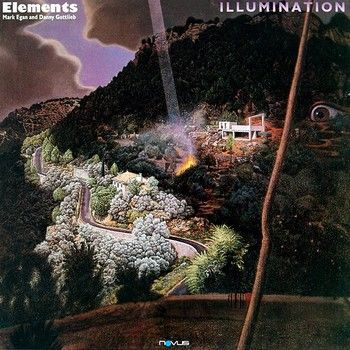
Elements - Illumination - 1988 - Novus

Starting with their days at the University of Miami in the early '70s and continuing during their period with Pat Metheny, bassist Mark Egan and drummer Danny Gottlieb have been longtime friends. Mark Egan was in Pat Metheny's band from 1978-1980, while Danny Gottlieb stayed until 1983. In 1982, Danny and Mark formed the jazz fusion band, Elements, which, from the beginning, also included Bill Evans on saxophone and keyboardist Clifford Carter. The great guitarist Steve Khan, keyboardist Gil Goldstein, several percussionists, saxophonist David Mann, and other great musicians have been guests on their albums. Elements' music is a subtle, creative, and thoughtful form of fusion. Try and listen to Elements' brilliant "Untold Stories" album [All tracks @ 320 Kbps: File size = 112 Mb]

TRACKS / COMPOSERS

1 Hymnalayas - Egan, Gottlieb 6:47
2 Walk In - Egan, Gottlieb 6:38
3 Mandala - Egan 6:20
4 Illumination - Egan 7:36
5 The Seeker - Carter 5:45
6 1000 Words - Egan 5:42
7 Go Ahead Stan - Egan, Gottlieb 6:00
8 Sunken Cathedral - Egan, Gottlieb, Evans, Carter 6:36

MUSICIANS

Steve Khan - Guitar on tracks 2,4,6
Stan Samole - Guitar on track 7
Mark Egan - Bass on all tracks: Keyboards on track 1
Clifford Carter - Keyboards on all tracks
Danny Gottlieb - Drums on all tracks: Percussion on tracks 1,3,4,5: Tabla [Dynacord] on track 7
Bill Evans - Saxophone on tracks 3,4,5,8

26.11.12

Monti Amundson

LINK
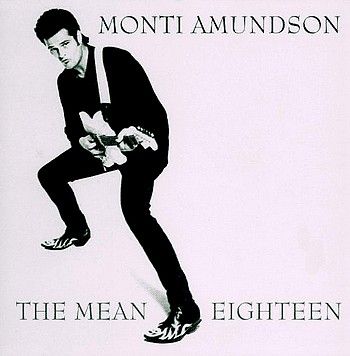
Monti Amundson - The Mean Eighteen - 1993 - Munich Music

His name is Monti Amundson but most people call him Big Monti. Not just because of the man’s physical appearance, but because of his larger than life voice, guitar virtuosity, and sheer presence. When Big Monti takes the stage, it’s clear that there’s more going on than the usual extended guitar solos – the man plays and sings larger than life. Monti’s breakout band, The Blubinos (pronounced blue-bye-nose), were a dominant force in the Northwest music scene from 1987 to 1992 and shared concert stages with some of the biggest names in the business, including John Lee Hooker, Johnny Winter and Buddy Guy. In 1991 The Blubinos won Portland Music Association’s award for “Outstanding Blues Act”. In 1993 Monti signed on with Munich Records in Holland and promptly moved his headquarters to Amsterdam. Over the next six years Monti recorded five albums and toured extensively in Europe, developing a huge fan base. When Monti gets compared to Stevie Ray Vaughan or Johnny Winter he just says “thank you”. The fact is, the big man has his own style. “I’m a blues guitar player in a band that plays rock n’ roll,” is how Monti explains it. He doesn’t so much as straddle the line between the genres as bend it, ignore it, or race back and forth across it until both sides go up in flames. The blues of Big Monti comes straight from the heart, cuts through your soul and is as real as it gets. © 2009 Silverback Management & Monti Amundson http://www.montiamundson.com/bio.php

When Monti Amundson gets compared to Stevie Ray Vaughan or Johnny Winter he just says thank you. But the fact is the big man has his own style. His influences range from the aforementioned and fellow Texas rocker Billy Gibbons to B.B. King and rock legends Jimi Hendrix and Jeff Beck. The blending of these styles in combination with Amundson’s vocals is what makes him unique. Above all Monti Amundson is a great live performer who gets his point across. Whether it’s an acoustic slide number or an all out show stopper, Amundson knows how to move a crowd. Known to live out of a suitcase for years at a time, Amundson’s music has already made a great impression throughout Europe. In his home base Portland, Oregon his music has been highly valued for almost twenty years. The blues of Monti Amundson comes straight from the heart, cuts through your soul and is as real as it gets. © 2012 Last.fm Ltd. All rights reserved http://www.last.fm/music/Monti+Amundson

The 18 songs here (including 12 studio tracks from the "Straight Out!" and 6 bonus tracks from a live show at Key Largo in Portland) were penned by the great Monti Amundson, a veteran of the same Eugene to Portland I-5 axis that spun off bands like the Robert Cray Band, the Jackals, and Johnny and the Distractions. Monti sounds like a rough-and-ready rock'n'roll Everyman, except that not every man can play like this. Monti says "I'm a blues guitar player in a band that plays rock'n'roll," but Monti's music covers many genres of music and the rhythm team of bassist Debbie Smith and drummer Cory Burden struts, slams and shuffles with the best in the business. Monti and the band revs up the smoky soul of barn-burning Texas blues and translates it into their own take of great rock'n'roll music. Monti is often likened to to Stevie Ray Vaughan and Johnny Winter. He may not be as good a guitarist as these two legends, (few are), but he can still play some killer guitar and is a great songwriter. "The Mean Eighteen" is HR by A.O.O.F.C. Monti Amundson should be far better known than he is. Buy his great "Man On The Floor" album and support great blues rock. "MOTF" was recently on sale used on Amazon @$7.37 and is a real bargain. Check out Monti's website @ http://www.montiamundson.com/ [All tracks @ 320 Kbps: File size = 137 Mb]

TRACKS

1 Take A Walk 3:44
2 Cruel Is Your Name 4:12
3 Ninety-nine Below 2:46
4 Shake A Leg Meg 2:30
5 Lesson Or Two 3:13
6 I'm Wrong 3:25
7 Sin No More Blues 3:55
8 Female Dictionary 3:16
9 Purple Heart 2:52
10 In Over My Head 3:42
11 Big Block Rock 3:01
12 Broke Down Car 3:03
13 Rock Treatment 3:53
14 Brain Grenad 3:12
15 Red Hot Wire 2:59
16 Not A Day Goes By 3:38
17 Bad Day Rough Week 2:57
18 Lightning Strikes 3:11

All tracks composed by Monti Amundson

BAND

Monti Amundson - Guitar, Vocals
Debbie Smith - Bass
Cory Burden - Drums

BIO (WIKI)

"Big" Monti Amundson is an American guitar player who plays blues and rock and roll. His style has been compared to that of Stevie Ray Vaughan, and while commercial success has eluded him, he has built a reputation as a live act in the United States and in Europe, first as a power trio called Monti Amundson & The Blubinos, then under his own name. Amundson's first band was The Blubinos, variously marketed under that name and as Monti Amundson & The Blubinos. Besides Amundson, the band consisted of Debbie Smith (bass) (later replaced by Stan Becraft, then Johnny Wilmont) and Cory Burden (drums), and played Texas blues in clubs in Eugene, Oregon, from the 1980s on. The band recorded half a dozen records in Portland and Eugene, and was signed to a Dutch label after the second album, Mean Eighteen. The band played a farewell show in Eugene in 1992, but recorded two more albums until 1997. Distribution in the United States was problematic, and Amundson was so frustrated that in 1997 he had bootlegs printed of his own Man on the Floor to sell at shows in the US ("Man, I've done some bone-head shit in my time," as he later acknowledged), which led to a conflict with his Dutch company which, in the end, was amiably settled. Bothered by personal problems and a lack of commercial success, he was without record deal and didn't record any albums between 2000 and 2005, when he hooked up with Billy Triplett, a Portland studio engineer, and recorded Big Monti, now without the Blubinos, which was released in 2005. A side project of his is the Sultans of Slide, a group of slide blues guitar players that performed occasional shows starting in 2009, when it consisted of Amundson, Franck "Paris Slim" Goldwasser, Jim Mesi, Bob Shoemaker, and Ben Bonham. In 2011, the Sultans of Slide consisted of Amundson, Henry Cooper and Goldwasser, and released a record, Lightning Strikes, which was promoted with a tour in Europe. In 2010 he released a 4-CD compilation, gathering "30 years of songwriting"; he noted that he's been writing the same song since he was thirteen and penned "Woman": "I've been writing pretty much the same song ever since. Yeah, there's broke down cars and drinking songs, but mostly it's about love and loss. I've had both in spades."

Doyle Bramhall

LINK
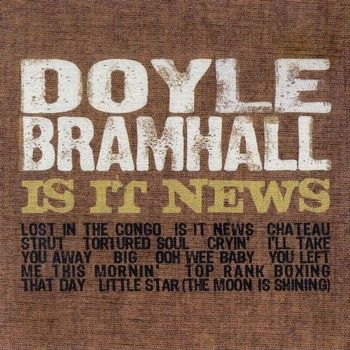
Doyle Bramhall - Is It News - 2007 - Yep Roc Records

Considering that it took Texas drummer and singer/songwriter Doyle Bramhall's 12 years to issue his debut album, 1994's Bird Nest on the Ground and that nine years passed before his sophomore effort, Fitchburg Street, dropped, his third set, arriving only four years after its predecessor, is quick work. Bramhall is a bit of a living legend in Texas music circles. He's worked with everyone from Jimmie and Stevie Ray Vaughan, to Marcia Ball and Mason Ruffner to Jennifer Warnes -- and a whole lot of others. Is It News was co produced by songwriting guitar slinger C.C. Adcock and Bramhall and recorded in five locations from Minnesota to Los Angeles to Austin to New Orleans. Bramhall wrote or co-wrote everything on the set, including "Chateu Strut" with Stevie Ray. The cast of players here is also impressive. It includes everyone from his co-producer and Jimmie Vaughan to his son Doyle II to Denny Freeman, Jason Burns, Billy Etheridge, Jimmy Mac, and Matt Perrine, just to name a few. That doesn't make it a cluttered effort, however, and Is It News feels all of a piece. The music, rooted in blues and Texas-style R&B, comes roaring out of the gate, but it's not simply some boogie bar-band effort. By the standards of his other records, this is downright slick and better for it. There is real variety in the tunes here. "Lost in the Congo" is Bo Diddley by way of New Orleans funk and swamp rock with a smokin' little guitar solo by Mato Nanji and slide work by Mike Keller. But Freeman and Adcock also play guitar here, and it's one dense, spooky rock number. The title track has a little more Texas swagger in its backside, a bluesy broken love song with great production and backing vocals. The mix is really warm and inviting and Bramhall's singing is at its very best. The swamp sound returns but the vibe is different, Texas soul. Speaking of soul, "I'll Taker You Away," with its big reverb, warm wall of guitars, and Bramhall's B-3 work, is a smoking plea for forgiveness. "Big" features the huge nasty blues-rock that made his other records so popular with I-IV-V beatheads, but Bramhall and Adcock are talking enormous here. They listened to a lot of Diddley records to get these guitar sounds and the drums. Their sound can be likened as popping up through the floor of the apartment downstairs and knock dishes off your table. It's enormous, noisy, and nasty. "Ooh Wee Baby" is a slowish love song, but made for the dancefloor. It's got all this country-styled production in it, but the sound is something from the '50s, all innocent and soulful like the best in rhythm and blues. The humorous "Top Rank Boxing" has the swamp shuffle happening, but the canned handclap sound on it would have been better left out of the mix. Also, "That Day," an acoustic number that sounds like an elegy to S.R.V., just doesn't fit here, especially so near the end of the set. The roiling-snake toughness of big-bumpin' blues is in full force on "Little Star (The Moon Is Shining)." Bramhall's voice with all that reverb on it sounds like it's coming out of a canyon in the middle of a foggy night. But it works. "Is It News" is loud and proud, full of twists and turns in its eclectic production. (Dave Edmunds, Nick Lowe, and Jim Dickinson will likely really dig this -- even as the squares scratch their heads and wonder, What the...?) But it's also very warm. It's so warm, baby, it'll snuggle up to ya nice and slow like, then grab ya and wrassle ya to the ground and demand your full attention. Then it'll leave you panting for more. Thankfully, all you have to do to reproduce this feeling is play it again. It's retro, sure, but in all the righteous ways -- in others it sounds as space-age freaky-friendly as the Jetsons. Either way it rocks. Is It News is nearly hip beyond belief. Who would have though this kinda cool still existed? This CD was nominated for a Grammy award in 2007 for Best Contemporary Blues Album. © Thom Jurek © 2012 Rovi Corp | All Rights Reserved http://www.allmusic.com/album/is-it-news-mw0000725815

Great roots blues from the late Doyle Bramhall influenced by artists like John Lee Hooker , OV Wright, Buddy Miles, Otis Redding , Howlin 'Wolf, Erma Franklin and many more. In 2007 "Is It News" was nominated for a Grammy award for Best Contemporary Blues Album. Listen to Doyle's "Bird Nest on the Ground" album [All tracks @ 320 Kbps: File size = 110 Mb]

TRACKS / COMPOSERS

1 Lost In the Congo - CC Adcock, D. Bramhall 4:31
2 Is It News - D. Bramhall 4:07
3 Chateau Strut - B. Etheridge, D. Bramhall, Stevie Ray Vaughan 3:55
4 Tortured Soul - D. Bramhall 4:30
5 Cryin' - CC Adcock, D. Bramhall 3:10
6 I'll Take You Away - CC Adcock, D. Bramhall 4:31
7 Big - CC Adcock, D. Bramhall 4:35
8 Ooh Wee Baby - D. Bramhall 4:12
9 You Left Me This Mornin' - CC Adcock, D. Bramhall 1:12
10 Top Rank Boxing - B. Logan, CC Adcock, D. Bramhall 4:15
11 That Day - D. Bramhall 2:43
12 Little Star (The Moon Is Shining) - D. Bramhall 4:06

MUSICIANS

Doyle Bramhall - Acoustic Guitar, Drums, Percussion, Hammond Organ, Vocals, Human Whistle
Denny Freeman - Guitar, Leslie Guitar, Rhythm Guitar, Slide Guitar, Hammond Organ, Piano
Mike Keller - Guitar, Acoustic Guitar, Leslie Guitar, Rhythm Guitar, Soloist
Doyle Bramhall II - Slide Guitar, Background Vocals
Mato Nanji - Guitar, Leslie Guitar, Soloist
Jimmie Vaughan - Guitar, Maracas
Tarka Cordell - Acoustic Guitar
Scott Nelson - Bass
Billy Etheridge - Keyboards, Organ
Justin Stanley - Percussion
Derek Huston - Baritone & Tenor Sax
Jimmy Mac - Accordion
Matt Perrine - Sousaphone
Georgia Bramhall, Strutts - Vocals

BIO

Born in Dallas in 1949, this singer/songwriter/drummer grew up listening to Dallas radio (with heavy doses of Jimmy Reed, Ray Charles, and Bobby Blue Bland on rock & roll stations) and locals the Nightcaps, one of the country's first white electric blues bands. In high school he joined the Chessmen, which soon included a young Jimmie Vaughan on guitar; they opened in Dallas on Jimi Hendrix's first U.S. tour. Moving to Austin in 1970, he and Vaughan formed Texas Storm, which later shortened its name to Storm and occasionally included Jimmie's younger brother Stevie on bass. Doyle next formed the Nightcrawlers with Stevie (now on lead guitar), who later credited Bramhall as a primary vocal influence. During this time the two also co-wrote "Dirty Pool," which Vaughan included on his debut, Texas Flood. Doyle wrote or co-wrote seven more songs on subsequent Stevie Ray albums, and collaborated on three for Family Style by the Vaughan Brothers (which also featured Bramhall on drums). While drumming with Marcia Ball and Mason Ruffner in the early '80s, Bramhall began stockpiling solo recordings, which eventually comprised his long-awaited debut on CD, featuring both Vaughans and Doyle's son, guitarist Doyle Bramhall II, formerly of the Arc Angels. He also began a collaboration that proved interesting -- with pop singer Jennifer Warnes. The striking Bird Nest on the Ground appeared in 1994 from Discovery, followed by Fitchburg Street in 2003 and Is It News in 2007, both from Yep Roc. Purportedly suffering from pneumonia, Bramhall died of heart failure in his sleep on November 12, 2011 in Alpine, Texas. He was 62. © Dan Forte © 2012 Rovi Corp | All Rights Reserved http://www.allmusic.com/artist/doyle-bramhall-mn0000167549

Kevin Eubanks

LINK
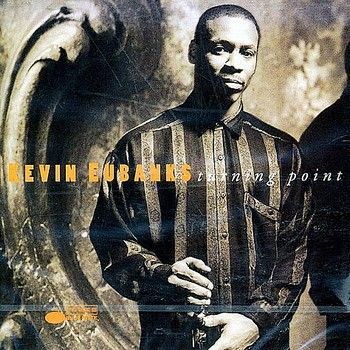
Kevin Eubanks - Turning Point - 1992 - Blue Note

Down Beat (7/92, p. 50) - 4 Stars - Very Good - "... he's back on the right track... an uncompromising Blue Note debut.... suggests a bold new direction...

" Option (11-12/92, p. 114) - "... guitarist Eubanks returns to `real' jazz with a vengeance... "

Turning Point is a highly appropriate title for this album. After recording his share of commercial fluff for GRP, Kevin Eubanks switched to Blue Note with this heartfelt CD and strived for excellence instead of going out of his way to avoid it. Creativity, personal improvising, and spontaneity are main ingredients of the album, which unites the talented electric and acoustic guitarist with bass explorer Dave Holland and drummer Marvin "Smitty" Smith, among others. Like so much intellectual jazz, Point requires several listenings in order to be fully appreciated. Alex Henderson © 2012 Rovi Corp | All Rights Reserved http://www.allmusic.com/album/release/turning-point-mr0000128190

Kevin Eubanks has released several albums and similar to great guitarists like Larry Carlton has been involved with far too many bland, smooth jazz, commercial recordings which have stifled style and magnificent guitar ability. However, "Turning Point" manages to avoid the boring commercial trends and is a quality album of great jazz guitar by a very underrated artist. This album is HR by A.O.O.F.C. Listen to Kevin's terrific "Zen Food" album [All tracks @ 320 Kbps: File size = 109 Mb]

TRACKS

1 Turning Point, Pt. 1 5:21
2 Aftermath, Pt. 2 4:44
3 Initiation, Pt. 3 4:47
4 New World Order 7:02
5 Colors of One 5:04
6 Spiral Ways 5:44
7 Freedom Child 6:40
8 On My Way to Paradise 6:27
9 Lingering Destiny 4:44

All tracks composed by Kevin Eubanks except Track 7 by Kevin Eubanks & Gamal Buhaina

MUSICIANS

Kevin Eubanks - Electric & Acoustic Guitar
Dave Holland - Acoustic Bass on Tracks 1,2,3,6
Charnett Moffett - Acoustic Bass on Tracks 4,5,7,8
Marvin "Smitty" Smith - Drums on Tracks 1,2,3,6
Mark Mondesir - Drums on Tracks 4,5,7,8
Kent Jordan - Alto Flute except Track 9

BIO (WIKI)

Kevin Tyrone Eubanks (born November 15, 1957 in Philadelphia, Pennsylvania) is an American jazz guitarist and composer who was the leader of The Tonight Show Band with host Jay Leno from 1995 to 2010. He also led The Primetime Band on the short-lived The Jay Leno Show. Eubanks was born into a musical family. His mother, Vera Eubanks, is a gospel and classical pianist and organist. His uncle, Ray Bryant, was a jazz pianist. His older brother, Robin Eubanks, is a trombonist, and his younger brother Duane Eubanks is a trumpeter. Two cousins are also musicians, the late bassist David Eubanks and the pianist Charles Eubanks. Kevin studied violin and trumpet, before settling on the guitar. As an elementary school student, Eubanks was trained in violin, trumpet, and piano at the Settlement Music School in Philadelphia. He later attended Berklee College of Music in Boston and then moved to New York to begin his professional career. Eubanks is a pescetarian and maintains a diet of fresh fruits, vegetables, grains, egg whites, and fish. He is also an avid fan of Philadelphia sports teams. He once lost a bet on the Philadelphia 76ers, and he was forced to eat a corn dog when he lost. In 2007, he was voted PETA's "World's Sexiest Vegetarian Man". After Eubanks moved to New York, he began performing with noted jazzmen such as Art Blakey (1980–81), Roy Haynes, Slide Hampton and Sam Rivers. Like his brother Robin, he has played on record with double bassist Bill Dryden and Dave Holland. In 1983, while continuing to perform with others, he formed his own quartet, playing gigs in Jordan, Pakistan, and India on a tour sponsored by the U.S. State Department. His first recording as a leader, Guitarist, was released on the Elektra label when Eubanks was 25 years old. It led to a seven-album contract with the GRP label and four albums for Blue Note. In total, Eubanks has appeared on over 100 albums. In 2001, he founded the label Insoul Music on which he has released six albums. Eubanks has taught at the Banff School of Fine Arts in Canada, at Rutgers University, and at the Charlie Parker School in Perugia, Italy. In 2005, Eubanks received an honorary doctorate degree from the Berklee College of Music, of which he is an alumnus, but not a graduate. He is a member of Kappa Alpha Psi fraternity and has served as an active member of the Artistic Advisory Panel of the BMI Foundation since 1999. In 1992, Eubanks moved to the West Coast to assume the guitar spot in The Tonight Show Band. At this time, he composed The Tonight Show with Jay Leno's closing theme music, "Kevin's Country". In 1995, Eubanks replaced Branford Marsalis to become the leader of The Tonight Show Band. He served in this capacity from 1995 to 2010. When NBC moved Leno's show from late night to primetime (10PM in the Eastern time zone), Eubanks moved with the band to continue conducting the music for the short-lived The Jay Leno Show. Eubanks appeared on the new show as The Primetime Band. It was announced on February 16, 2010 that Eubanks would only be returning for a short time as band leader when Jay Leno began his second tenure on The Tonight Show. On April 12, 2010, Eubanks announced on the show that he would be leaving The Tonight Show following its 18th season. His last show was on Friday, May 28, 2010. Eubanks indicated in an interview with The Philadelphia Inquirer that he wanted to refocus on music, adding that his leaving was not provoked by any problems with Jay Leno or NBC. Following his departure from The Tonight Show, Eubanks began touring with band mate Marvin "Smitty" Smith on drums and Bill Pierce on sax. Eubanks has appeared on various TV shows such as Hollywood Squares, V.I.P., Muppets Tonight, Girlfriends, Longshot and Days of our Lives. He has written four feature film scores. On his website Eubanks states his preference for Abe Rivera guitars, Mesa/Boogie amplifiers and D'Addario guitar strings

21.11.12

Allan Holdsworth

LINK
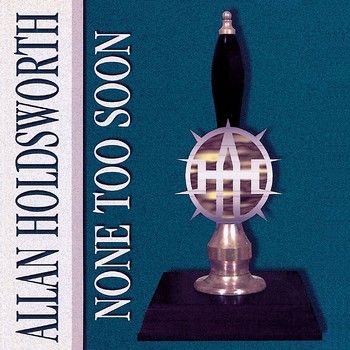
Allan Holdsworth - None Too Soon - 1996 - Polydor

"Django Reinhardt, Charlie Christian, Jimmy Raney, Wes Montgomery in fact most of the great guitar players; I loved them all. The newer guys: John McLaughlin, Pat Metheny, John Scofield, Scott Henderson and Frank Gambale... They're all amazing with very different musical personalities. Of course there's Michael Brecker and Keith Jarrett, but they don't play the guitar (thank God!). I think I've been influenced by all instruments. I was influenced a lot by horn players, from Charlie Parker, Cannonball Adderly, John Coltrane on to Michael Brecker. There's many, many more that you could fill this whole page with people that have brought great gifts to the world of music." - Allan Holdsworth on his influences

Allan's ninth album is a collection of interpretations of jazz standards by John Coltrane, Bill Evans, Django Reinhardt, and Joe Henderson, along with an Irving Berlin tune, two compositions by the late Gordon Beck (the album's pianist, and Allan's close personal friend of many years), and an intriguing arrangement of The Beatles' "Norwegian Wood". Holdsworth fans are in for a special treat, as the musical settings provide an intriguing backdrop for some of his more adventurous soloing to date. The project's underlying agenda is revealed in his quote from the reissue liner notes: "... after I’d completed Hard Hat Area, Gordon was visiting again and he said, ‘Maybe you should do a record of tunes that people might be able to relate to.’ He had the impression that my music mostly sailed past people, and he thought that maybe if I played something recognizable, they might be able to appreciate what was going on.”Voted "Album of the Year" in 1997 by Audiophile Imports, None Too Soon is a modern jazz classic and remains unique among Allan Holdsworth’s many recordings. It also has the noted distinction of being the only Holdsworth album to date to feature the renowned Tribal Tech battery of bassist Gary Willis and drummer Kirk Covington. Presented in digipak format, with fresh liner notes scribed by MJR artist and Guitar Player Magazine editor, Barry Cleveland. © http://www.moonjune.com/catalog/043_ALLAN-HOLDSWORTH_None-Too-Soon_MJR043/

The brilliant guitarist, Allan Holdsworth was a member of the great Canterbury progressive jazz rock bands Soft Machine and Gong. He has also played with greats like Ian Carr's Nucleus, Tony William's Lifetime, UK, Jean Luc Ponty, Bill Bruford, and Level 42. He has influenced countless others, including musicians like Frank Zappa, Eddie Van Halen, Yngwie Malmsteen, Alex Lifeson and Steve Vai. But as as a solo artist he has also recorded some incredible albums like "Metal Fatigue" and "With a Heart in My Song". "None Too Soon" is a collection of jazz standards by legends like Irving Berlin, John Coltrane, Bill Evans, Django Reinhardt, and Joe Henderson. The album also includes an arrangement of Lennon and McCartney’s “Norwegian Wood”, and two compositions by Keyboardist Gordon Beck. Allan didn’t change his guitar style or make any compromises when covering these tracks. Allan said “Gordon (Beck) chose most of the tunes, which I hadn’t grown up playing, so when he would teach me one, it would be just like I was learning a piece of original music. I made my own charts, and my approach to playing the songs was exactly the same as on my previous albums.” [All tracks @ 320 Kbps: File size = 113 Mb]

TRACKS / COMPOSERS

1. Countdown - John Coltrane (3:09)
2. Nuages - Django Reinhardt (5:40)
3. How Deep is the Ocean - Irving Berlin (5:29)
4. Isotope - Joe Henderson (5:41)
5. None Too Soon Pt. I / Interlude / None Too Soon Pt. II - Gordon Beck (7:42)
6. Norwegian Wood - Lennon & McCartney (5:55)
7. Very Early - Bill Evans (7:40)
8. San Marcos - Gordon Beck (3:22)
9. Inner Urge - Joe Henderson (6:15)

MUSICIANS

Allan Holdsworth - Guitar, Synthaxe
Gary Willis - Bass
Gordon Beck - Digital Piano
Kirk Covington - Drums

BIO

Guitarist Allan Holdsworth is widely considered to be one of the finest instrumentalists in all of jazz fusion, yet has never truly received the recognition that he so rightfully deserves. Born on August 6, 1946, in Bradford, Yorkshire, Holdsworth was originally taught music by his father, who was a pianist. Holdsworth didn't pick up the guitar until he was 17 years old, but learned the instrument quickly. After playing in local outfits (and learning the violin), Holdsworth relocated to London, where he was taken under the wing of saxophonist Ray Warleigh. By 1972, Holdsworth had joined progressive rockers Tempest, appearing on the group's self-titled debut a year later before joining Soft Machine in December 1973 -- and radically changing the latter outfit's sound to guitar-based fusion in the process. U.S. drummer Tony Williams discovered Holdsworth around this time, which led to an invite for the up-and-coming guitarist to replace John McLaughlin in Williams' Lifetime project -- Holdsworth abruptly left Soft Machine in March of 1975, subsequently appearing on the Williams recordings Believe It and Million Dollar Legs. But Holdsworth's union with Williams was a brief one, as the guitarist joined up with French-English prog rockers Gong for such albums as 1976's Gazeuse! (released as Expresso in the U.S.) and 1978's Expresso II, in addition to guesting on recordings by Jean-Luc Ponty, Bill Bruford, Gordon Beck, Jack Bruce, and UK. Also in the late '70s, Holdsworth launched a solo career, which over the years has seen the release of nearly 20 albums (a few standouts include 1983's Road Games, 1985's Metal Fatigue, 1994's Hard Hat Area, and 2000's The Sixteen Men of Tain), as the guitarist has been joined by such acclaimed musicians as Paul Williams (a former bandmate of Holdsworth's in Tempest), Gary Husband, Chad Wackerman, Gary Husband, Jimmy Johnson, Steve Hunt, and Alan Pasqua, among others. In the mid-'80s, Holdsworth was one of the first musicians to use a Synthaxe, a guitar that contained a breath controller that proved to be a cross between a synthesizer, guitar, and saxophone (Holdsworth was awarded Best Guitar Synthesist from 1989 through 1994 in the readers' poll of Guitar Player magazine). In the '90s, Holdsworth also created his own signature guitar model with the Carvin company. In the mid-'90s, Holdsworth briefly shifted away from his fusion originals and recorded an album with longtime musical partner Gordon Beck that dipped into jazz standards. The Sixteen Men of Tain (2000) marked another shift, in that it was the first Holdsworth release to feature an all-acoustic rhythm section. This was followed in 2002 by All Night Wrong, his first official live release. Then! Live in Tokyo was next, featuring Holdsworth's 1990 live band, which was followed by Against the Clock, a career retrospective, in 2005. © Greg Prato © 2012 Rovi Corporation. All Rights Reserved http://www.allmusic.com/artist/allan-holdsworth-p6754/biography

20.11.12

Tommy Castro

LINK
Tommy Castro - Right as Rain - 1999 - Blind Pig

Young guitar slinger Tommy Castro came back with his third Blind Pig album in early 1999, again produced by veteran Jim Gaines (Stevie Ray, Santana, Huey Lewis, etc.), and it's another bid for mainstream blues-rock success. From the opening notes of the kickoff tune, "Lucky in Love," Castro is in the driver's seat with a set of blues-rock originals that give him plenty of room to spray his Stevie Ray-inspired guitar licks in between his soul-man vocals. Dr. John makes guest keyboard appearances on "I've Got to Love Somebody's Baby" and "Don't Turn Your Heater Down," the latter also sporting a guest vocal turn from Delbert McClinton. An off-the-wall cover choice is "Chairman of the Board," sandwiched between solid originals like the ballad "Just a Man" and the funky "My Kind of Woman." There isn't much hard blues on this outing, but Castro continues to define his own spin on the form without being just another pretty-boy Stevie Ray Vaughan-abee in the process -- this being a very good thing. © Cub Koda © 2012 Rovi Corp | All Rights Reserved http://www.allmusic.com/album/right-as-rain-mw0000602040

Right As Rain, is his best yet. Featuring eight radio-friendly originals and guest appearances by Dr. John and Delbert McClinton, Right As Rain is sure to garner rave reviews, strong radio play and outstanding sales. © 2012 Blind Pig Records, a division of Whole Hog, Inc. - All Rights Reserved http://www.blindpigrecords.com/index.cfm?section=album&catalognum=BPCD5051

"A gifted lead guitarist firmly in touch with his lyrical voice, Castro writes an alluring blend of straight-ahead blues and Memphis-style soul. While he has his own definable sound, Castro calls to mind great blues-rock players such as Billy Gibbons of Z.Z. Top, Stevie Ray Vaughan, and even Duane Allman." - Blues Revue

Buy Tommy's great "Gratitude" album and support great soul blues and blues rock [All tracks @ 320 Kbps: File size = 91.3 Mb]

TRACKS / COMPOSERS

1 Lucky in Love - Tommy Castro / Billie Lee Lewis 3:56
2 Like an Angel - Tommy Castro / Randy McDonald 4:38
3 Right as Rain - Tommy Castro 4:19
4 Don't Turn Your Heater Down - Steve Cropper / Alvertis Isbell 2:30
5 I've Got to Love Somebody's Baby - Isaac Hayes / David Porter 4:19
6 I Got to Change - Tommy Castro / Scott Mathews 3:08
7 If I Had a Nickel - Tommy Castro / Keith Crossan 4:42
8 Callin' San Francisco - Tommy Castro / Randy McDonald 4:20
9 Just a Man - Tommy Castro 5:09
10 Chairman of the Board - Lamont Dozier / Brian Holland / Eddie Holland 4:55
11 My Kind of Woman - Tommy Castro / Elmore James / Billie Lee Lewis / Marshall Sehorn 3:49
12 Kickin' In - Tommy Castro / Mark Gilbert 3:53

MUSICIANS

Tommy Castro - Guitar, Vocals
Randy McDonald - Bass, Background Vocals
Jimmy Pugh - Organ, Wurlitzer Piano
John Turk - Piano, Background Vocals
Dr. John - Piano on "I've Got to Love Somebody's Baby", & Organ on "Don't Turn Your Heater Down"
Billy Lee Lewis - Drums, Background Vocals
Keith Crossan - Saxophone, Background Vocals
Tom Poole - Trumpet
Delbert McClinton - Vocals on "Don't Turn Your Heater Down"
Charles Jones, Annie Stocking, Jeanie Tracy, Ron E.Beck, Roosevelt Winchester, L.Z. Love, Cheryl Serame - Background Vocals

BIO

Tommy Castro is one of the most popular and creative roots artists to emerge in recent years. On his newest CD, Painkiller, Castro teamed up with producer John Porter, renowned for his work with a Who's Who list of artists such as Los Lonely Boys, Taj Mahal, Keb Mo, Santana, B.B. King, Elvis Costello, adn Buddy Guy. Said Castro, "When I started looking for a producer, I realized that John had produced some of my favorite records of the last ten years. After working with him in the studio, I understand now why that is. With John, everything just seems to be right; all the parts work and flow together." Everything indeed just seems right about Painkiller. With the Tommy Castro Band anchoring the sessions, Porter has fashioned a most tasteful album from the many talented parts of Castro's patented rock 'n' soul music. Special guests Coco Montoya, Angela Strehli, David Maxwell, and Teresa James join the fun. Tommy's career has been marked by one triumph after another. Considering his innate charisma and his skills as a supremely talented guitarist, gifted vocalist, and engaging songwriter, it is easy to see why Castro has enjoyed so much success so quickly. In a remarkably short time, he went from performing at a tiny San Francisco saloon to opening act on B.B. King's national tours and international acclaim as one of the most compelling artists on the scene. Born and raised in San Jose, California, Tommy expressed interest in learning to play the guitar at age ten. Young Castro was initially inspired by the likes of Eric Clapton, Mike Bloomfield and Elvin Bishop. Later, wanting to know who their influences were, Tommy became enthralled with the guitar playing of B.B., Buddy Guy, Muddy Waters, Elmore James and Freddie King, as well as the vocal stylings of Ray Charles, Otis Redding, Wilson Pickett and James Brown. Castro went on to play with many Bay Area bands. "When I was a kid, music was something I did for fun. Later, it became obvious to me that playing music was the thing I was meant to do, so I made a decision to pursue it as a career." For two years he toured the U.S. extensively with Warner Brothers recording artists The Dynatones. In 1991 he formed the Tommy Castro Band, and they quickly became one of the hardest-working and most popular groups in the Bay Area. In 1993 they were named "Club Band of the Year" at the Bay Area Music Awards, an especially prestigious honor since it is a write-in category that includes all musical genres. They won that distinguished award, regarded as an indicator of their success, again in 1994. Previous recipients of the award include Chris Isaak and Huey Lewis and the News. In 1996, Tommy's first major release, Exception to the Rule on Blind Pig, garnered near unanimous raves from blues and mainstream publications around the world as the press took notice of a great new artist on the scene. Industry trades took notice as well. Calling him "an up and coming blues phenom," Billboard said, "Castro combines the earthy soulfulness of Albert Collins and B.B. King with the polish of Robert Cray." And importantly, radio's insider "bible," The Gavin Report, said of the album: "Castro has etched one of those rare blues records that rises above the usual cliches of the genre. Castro is the awesome exception to the blues rule... the next blues rock hero." Blues Revue noted, "Castro's energy and charisma leap right out of each and every one of the cuts on the album. Castro's clearly got the goods and knows how to use them." Living Blues offered, "Castro's stinging, clean guitar tone shines. A talented guitarist who shows much promise, Tommy Castro can play with both scorching power and restraint." Even mainstream music magazines were lavish in their praise, with Musician magazine exclaiming, "Castro could be a star," while Guitar magazine noted, "It's straightforward, grooving blues that'll get your feet moving." Castro released his second album for Blind Pig Records in 1997, Can't Keep A Good Man Down. Grammy award winner Jim Gaines (known for his production with Stevie Ray Vaughan, Santana, and Huey Lewis, among many others) helmed its production and offered listeners a heady mix of Tommy's trademark slashing guitar work and his commanding vocal skills. The radio trade Album Network said, "This recording burns through a mixture of blues, rhythm & blues and a splash of rock 'n' roll. Castro is the real deal." The CD soon received continuous airplay and regular fan requests on well over 400 radio stations nationwide. Castro was featured on the cover of Blues Revue with a highly laudatory feature article. Another national publication Blues Access, highlighted Castro's burgeoning appeal: "If you're looking for driving blues-rock with soulful vocals and a Southern accent, your search is over. This is party music, good-time music with the potential to appeal to an audience outside of the blues crowd." One recognition of this mainstream appeal came with the selection of the Castro group by HBO Productions as the house band for NBC-TV's "Comedy Showcase," airing after that network's legendary "Saturday Night Live." The band appeared on national television for three consecutive seasons. Castro's music has also been featured in network television programs such as "Nash Bridges" and "The Young and the Restless." Castro's next recording-produced by the talented Jim Gaines-was 1999's Right As Rain. The CD showcased Castro's electrifying blue-collar rock 'n' soul music in an engaging program that features guest appearances by roots rock legends Dr. John and Delbert McClinton. Guitar magazine said, "With soulful, no-nonsense vocals and a prevalent horn sound, Castro creates an accessible Stax/Volt vibe. The guitar soars any time he decides to cut loose, but the songs also benefit from his ability to play with tasteful restraint." Playboy added, "Worshipped for his guitar virtuosity, Castro throws a bit more rock and two bits of soul into his basic blues mix on Right As Rain. He has the voice, the band, and the guitar to pull it off." And perhaps most impressive of all, the readers of Blues Revue magazine voted the disc one of the best 40 albums of all time! Tommy has wowed and won fans on every stage he's performed on, with is riveting presence growing stronger by the year. In 2000, to demonstrate Castro's remarkable charisma and ability to command a stage, Blind Pig released Live At The Fillmore, both as a long form video (on DVD and VHS) and an enhanced CD. The San Francisco Chronicle said "Castro's loose-jointed blues-rock sound is captured in all its onstage glory. He has distilled the essence of great bar bands everywhere and put his personal stamp on it at the same time." Blues Revue said the live disc "demonstrates Castro's strengths as a singer, guitarist, and bandleader. His rapport with the audience-and his sheer joy in performing-highlight this tight set." Other additions to his discography include the 2001 album Guilty of Love from the fledgling 33rd Street Records label, and the 2003 release Gratitude on his own Heart and Soul label, on which he paid tribute to his influences. He also appeared on the 2003 title from Telarc entitled Triple Trouble, which also features guitarist Lloyd Jones and harmonica/sax player Jimmy Hall. Prominent observers of the blues have extolled Tommy's dynamic musicianship and pointed to him as being among a small few that represent the future of the blues. B.B. King was so enamored of the Tommy Castro Band that he invited them to be openers on his 2001 concert tour, and again in 2002. When teenaged Castro bought his very first blues album (B.B. King's Live at the Cook County Jail) and listened to it incessantly, trying to copy the guitar licks, he never dreamed that one day he'd be sitting side by side on a concert stage actually playing those licks with B.B. himself. In all, the band played over eighty concert dates with "the King of the blues." And Carlos Santana, who's also invited Castro to share the stage with him, said of Tommy, "The blues is in good hands. This is the person who has the voice, the sound, and the right intentions to touch everybody's heart." Anxious to give his ever-growing fan base another album of new "Tommy Castro Band music," Castro and company set out to create Soul Shaker by focusing first and foremost on the songs. Said Tommy, who for the first time had a hand in writing all the songs on the album, "I've been working on songs for this record for a couple of years, writing with some of the best songwriters in the business, members of the band and on my own. Producer Kevin Bowe and I, with the help of all the musicians involved, let the songs dictate the approach. The result is that, which for the most part the material was done in a familiar way, we were also led into some new territory. So, our long-time fans will hear more of what they know and love about us, and there'll also be some pleasant surprises." On Soul Shaker, with a spark and vitality as fresh as day one, without conforming and without compromise, Tommy and the band continue to explore the boundaries of American roots music. And their mesmerizing blend of rock, blues and Memphis soul provides all the soul shakin' you need. Tommy Castro and his brilliant band have captured a hold of legions of fans and critics alike around the world with their mesmerizing blend of rock, blues adn Memphis soul. On Painkiller, style and soul, they continue to explore the boundaries of American roots music. © http://www.tommycastro.com/bio_castro.htm