A.O.O.F.C
recommends
Mizar6

babydancing


Get this crazy baby off my head!

10.12.07

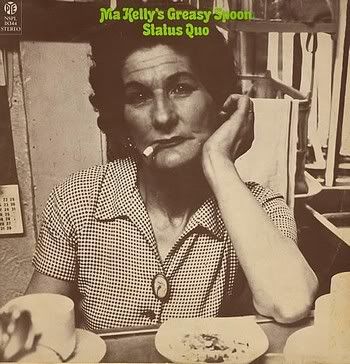
Status Quo


statusquo-makellysgreasyspoon1970


Status Quo - Ma Kelly's Greasy Spoon - 1970 - Pye


A great Quo album. Status Quo produced some great blues rock boogie in their early days. This album is nearly unrecognizable from their later stuff. This is the real Quo before they became overcommercialised. Give it a listen. You'll be amazed!

TRACKS

1. Spinning Wheel Blues (Rossi/Young) - 3:21
2. Daughter (Lancaster) - 3:01
3. Everything (Rossi/Parfitt) - 2:36
4. Shy Fly (Rossi/Young) - 3:49
5. April Spring Summer And Wednesdays (Rossi/Young) - 4:12
6. Junior's Wailing (White/Pugh) - 3:33
7. Lakky Lady (Rossi/Parfitt) - 3:14
8. Need Your Love (Rossi/Young) - 4:46
9. Lazy Poker Blues (Green/Adams) - 3:37
10. Is It Really Me/Gotta Go Home (Lancaster) - 9:34

BAND

Francis Rossi - guitar, vocals
Rick Parfitt - guitar, keyboards, vocals
Alan Lancaster - bass, guitar, vocals
John Coghlan - drums, percussion

REVIEWS

It's very easy to judge bands on the embarassments they later become. Is it that hard to believe that once upon a time Status Quo were actually quite good? Even Cliff Richard, once upon a time, was making vital if derivative Rock n Roll records, before releasing an odious vomit inducing Xmas single every December. What may surprise many music followers is how heavy Status Quo are here. Yes, 'Ma Kelly's' Greasy Spoon' saw a wholly succesful reinvention for the group. Out went the whimsy and the summer of love, in came long hair, long trousers and boogie rock n roll. They haven't quite reached the formula of later years, 'Ma Kelly's Greasy Spoon' is actually quite a varied album, within an admittedly narrow vision of music. It's all rock music, but we've elements of the blues, we've fast songs, slow songs. A decent rhythm section and a selection of songs that display good interplay between the band members. 'Lazy Poker Blues' for instance is a decent blues tune, utterly unoriginal of course, yet plenty of bands were unoriginal at the time. A stand-out arrives with the mighty 'April Spring Summer And Wednesdays', it's got a groove, man. Ah, are you a modern music lover? Have you heard Kings Of Leon? People that are old Quo fans, buy either of the first two Kings Of Leon records. Kings Of Leon fans? Buy 'Ma Kelly's Greasy Spoon'. I like going back into the past of music and linking it to new groups. Another highlight arrives with 'Shy Fly', speedy rock music with clashing cymbals, rumbling bass and decent lead guitar.

Of the later, famous Quo style, opening track 'Spinning Wheel Blues' clearly demonstrates where it came from. Another decent lead guitar part here. Well, Quo weren't virtuoso's, but they were pretty tight within what they were trying to do. It's so different to the first two albums as to almost be a different band altogether, they deserve credit for that, ditching the style that had brought them an international hit song with 'Pictures Of Matchstick Men'. Ah, good harmonica blasting away during the second part of 'Spinning Wheel Blues', in particular. Factor in that none of the tracks on this album come across as filler, add in the nine minute plus closing tune. A closing tune that ends with a lengthy jam session, an impressive one too. We dig the Quo! I could ask a stupid question right about now. Status Quo, whilst meaning nothing in the USA, have been hugely popular all across Europe. Yet there appears to be little discussion about them in terms of analysis on the web? I don't mean in-depth articles, even a decent comprehensive review page seems impossible to come across. Status Quo are far from being my favourite group, they did some pretty terrible stuff through the years and clearly influenced some of the sillier moments in Spinal Tap. Yet, credit where credit is due. And yes, I do intent to at least correct one thing. There will be a comprehensive review page, this one. © Adrian's Album Reviews, www.adriandenning.co.uk/quo.html

A change in style can be very risky especially when you decide to leave the reason of your success behind and start all over. by the beginning of 1970 STATUS QUO were teetering on the edge with sales down and their name out of fashion. Both events set a very demoralizing background for the band. However perseverance and good management set the pace for the new boogie rock denim clad bluesy combo. Following a hit single "Down The Dustpipe" (not included in the album in the best tradition of charts hitting bands) Ma Kelly's Greasy Spoon had all the numbers to be a best seller great cover artwork which has since become a trademark icon of dirty pub rock paraphernalia depicting an old waitress dangling her cheap fag from the corner of her mouth and unstoppable radio promotion giving the band the credit that this genuinely inspired new album deserved. © 2003 osCommerce, www.systemrecords.co.uk/statusquomakellysgreasyspoonlp-p-9934.html

9.12.07

Marian McPartland - Piano Jazz With Dave Brubeck


mmcpartlandpianojazz-davebrubeck


Marian McPartland - Piano Jazz With Dave Brubeck - 1993 - Jazz Alliance

Dave Brubeck and Marian McPartland became good friends back in the 1950s, so it was no surprise that he was one of her guests in the early years of her long running radio program. Unlike many of her guests, Brubeck doesn't keep the solo spotlight on himself in the early part of the show, preferring to have his hostess join him for delightful duets of standards like "St. Louis Blues" (a long time favorite concert opener for Brubeck) and often recorded Brubeck masterpieces such as "The Duke" and "In Your Own Sweet Way"; Brubeck's Chopin-influenced "Thank You (Dziekuje)" deserves to be as well known. Marian solos on another lovely Brubeck ballad, "Summer Song." Brubeck was joking about a lack of confidence in playing alone when the tapes weren't rolling, so it is hilarious to hear McPartland comment to Brubeck at the end of their rousing finale of "Take Five," "What do you mean no chops?" to her guest's laughter. Needless to say, they complement one another's playing very well on all of their duets, including the adventurous improvised "Free Piece." Although a total of 32 editions of Marian McPartland's Piano Jazz were issued on compact disc between 1993 and 1996, this is the only release that features a track not included in the original broadcast on National Public Radio. At Brubeck's insistence, the original session tapes were located and a brief version of his "Polytonal Blues," which was originally recorded for a Concord LP as "Polly," was added; this wild performance is typical Brubeck, who picked up the pace of recording solo tracks in the years following this taping. This is one of the most enjoyable editions of Piano Jazz made commercially available so far, and unless Concord is willing to resume releasing additional great programs from this series (which began airing in 1979), collectors will have to make due taping and trading copies of the broadcasts. © Ken Dryden, All Music Guide

TRACKS

1. Conversation - Marian McPartland
2. St. Louis Blues - Dave Brubeck, Marian McPartland
3. Conversation - Marian McPartland
4. Thank You - Dave Brubeck
5. Conversation - Marian McPartland
6. The Duke - Marian McPartland, Dave Brubeck
7. Conversation - Marian McPartland
8. In Your Own Sweet Way - Marian McPartland, Dave Brubeck
9. Conversation - Marian McPartland
10. One Moment Worth Years - Marian McPartland, Dave Brubeck
11. Conversation - Marian McPartland
12. Summer Song - Marian McPartland
13. Conversation - Marian McPartland
14. Free Piece - Dave Brubeck, Marian McPartland
15. Conversation - Marian McPartland
16. Polytonal Blues - Dave Brubeck
17. Conversation - Marian McPartland
18. Take Five - Dave Brubeck, Marian McPartland

MUSICIANS

Dave Brubeck - Piano
Marian McPartland - Piano

8.12.07

Gong


gong-expresso21978


Gong - Expresso 2 - 1978 - Virgin

Great jazz rock album. Not as avant garde and experimental as Gong's earlier work, but by the late seventies, Gong's music was becoming more mainstream and accessible. There is some great violin work from Darryl Way, who was a key member of the great Curved Air. Also, check out the brilliant guitar work of Soft Machine's Allan Holdsworth who plays on three tracks. If you would like to sample Gong's earlier work, you should buy their classic psychedelic "Camembert Electrique" album, from 1971.

TRACKS

1. Heavy Tune
2. Golden Dilemma
3. Sleepy
4. Soli
5. Boring

Tracks 1, 3, & 4 are the only tracks that Allan Holdsworth appears on.


MUSICIANS


Mireille Bauer: Marimba, Vibraphone
Francois Causse: Congas
Allan Holdsworth: Rhythm Guitar, Guitar
Bon Lozaga: Rhythm Guitar
Benoit Moerlen: Vibra, Marimba, Percussion, Tubular Bells, Glockenspiel, Claves, Xylophone
Pierre Moerlen: Drums, Glockenspiel, Vibraphone, Xylophone, Timpani, Tubular Bells
Hansford Rowe: Bass
Mick Taylor: Lead Guitar
Darryl Way: Violin


BIO (Wikipedia)


Gong is a progressive/psychedelic rock band formed by Australian musician Daevid Allen. Their music has also been described as space rock. Other notable band members include Allan Holdsworth, Tim Blake, Didier Malherbe, Pip Pyle, Gilli Smyth, Steve Hillage, Mike Howlett and Pierre Moerlen. Others who have, albeit briefly, played in Gong are Bill Bruford, Brian Davison and Chris Cutler. The various incarnations of Gong, its spin-offs and related bands, such as Pierre Moerlen's Gong, have become known as the Gong Global Family. Gong formed in 1967, after Allen—then a member of Soft Machine—was denied entry to the United Kingdom due to a visa complication. Allen remained in France where he and a London-born Sorbonne professor, Gilli Smyth, established the first incarnation of the band. This line-up fragmented during the 1968 student revolution, with Allen and Smyth forced to flee France for Deya in Majorca. They allegedly found saxophonist Didier Malherbe living in a cave in Deya, before film director Jérôme Laperrousaz invited the band back to France to record the soundtrack of his movie Continental Circus. They were subsequently approached by Jean Karakos of the newly formed independent label BYG and signed a multi-album deal with them (Magick Brother, Mystic Sister, "Camembert Electrique" and Allen's solo album Bananamoon were all released on BYG). Gong played at the first Glastonbury Festival in June 1971, which they followed up with a UK tour the following Autumn. They were subsequently (late 1972) one of the first acts to sign to Virgin Records, getting first pick of the studio-time ahead of Mike Oldfield. By now, a regular line-up had established itself and Gong released their Camembert Electrique album. After the band signed with Virgin, subsidiary Caroline Records "Camembert" was given a belated UK release in late 1974. It was priced at 59p (that is, the price of a typical single rather than an album), ensuring that sufficient numbers were sold for the album to chart had it not been barred from the charts for being so cheap. Between 1973 and 1974, Gong, now augmented by guitarist Steve Hillage, released their best-known work, the Radio Gnome Trilogy—three records that expounded upon the (previously only hinted at) Gong mythology. At a gig in Cheltenham, in 1975, Allen refused to go on stage, claiming that a "wall of force" was preventing him, and left the band. With both Smyth, who wanted to spend more time with her two children, and synth wizard Tim Blake having jumped off in previous months, this marked the end of the 'classic' line-up. The band continued, touring the UK in November 1975 (as documented on the 2005 release Live in Sherwood Forest '75) and working on their next album Shamal, but Hillage, who had been the band's de facto leader since Allen's exit, and his partner Miquette Giraudy, who had taken over from Smyth in late 1974, left before Shamal was released in early 1976. They re-joined the band briefly for a 1977 live reunion in Paris. Drummer Pierre Moerlen, who had been persuaded by Virgin to rejoin Gong as a co-leader with Malherbe (after his spell with the French contemporary ensemble Les Percussions De Strasbourg) in 1975, gradually took over the band's leadership. When Malherbe, the only remaining founding member, finally left in 1977, Moerlen formed a new percussion-based line-up with American bassist Hansford Rowe and percussionists Mireille Bauer and Benoit Moerlen. To avoid confusion, it became known as Gong-Expresso, and from 1978 on, as Pierre Moerlen's Gong. Allen, however, continued to develop the Gong mythology from the late seventies up until the nineties in his solo work, and with bands such as Euterpe and Planet Gong (which comprised Allen and Smyth playing with the British festival band Here & Now), while Smyth formed a separate band: Mother Gong. After spending most of the Eighties in his native Australia, Allen returned to the UK in 1988 with a new project, the Invisible Opera Company of Tibet, whose revolving cast included the likes of Harry Williamson, violinist Graham Clark and Didier Malherbe. This morphed into GongMaison and by 1992, the name Gong was again in use, by which time original drummer Pip Pyle had also rejoined. The band released the album Shapeshifter (subsequently dubbed Radio Gnome part 4), followed by extensive touring. In 1994, Gong celebrated its 25th birthday in London, including a performance by most of the 'classic' line-up, including the returning Gilli Smyth and Mike Howlett. This formed the basic of the "Classic Gong" band which toured worldwide from 1996 to 2001 and released Zero to Infinity in 2000 (by Allen, Smyth, Howlett and Malherbe plus new recruits Theo Travis and Chris Taylor). However, 2003 saw a radical new line-up called Acid Mothers Gong, including Acid Mothers Temple member Kawabata Makoto and University Of Errors guitarist Josh Pollock. Allen and Smyth's son Orlando Allen drummed on the album Acid Motherhood but the drummer on most of the band's live dates was Ruins drummer Tatsuya Yoshida. While the "Classic Gong" line-up retired from regular touring in 2001, there have been one-off reunions since, most notably at the "Gong Family Unconvention" (Uncon), the first of which was held in 2004 in the Glastonbury Assembly rooms as a one day event. The 2005 Uncon was a 2-day affair featuring several Gong-related bands such as Here and Now, System 7, House of Thandoy and Kangaroo Moon. The most recent Uncon was a 3-day event held at the Melkweg in Amsterdam on 3-5 November 2006, with practically all Gong-related bands present: classic Gong (with Allen, Smyth, Malherbe, Hillage, Blake and Howlett, plus Miquette Giraudy, Chris Taylor and Theo Travis), System 7, Steve Hillage Band, Hadouk, Tim Blake & Jean-Philippe Rykiel, University of Errors, Here & Now, Mother Gong, Zorch, Eat Static, Acid Mothers Gong, Slack Baba, Kangaroo Moon and many others. These events have all been compèred by Thom the Poet.

Blood, Sweat & Tears


bloodsweattears-nuclearblues1980


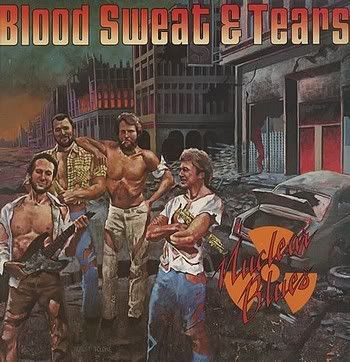
Blood, Sweat & Tears - Nuclear Blues - 1980 - MCA Records

A great album from Blood, Sweat & Tears. This album was a change of style for the band, and cannot be compared with the bands seventies recordings. Apart from David Clayton-Thomas on vocals, the band contained a whole new change of personnel. In the early 80's, the face of music had drifted away from the style that made Blood, Sweat and Tears popular, but this album still contains some terrific jazz funk & blues elements and is a hell of a good album. After this album was recorded, the group virtually disbanded for the next five years. Check out their brilliant self titled album "Blood, Sweat & Tears. "


TRACKS

1. Agitato (5:51)
2. Nuclear Blues (4:24)
3. Manic Depression (4:18)
4. I'll Drown in my Own Tears (7:21)
5. Fantasy Stage (5:41)
6. Suite: Spanish Wine (13:30)
a) Introduction: La Cantina (2:15)
b) Theme: Spanish Wine (1:02)
c) Latin Fire (2:22)
d) The Challenge (2:15)
e) The Duel (2:20)
f) Amor (3:16)
g) Spanish Wine Reprise (1:42)
All songs written or co-written by members of Blood, Sweat & Tears except "Manic Depression" (Jimi Hendrix) and "I'll Drown In My Own Tears" (H. Glover).

MUSICIANS

- David Clayton-Thomas / Vocals
- Bruce Cassidy / Trumpet, Fluegelhorn, Steiner Electric trumpet
- Bobby Economou / Drums
- David Piltch / Bass
- Robert Piltch / Electric and Classical Guitar
- Earl Seymour / Baritone and Tenor Sax, Flute
- Vern Dorge / Alto and Soprano Sax, Flute.
- William Smith / Background Vocals on "Drown in my own Tears."
- Lonnie Jordan / Background vocals on "Drown in my own Tears."

REVIEWS

Nuclear Blues" looks like it will stand as the last studio album released in the name of Blood Sweat and Tears. I phrase the wording in that way deliberately, as this is not really a genuine BS&T album. The only relationship line up wise with any of the previous albums is through singer David Clayton-Thomas, the rest of the line up being Canadian musicians originally brought together by Clayton-Thomas to form a new band.

Ironically, this is probably the most progressive, and certainly the jazz funkiest (if that is a legitimate expression!) album release in the band's name. In this case however the term progressive is not necessarily synonymous with "good".

The album opens with a funky jazz rock instrumental written by brass instrumentalist Bruce Cassidy. The track has occasional horn bursts such as we have come to expect from a BS&T song, but the overt funk masks anything more substantial. The funk element is carried into the Clayton-Thomas written title track. Ironically, it is only when we get to a cover of Jimi Hendrix's "Manic Depression" that we start to find anything truly reminiscent of the band's early years.

Side one concludes with a lengthy blues cover of Henry Glover's "I'll drown in my own tears", perhaps best known through the Janis Joplin version. Clayton-Thomas gives a suitably soulful performance which largely mirrors Joplin's approach.

Side two contains just two tracks. "Fantasy stage" is a downbeat but still funky song with an Earth Wind and Fire or later Santana like arrangement. The rest of the site is taken up by a 15 minute suite called "Spanish Wine". This is a 7 part piece with something of a Spanish flavour. After the Spanish guitar intro of "LA cantina", we move into the brief Don Juan brass filled "Spanish wine". Thereafter, things become more conventionally jazz orientated, "Latin fire" being little more than an exercise in improvisation. Each of the band members appears to get a shot at solo spot as we continue through "The challenge", "The duel" and "Amor". The only notable absentee from the whole exercise is Clayton-Thomas, who is the sole band member not to perform on the track or to receive a writing credit. Those who enjoy orthodox jazz will probably appreciate the suite, but for me it is over indulgent and makes for a sad end to a once great band.

In all, "Nuclear blues" does have some redeeming qualities. It is not however from the same mould as previous albums by the band, and for that reason alone I would recommend approaching with some trepidation. I am sure however that some will find it to be worthwhile.

Incidentally, I find I have two copies of this album. The first is a Dutch cassette release on the Bigtime label which with admirable attention to detail seems to think that Clayton and Thomas are two different people. The sleeve has an alternative cover with a picture of what looks very much like an old like up of the band playing live. The other, which I had assumed to be an entirely different album, is an LP called "The challenge" on the German Astan label. The tracks are however identical. Review by Easy Livin (Bob McBeath), 7/5/2007 , . © Prog Archives, All rights reserved.
The musical emphasis has mostly shifted, from pop/soul with a jazz flavor to out-and-out fusion jazz, such as "Agitato," and the lengthy and often quite lovely "Spanish Wine" suite, with only an occasional lead vocal (a radically re-arranged cover of Jimi Hendrix's "Manic Depression"). Big exceptions include the title tune, in which Clayton-Thomas vents his paranoia about Three Mile Island, and an impassioned, if relatively straightforward, cover of the old blues standard "I'll Drown In My Own Tears." © 2000-2007, Moonshadow eCommerce Inc. Patents Pending.

BIO

No late-'60s American group ever started with as much musical promise as Blood, Sweat & Tears, or realized their potential more fully -- and then blew it all in a series of internal conflicts and grotesque career moves. It could almost sound funny, talking about a group that sold close to six million records in three years and then squandered all of that momentum. Then again, considering that none of the founding members ever intended to work together, perhaps the group was "lucky" after a fashion.

The roots of Blood, Sweat & Tears lay in one weekend of hastily assembled club shows in New York in July 1967. Al Kooper (born February 5, 1944, Brooklyn, NY) was an ex-member of the Blues Project, in need of money and a fresh start in music. He'd been toying with the notion, growing out of his admiration for jazz bandleader Maynard Ferguson, of forming an electric rock band that would use horns as much as guitarists, and jazz as much as rock as the basis for their music. As he later related, he saw the proposed group coming down somewhere midway between James Brown's Famous Flames and the Count Basie Orchestra. Kooper hoped to raise enough cash to get to London (where he would put such a band together) through a series of gigs involving some big-name friends in New York. When the smoke cleared, there wasn't enough to get him to London, but the gig itself produced a core group of players who were interested in working with him: Jim Fielder (born October 4, 1947, Denton, TX), late of Buffalo Springfield, on bass, whom Kooper brought in from California; Kooper's former Blues Project bandmate, guitarist Steve Katz (born May 9, 1945, Brooklyn, NY); and drummer Bobby Colomby (born December 20, 1944, New York, NY), with whom Katz had been hanging out and also talking about starting a group. Kooper agreed, as long as he was in charge musically -- having just come off of the Blues Project, who'd been organized as a complete cooperative and essentially voted themselves out of existence, he was only prepared to throw into another band if he were calling the shots. This became the group that Kooper had visualized; it would have a horn section that would be as out front as Kooper's keyboards or Katz's guitar. Colomby brought in alto saxman Fred Lipsius (born November 19, 1944, New York, NY), a longtime personal idol, and from there the lineup grew, with Randy Brecker (born November 27, 1945, Philadelphia, PA) and Jerry Weiss (born May 1, 1946, New York, NY) joining on trumpets and flügelhorns, and Dick Halligan (born August 29, 1943, Troy, NY) playing trombone. The new group was signed to Columbia Records, and the name Blood, Sweat & Tears came to Kooper in the wake of an after-hours jam at the Cafe au Go Go, where he'd played with a cut on his hand that had left his organ keyboard covered in blood.

The original Blood, Sweat & Tears turned out to be one of the greatest groups that the 1960s ever produced. Their sound, in contrast to R&B outfits that merely used horn sections for embellishment and accompaniment, was a true hybrid of rock and jazz, with a strong element of soul as the bonding agent that held it together; Lipsius, Brecker, Weiss, and Halligan didn't just honk along on the choruses, but played complex, detailed arrangements; Katz played guitar solos as well as rhythm accompaniment, and Kooper's keyboards moved to the fore along with his singing. Their sound was bold, and it was all new when Blood, Sweat & Tears debuted on-stage at the Cafe au Go Go in New York in September 1967, opening for Moby Grape. Audiences at the time were just getting used to the psychedelic explosion of the previous spring and summer, but they were bowled over by what they heard -- that first version of Blood, Sweat & Tears had elements of psychedelia in their work, but extended it into realms of jazz, R&B, and soul in ways that had scarcely been heard before in one band. The songs were attractive and challenging, and the arrangements gave room for Lipsius, Brecker, and others to solo as well as play rippling ensemble passages, while Kooper's organ and Katz's guitar swelled in pulsing, shimmering glory. The group's debut album, Child Is Father to the Man, recorded in just two weeks late in 1967 under producer John Simon, was released to positive reviews in February 1968, and it seemed to portend a great future for all concerned. It remained one of the great albums of its decade, right up there with Bob Dylan's Highway 61 Revisited and the Rolling Stones' Beggars Banquet. The only thing it didn't have, which those other albums did, was a hit single to get radio play and help drive sales. Child Is Father to the Man was out there on its own, invisible to AM radio and the vast majority of the public, awaiting word-of-mouth and whatever help the still fledgling rock press could give it, and the band's touring to promote it.

Even as their debut was being recorded, however, elements of discontent had manifested themselves within the group that would sabotage their first tour and their future. At first, these were disagreements about repertory, which grew into issues of control, and then doubts about Kooper's ability as a lead singer. With Colomby and Katz taking the lead, the group broached the idea of getting a new vocalist and moving Kooper over exclusively to playing the organ and composing. By the end of March 1968, with Child Is Father to the Man nudging onto the charts and sales edging toward 100,000 copies and some momentum finally building, Blood, Sweat & Tears blew apart -- Kooper left the lineup, taking a producer's job at Columbia Records; at that same point, Randy Brecker announced his intent to quit. Ironically, at around the same time, Jerry Weiss, who'd actually favored Kooper's ouster, also headed for the door as well, to form the group Ambergris?, which lasted long enough to cut one album in 1970.

That might've been the end of their story, except that Bobby Colomby and Steve Katz saw the opportunity to pull their own band out of this debacle. Columbia Records decided to stick with them while Katz and Colomby considered several new singers (including Stephen Stills), and actually got as far as auditioning and rehearsing with Laura Nyro before they found David Clayton-Thomas (born David Thomsett, September 13, 1941, Surrey, England). A Canadian national since the age of five, Clayton-Thomas at the time was performing with his own group at a small club in New York. He came aboard, with Halligan moved over to keyboards, Chuck Winfield (born February 5, 1943, Monessen, PA) and Lew Soloff (born February 20, 1944, Brooklyn, NY) on trumpets, and Jerry Hyman (born May 19, 1947, Brooklyn, NY) succeeding Halligan on the trombone. The new nine-member group reflected Colomby and Katz's vision of a band, which was heavily influenced by the Buckinghams, a mid-'60s outfit they'd both admired for its mix of soul influences and their use of horns -- toward that end, they got James William Guercio, who had previously produced the Buckinghams, as producer for their proposed album. Though Kooper was gone from Blood, Sweat & Tears, the group was forced to rely on a number of songs that he'd prepared for the new album.

The resulting album, simply called Blood, Sweat & Tears, was issued 11 months after Child Is Father to the Man, in January 1969. Smoother, less challenging, and more traditionally melodic than its predecessor, it was ambitious in an accessible way, starting with its opening track, an adaptation of French expressionist composer Erik Satie's "Trois Gymnopedies" that transformed the languid early 20th century classical work into a pop standard. Clayton-Thomas was the dominant personality, with Lipsius and the other jazzmen in the band getting their spots in the breaks of each song -- equally important, and rather more telling the singles drawn from the album were all edited down, abbreviating or removing most of the featured spots for the jazz players. The first single by the new group, "You've Made Me So Very Happy," quickly rose to the number two spot on the charts and lofted the album to the top of the LP listings as well. That was followed by "Spinning Wheel" b/w "More and More," which also hit number two, which, in turn, was followed by the group's version of Laura Nyro's "And When I Die," another gold-selling single. When the smoke cleared, that one album had yielded a career's worth of hits in the space of six months, and the LP had won the Grammy as Album of the Year, selling three million copies in the bargain. So much demand was created for work by Blood, Sweat & Tears that the now 18-month-old Child Is Father to the Man, with the different singer and very different sound, made the charts anew in the summer and fall of 1969 and earned a gold record.

The group soon faced the problem that every act with a massive success has had to confront -- where do you go from up? By fall 1969, with ten months of massive success behind them, the record company was eager for a follow-up album. The group began recording Blood, Sweat & Tears 3 while the second album was still selling many tens of thousands of copies every week. This time, the group would produce the album themselves, an unusual arrangement for what was still essentially a new group, but one the label agreed to, in the wake of the previous album's sales.

And then issues of image and politics entered into the picture. When Al Kooper led the group, there was no question of how hip and tuned in Blood, Sweat & Tears were, to the rock culture and the counterculture -- by his own account, Kooper was a resident "freak" wherever he went in those days, and they were a daring enough ensemble to speak for themselves with their music. But the new group's music, and their use of horns, in particular, was more traditional, and it made them a little suspect among rock listeners. "Spinning Wheel," especially, was the kind of song that invited covers by the likes of Mel Tormé and Sammy Davis, Jr., and was the sort of "rock" hit that your parents didn't mind hearing. And "You've Made Me So Very Happy," for all of the soulfulness of David Clayton-Thomas' singing, also had a kind of jaunty pop-band edge that made the group seem closer in spirit to the Tonight Show band than, say, to the Rolling Stones.

Compounding the uncertainty of just who and what Blood, Sweat & Tears were, and how cool they were, was a decision that they made in early 1970, to undertake a tour of Eastern Europe on behalf of the U.S. State Department. A few other rock bands had played Eastern Europe before, but never on behalf of a government, much less one that, at that particular time, was singularly unpopular with a lot of Blood, Sweat & Tears' potential fan base over the war in Vietnam. There was something horribly wrong with this picture in May 1970, but the group was oblivious to it.

The reason for the tour was a practical one, according to some sources. Clayton-Thomas was a Canadian with very uncertain visa status in the United States, and the State Department indicated that it would be a lot more agreeable about their singer working here if the band did them this favor. It was a coup for the administration, getting one of the hottest rock acts in the world to represent the government in the Eastern bloc nations -- but it also took place just at the time of the Kent State massacre, in which four students were shot to death by National Guardsmen, an event that Nixon chose to capitalize on politically.

And it got worse when they came back, after seeing the police in Bucharest, in particular, take a violent hand to any audience spontaneity; a statement was issued on the group's behalf, upon their return, trumpeting the virtues of American freedom -- this, one month after Kent State, with the murders of the students still an open wound and the reactionary rioting that had ensued in cities like New York (where the police had done nothing to stop a mob of construction workers from attacking anyone with long hair and invading City Hall) still fresh in peoples' minds. In June 1970, Blood, Sweat & Tears were the only act hipper than the Johnny Mann Singers putting out feel-good messages about the United States government.

It was on their return to America, amid these dubious career moves, that Blood, Sweat & Tears 3 was released. Under the best of conditions, it would have been too much to hope that it could match its predecessor, and the truth was that it didn't. Despite some attractive songs, the album never achieved the same mix of accessibility and inspiration displayed by the earlier album. The album shipped gold and topped the LP charts for two weeks in mid-1970, and the single "Hi-De-Ho" made it to number 14, but the edge was off and the numbers didn't keep soaring week after week as the sales of their prior two LPs had. More troubling, the group was starting to get criticized in the rock press, not directly for their State Department tour -- though that couldn't have made a lot of reviewers and columnists too predisposed to go easy on the band -- but over who and what they were (and that was where the infamous tour did enter into the picture). A lot of rock critics felt that Blood, Sweat & Tears were a pretentious pop group that dabbled in horn riffs, while others argued that they were a jazz outfit trying to pass as a rock band -- either way, they weren't "one of us" or part of who we were. Oddly enough, some members of the jazz press liked them, but that was small help -- at any time after the early '40s, jazz reviewers in America reached no more than a small percentage of listeners. And regardless of what the critics said, a lot of serious jazz listeners who were the same age as the bandmembers thought the group was fluff, jazz-lite.

Their image problem grew only worse when the group accepted an engagement to appear at Caesar's Palace in Las Vegas -- the gambling mecca had never been known as friendly to current rock acts, and the group felt it was doing journeyman service by opening up Caesar's Palace to performers under 30. Instead, it multiplied their difficulties -- Vegas and what it represented were almost as bad as Nixon. In the meantime, another act, Chicago, produced by James William Guercio, broke big in 1970, also on the Columbia label, and avoided all of these pitfalls and internal problems and ended up stealing a huge chunk of Blood, Sweat & Tears' audience. It seemed as though, after an extraordinary run of luck, the group couldn't catch a break; their musical contribution to the Barbra Streisand film The Owl and the Pussycat did nothing to enhance their image. The group's fourth album, begun in early 1971, was the first that ran into real trouble in the making, which showed from the presence of three producers in the credits, and even Kooper was represented in the songwriting and arranging department.

The fourth album, issued in June 1971, peaked at number ten on the charts, nowhere near the top, and none of its singles cracked the Top 30. It was around this time that the membership began shifting and splintering. By 1971, the group was basically divided into three factions, the rock rhythm section pitted against the jazz players, and the singer between them both, and no one happy with what anyone else was doing. Clayton-Thomas no longer enjoyed working with the rest of the band and chose to exit after the release of the fourth album to pursue a solo career.

Despite this loss, the group carried on, and the label was willing to carry them a bit longer -- after all, Blood, Sweat & Tears had sold a lifetime's worth of LPs, and the two subsequent albums, though disappointing in its wake, were respectable successes by any conventional standard, and one always hopes that lightning will strike twice. Bob Doyle took the vocalist spot for a few months, and was then replaced by Jerry Fisher; elsewhere in the lineup, Fred Lipsius, who'd been there from the start and had put the original horn section together, finally called it quits and was replaced by Joe Henderson, who, in turn, was succeeded by Lou Marini, Jr., and Dick Halligan, who'd replaced Kooper on keyboards after the first band's breakup, was succeeded by Larry Willis, while Steve Katz got a second guitarist to play off of in the person of George Wadenius. All of these personnel changes led to an extended period of inactivity for the band, which Columbia Records made up for by releasing Blood, Sweat & Tears' Greatest Hits in 1972 -- this was probably a little sooner than they might otherwise have done it, under ideal circumstances, but the album became a Top 20 album and earned a gold record award and was a very popular catalog item for many years; one advantage that its original LP version offered the casual fan was that its songs were all the shorter, single edits of their hits, which were otherwise only available on the original 45 rpm records.

In September 1972, this lineup released an album, appropriately enough called New Blood, which never made the Top 30 despite some good moments, accompanied by a single, "So Long Dixie," which didn't crack the Top 40. By this time, they'd turned more toward jazz, recognizing that the rock audience was slowly drifting out of their reach. Founding members Jim Fielder and Steve Katz called it quits during this period, Katz preferring to work in the more rock-oriented orbit of Lou Reed. With replacements aboard, Blood, Sweat & Tears continued performing, but their next LP, humorously (or was it ominously?) entitled No Sweat, released in 1973, never rose higher than number 72 on the charts, and that was a hit compared to its successor, Mirror Image, which peaked at number 149. By this time, people were passing through the lineup like a revolving door, and even Jaco Pastorius put in some time playing bass for the group, all without leaving much of an impression on the public.

The plug might've been pulled right about here, but for the return of Clayton-Thomas, whose solo career had fizzled. Now fronting an outfit billed officially as Blood, Sweat & Tears Featuring David Clayton-Thomas, they released a modestly successful comeback album, New City, in 1975, which -- despite a few lapses in creativity and taste, and a range that encompassed Allen Toussant ("Life") and Randy Newman ("Naked Man," complete with a Mozartian digression) -- featured some of the group's best jazz sides in years as well as superb performances by Clayton-Thomas. The latter included a rare venture (for this group) into acoustic guitar blues on their rendition of John Lee Hooker's "One Room Country Shack." The accompanying single, a version of the Beatles' "Got to Get You Into My Life" (which, peculiarly enough, anticipated the single release of a remixed version of the British band's own recording) never made the Top 40, but the album did well enough to justify an ambitious tour that yielded a double-LP concert album, Live and Improvised, that was issued in Europe (and, 15 years later, in America). Columbia Records dropped the group in 1976, and a brief association with ABC Records led nowhere. The group was caught between their former Columbia rivals Chicago, who continued to get airplay and chart regularly with new releases, and purer jazz ensembles such as Return to Forever and Weather Report, who had captured the moment in the press and before the public. In the end, even Bobby Colomby, who had trademarked the group's name very early after Kooper's exit in 1968, gave up playing in the band, taking a corporate position at Columbia. Clayton-Thomas has kept the band alive in the decades since, fronting various lineups that continue to perform regularly and record sporadically, mostly updated renditions of their classic material.

The advent of the CD era, and the release of expanded versions of their first two albums, fostered new interest in the group's early history, which was furthered by the 1990s release of Kooper's Soul of a Man, which presented new concert renditions of the 1967-era group's repertory. During the first decade of the 21st century, Wounded Bird Records also belatedly reissued the band's post-BST4 albums on CD, with surprising success -- New Blood and, even more so, New City, sounded quite good musically, divorced from their origins by almost 30 years. The group name remains alive behind Clayton-Thomas, and their recordings through 1972 -- especially the first album -- still elicit a powerful response from those millions who've heard them. © Bruce Eder, All Music Guide
7.12.07

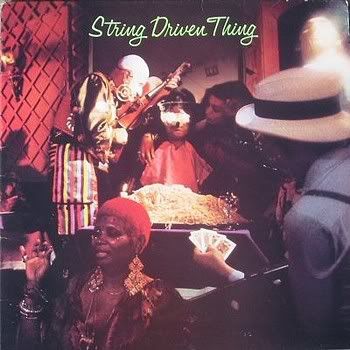
String Driven Thing


STRINGDRIVENTHING-STRINGDRIVENTHING1972


String Driven Thing - String Driven Thing - 1972 - Charisma

Their first self titled album on the independent Concord label was a limited edition of 100 copies only. If you have a copy of it, you could be rich! This album is a quite different self titled album, released in 1972 on Charisma records. A unique blend of folk and progressive rock, with shades of Genesis, Dylan, and early Fleetwood Mac thrown into the mix. Graham Smith’s violin dominates the album but is an essential part of the group's sound. This album is worth listening to, as are SDT's later albums, the excellent "The Machine That Cried, " and "Keep Your' And On It."

TRACKS

Side 1

1.Circus
2.Fairground
3.Hooked on the Road
4.Easy to be Free
5.Jack Diamond

Side 2

6.Let Me Down
7.Very Last Blue Yodel
8.My Real Hero
9.Regent St Incident
10.There You Are

All songs composed by Chris Adams

CREDITS

Colin Wilson (Banjo), Colin Wilson (Bass), Colin Wilson (Guitar), Colin Wilson (Guitar (Bass)), Chris Adams (Guitar), Chris Adams (Vocals), Pauline Adams (Percussion), Pauline Adams (Vocals), Graham Smith (Violin),
Shel Talmy (Producer)
Damon Lyon-Shaw (Engineer),

BIO

One of the finest bands signed to the Charisma label during its early-'70s heyday, Scotland's String Driven Thing originally formed as a trio in 1969, led by the husband-and-wife team of Chris and Pauline Adams, plus percussionist John Mannion. Locally popular at the tail end of the 1960s, the band faded from view shortly after releasing a self-titled debut album in 1970. They continued playing, however, with the lineup expanding to include bassist Colin Wilson In early 1972, Chris Adams journeyed to London, hoping to interest the Strawbs' management with a three-song demo. Finding himself with some free time, he was flicking through the record labels section of the Yellow Pages when he spotted Stratton Smith Enterprises. He called and found himself in conversation with the head of Charisma chief Tony Stratton Smith's publishing company, Mooncrest Music. Within a week, Stratton Smith himself was in Glasgow, for a String Driven Thing showcase at the Burns' Howff pub; a week after that, the band signed with his label. Shedding Mannion around the same time, the group returned to Glasgow with a princely retainer of 20 pounds per week, to rehearse. A month later, they went back south for their first ever live shows as a "signed" band: a community hall in the town of Tunbridge Wells, where Strat had his country retreat, and the 1972 Reading Festival. It was an audacious entry, but it worked and the group quickly set to work on its first Charisma album, to be titled -- like its independent predecessor -- String Driven Thing. Recorded in two weeks in August 1972 with producer Shel Talmy, the album landed rave reviews across the music press, with Melody Maker in particular leaping onto the group's side. (Amusingly, it later transpired that the album's distinctive gatefold sleeve, designed by Po of Hipgnosis, cost more than the actual recording sessions!) The band continued pushing forward. Visiting France, they stopped by the renowned Chateau D'Heuroville studios (the Honky Chateau of Elton John fame), where they were filmed recording some songs with a French producer, who later claimed he'd done a better job than Shel Talmy ("he had a point," mused Adams); December 1972, meanwhile, saw the band fly to New York to support Genesis at that band's first ever American show, at the Philharmonic Hall. String Driven Thing's rise ought to have been inexorable. Their latest single, "Circus," was making waves on both sides of the Atlantic, and plans were afoot for the group to join Genesis on their own latest tours of both Britain and the U.S. Unfortunately, the beginning of 1973 saw Chris Adams hospitalized with a collapsed lung, an event that was to have a serious impact on String Driven Thing's future. That experience, and the nightmare of the next week's worth of agonizing recuperation was to form the inspiration for much of The Machine That Cried, String Driven Thing's next album. However, although the band did make it onto the British dates, the American shows never happened; instead, the band found itself shunting up and down the British highway system, playing small clubs and universities, and breaking in the new material. The group's management at this time was being handled by Charisma's own in-house team, a less than satisfactory arrangement, but one that Stratton Smith seemed unwilling to change. Indeed, when Adams approached him to speak of the group's "total lack of confidence" in the setup, he simply "hummed and hawed and did nothing." Neither was that the end of the group's travails. In conversation with another label staffer one day, Adams mentioned that the band was considering adding a drummer to the lineup. A few days later, Stratton Smith showed up at a concert in Oxford, and instead offered them a keyboard player, Robert John Godfrey. He survived a week of rehearsals, but just one show, at the London Roundhouse, before the band declared him unsuitable and brought in a drummer (fellow Glaswegian Billy Fairley) after all. Godfrey went on to his own solo career at Charisma. In this form, String Driven Thing returned to the studio to record The Machine That Cried, alongside what remains their best-known number, the single "It's a Game." The LP has since been acclaimed not merely String Driven Thing's masterpiece, but one of the finest progressive rock albums of the entire era -- its CD reissue on the British Ozit label was widely heralded as among the most intelligent re-releases of recent years, and the excitement that greeted the re-formed String Driven Thing's return to action hailed almost wholly from memories of this marvelous album. At the time, however, all seemed doom-laden. "It's a Game," although it received plenty of British airplay, went nowhere (although a hit Bay City Rollers cover later went some way toward making amends); The Machine That Cried simply died and, by the end of the year, String Driven Thing looked to have followed it, as both the Adams and Chris Wilson walked out. Stratton Smith alone was left to carry the flag, rebuilding the group around himself and newfound vocalist Kim Beacon, and soldiering on until 1975. The two albums that followed both have their place in the prog rock pantheon, but the magic had gone from the band. It returned in the late '90s, as the Adams returned to the helm, overseeing both reissues of the band's original albums, and the preparation of new material and concerts. © Dave Thompson, © 1992 - 2007 All Media Guide, LLC

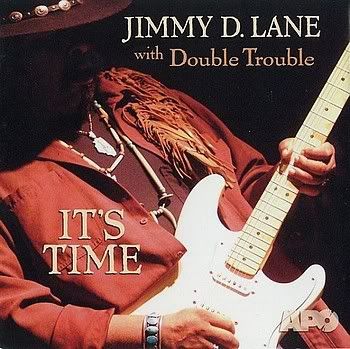
Jimmy D. Lane with Double Trouble


jimmydlane&doubletrouble-itstime2004


Jimmy D. Lane with Double Trouble - It's Time - 2004 - APO Records

Jimmy D. Lane is backed by the late, great Stevie Ray Vaughan's backing rhythm section Double Trouble with Tommy Shannon on bass and Chris Layton on drums. A well above average powerful blues rock recording. Check out his albums, Long Gone , and Legacy. This guy can really play.

TRACKS

1.What Makes People
2.'Til I Loved You
3.Half Love
4.Ain't It a Pity
5.It's Time
6.Stuck in the Middle
7.Hand on the Door
8.Bad Luck
9.My Nature
10.24-7
11.Bleeding Heart
12.Salina

MUSICIANS

Jimmy D. Lane (vocals, guitar, bass guitar, drums)
Celia Price (piano, Hammond b-3 organ)
Mike Finnigan (Hammond b-3 organ)
Tommy Shannon (bass guitar)
Chris Layton (drums)

REVIEWS

"Jimmy D. Lane's guitar playing will knock you over. His control of his guitar, from the most delicate tonal nuances to the flashiest, fastest licks, is almost superhuman. Only the most masterful guitar players can command their instruments this way, and all the practice in the world can't develop it. Jimmy D. Lane is a natural-born guitar monster." - Bob Margolin, guitarist in the Muddy Waters Band for seven years

It's Time could just as well have been titled It's Overdue. It's long been time for one of today's most powerful and expressive musicians to break the chains of relative commercial obscurity. Time to seize the reins of blues leadership, just as his father, Jimmy Rogers, did in the 1940s. Masters Eddie Kramer (engineer for Hendrix, Zeppelin, Woodstock etc.), Chris "Whipper" Layton and Tommy Shannon (of Double Trouble) and Mike Finnigan (organ in the bands of Etta James, Taj Mahal and CSN&Y) are all onboard to give Jimmy the nudge he needs to clear the launching pad. It's Time. © 2007 Acoustic Sounds, Inc. All rights reserved
If this is the first time you're hearing the name Jimmy D. Lane, it certainly won't be the last. The son of legendary bluesman Jimmy Rogers, Lane is a versatile guitarist who knows all of the traditional Chicago chops but prefers some muscle with his Blues. Eric Clapton and Living Blues Magazine have predicted big things for Lane, that praise following his first two APO releases, Long Gone and Legacy. And if his upcoming album lives up to its title as expected, big things are on the horizon for Lane. The record, called It's Time, features Stevie Ray Vaughan's rhythm section Double Trouble with Tommy Shannon on bass and Chris Layton on drums. Additionally, Eddie Kramer — the same man who engineered most all of the Hendrix albums as well as several by Led Zeppelin, The Rolling Stones, Peter Frampton and Joe Cocker to name just a handful — engineered and produced It's Time. Lane's guitar is scorching and his lyrics pointed. If you like your Blues high-voltage, dig Jimmy D. Lane. © www.analogueproductions.com/index.cfm


BIO (Wikipedia)

Lane was born on 4 July 1965 in Chicago, to the musician Jimmy Rogers and his wife Dorothy. In his childhood, he got to know many older bluesmen who worked with his father, including Muddy Waters, Howlin' Wolf, Willie Mabon, Little Walter and Albert King. Lane would say years later, "I feel blessed and fortunate to have known all those cats and I do not take it for granted."
At the age of 40, Jimmy D. Lane has already led quite a full life. The musicians he knows makes for an impressive resume. He has worked with Eric Clapton, Mick Jagger, Jim Keltner, Keith Richards, B.B. King, Van Morrison, Jonny Lang, Gary Moore, Double Trouble, Taj Mahal, Stephen Stilles, Jeff Healey, Jimmie Lee Robinson, Lowell Fulson, and Snooky Pryor, Kim Wilson, Pinetop Perkins, Johnny ‘Big Moose’ Walker, Johnnie Johnson, Kim Wilson, Robert Plant, Jimmy Page, Harry Hypolite, George ‘Wild Child’ Butler, David ‘HoneyBoy’ Edwards, Weepin’ Willie Robinson, Little Hatch, Nancy Bryan, Willie Kent, Henry Gray, Lazy Lester and Eomot RaSun. He has also worked with such blues greats such as Sam Lay, Hubert Sumlin, Carey Bell, Dave Meyers and his father, the legendary Jimmy Rogers.
Born July 4th, 1965 in Chicago, he grew up in a household where he became acquainted with a many famous Chicago bluesmen. Muddy Waters, Howlin' Wolf, Willie Mabon, Little Walter and Albert King, to name a few, would all stop by the house to visit the "old man." Coming from this environment has instilled in Lane the deepest respect for elder statesmen of the blues. "I feel blessed and fortunate, to have known all those cats, and I do not take it for granted."
At the age of eight, he began playing his dad's guitar, which he wasn't supposed to do. "I would break a string and put it back in the case like he wasn't going to discover it," Lane recalls. Shortly after that, Lane received a Gibson Acoustic from John Wayne. The Duke gave it to Shakey Jake, who was Wayne's driver, to give to Lane. "I would try to play along to a Bobby Blue Bland album" Lane states. He also wanted to join in with his dad and all those old cats that stopped by to "drink, tell lies and jam." Lane, however, would not get serious on the guitar until much later. Lane got discouraged from playing after the Gibson got smashed, and didn't play for a while.
Upon returning home from the military in 1983, he had a life changing experience. "I was laying on the bed with the headset on, trying to figure out what to do with my life, and that song, "Hey Joe" (the Hendrix version) came on the radio and I heard that song like I've never heard it before".
At that time, Jimmy knew exactly what to do. He took his last $59 to a pawnshop, bought a Harmony guitar and learned "Hey Joe" by ear. For the next four years he worked construction and roofing jobs, but would spend every other waking moment playing guitar. He would play along to blues as well as AC/DC and Journey records.
By 1987, Lane became lead guitarist of the Jimmy Rogers Band as well as leader of his own band, Jimmy D. Lane and The Hurricanes and later Blue Train Running. Lane toured extensively with his fathers band while managing his own solo career.
In 1993, The Jimmy Rogers Band toured Europe, where they made a stop to perform at the BBC. In '94 they performed at the W. C. Handy Awards and in '95 they appeared on the Conan O'Brien show, as well as the Chicago Blues Festival.
Jimmy made his solo recording debut in 1995. The self titled disc on Blue Seal Records features 12 fine originals and one of his dad's tunes. In 1993, however, he would meet the people who would put his recording career into high gear. During the sessions for Bluebird for Analogue Productions, with the Jimmy Rogers Band, he met Producer John Koenig and head of Acoustic Sounds, Chad Kassem. Koenig saw the Jimmy D. Lane band at B. B. King's Club in Universal City and was floored. Koenig and Kassem got together and Jimmy recorded Long Gone for Analogue Productions in 1995, at Ocean Way Studios in Los Angeles, which was released in 1997.
His second recording, Long Gone, showcases Jimmy’s guitar virtuosity on originals like "Whiskey," "Oh What A Feeling" and the title cut. The Hendrix/Vaughan influence can be heard in his searing guitar solos but listen and you will hear his feet are firmly rooted in the blues. His versions of John Lee Hooker's "Boom Boom" and Jimmy Rogers "I'm in Love" show his deep love for, and respect of blue tradition.
Lane can stretch out on his own, but is equally at home in a support mode as can be heard by comparing his playing on Long Gone to Bluebird. Lane plays on and co-produced Hubert Sumlin's I Know You, also on Analogue Productions, where as he states "You can hear Hubert's guitar, not some guy with his amp cranked up." In fact, it was Hubert Sumlin who gave Jimmy his first Strat in 1986.
Off stage, Lane's positive outlook on life is reflected in one of his favorite phrases "It's all good." This was originally the title of his third release, but changed it to Legacy in honor of his father's memory and the rich blues heritage he grew up with. Legacy, released in May '98, features guest appearances of blues greats Sam Lay on drums, Carey Bell on harp and Sumlin on guitar. It also features the last recordings of Jimmy Rogers, who played on "One Room Country Shack" and "Another Mule Kickin' In My Stall." Jimmy is proud of all his work with his dad, but this one touches him deeply. "I take great pride in the fact that the last time my dad picked up a guitar was to help me out on my project."
Jimmy's fourth release,It's Time, could just as well have been titled It's Overdue. It's long been time for one of today's most powerful and expressive musicians to break the chains of relative commercial obscurity. Time to seize the reins of blues leadership, just as his father, Jimmy Rogers, did in the 1940s. Masters Eddie Kramer (engineer for Hendrix, Zeppelin, Woodstock etc.), Chris "Whipper" Layton and Tommy Shannon (of Double Trouble) and Mike Finnigan (organ in the bands of Etta James, Taj Mahal and CSN&Y) are all onboard to give Jimmy the nudge he needs to clear the launching pad. It's Time.
Lane's music is on the rocking side, but is tempered with just the right amount of blues tradition. As Lane states "you can have too much water and too much fire, but with the right amount of both, you can boil an egg." Jimi Hendrix may have moved him to buy a guitar, but Hendrix is just one influence. Lane is a competent blues singer, songwriter and guitarist with a deep respect for "all those original cats who were there".

5.12.07

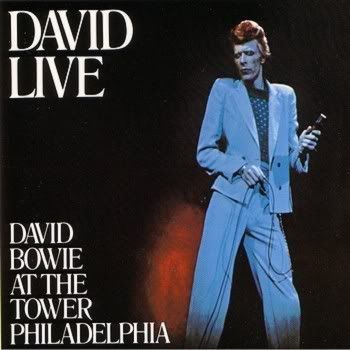
David Bowie


davidbowie-livetowerphiladelphia


David Bowie - David Live, David Bowie At The Tower Philadelphia - 1990 - Rykodisc

There are various versions of this official live concert floating around, with different track listings. This version contains a few bonus tracks. Bowie's voice sounds a bit strained at times, but it's a brilliant concert, and a must have for any Bowie fan.

TRACKS

1-01 1984 (3:21)
1-02 Rebel Rebel (2:42)
1-03 Moonage Daydream (5:10)
1-04 Sweet Thing (8:48)
1-05 Changes (3:36)
1-06 Suffragette City (3:46)
1-07 Aladdin Sane (4:58)
1-08 All The Young Dudes (4:19)
1-09 Cracked Actor (3:29)
1-10 When You Rock 'n' Roll With Me (4:19)
Written-By - Bowie* , Peace*
1-11 Watch That Man (4:23)

2-01 Knock On Wood (3:08)
Written-By - Eddie Floyd , Steve Cropper
2-02 Diamond Dogs (6:34)
2-03 Big Brother (4:11)
2-04 Width Of A Circle (8:14)
2-05 Jean Genie (5:19)
2-06 Rock 'n' Roll Suicide (4:49)
2-07 Band Intro (0:09)
2-08 Here Today, Gone Tomorrow (3:32)
2-09 Time (5:19)

This expanded version of the David Live album, which was culled from performances on the 12th, 13th, 14th & 15th July 1974 at the Tower Theatre, Philadelphia. Additional tracks from these concerts have been added. No studio overdubs or re-recording of voices, instruments or audience have been added with the exception of several backing vocals due to loss of theatre mike contact. Mixed at Electric Lady Studios, New York.

MUSICIANS

David Bowie (vocals);
Earl Slick (guitar);
David Sanborn (flute, alto saxophone);
Richard Grando (flute, baritone saxophone);
Michael Kamen (oboe, electric piano, Moog synthesizer);
Mike Garson (piano, Mellotron);
Herbie Flowers (bass instrument);
Tony Newman (drums);
Pablo Rosario (percussion);
Warren Peace (background vocals).

4.12.07

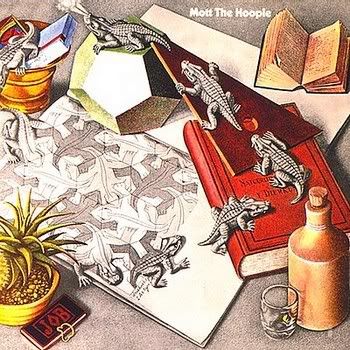
Mott The Hoople


mottthehoople-mottthehoople1969


Mott The Hoople - Mott The Hoople - 1969 - Island (UK)

From the brilliant cover illustration by M.C. Escher to what nearly every critic called a "straightfaced" version of Sonny Bono's "Laugh At Me" (as though it was impossible to perform it any other way), Mott The Hoople's debut album showedthat they were clearly no ordinary post-psychedelic Britishband. Their original material, particularly guitarist Mick Ralph's "Rock And Roll Queen", presaged the glam sound for which they would later become renowned. Appropriately, Mott The Hoople was produced by the inventive (and seriously whacked) Guy Stevens. A decade later, the Clash, who were strongly influenced by Mott The Hoople, called upon him to produce LONDON CALLING., © 1996-2007, Amazon.com, Inc. and its affiliates

Not the strongest debut album, but .it's still a respectable beginning, maybe leaning too heavily on their Blonde On Blonde influence. Check out their "Fairfield Halls Live 1970 " album, and get a taste of what this great rock group were all about.

TRACKS

1 You Really Got Me (Davies)
2 At The Crossroads (Doug Sahm)
3 Laugh At Me (Sonny Bono)
4 Backsliding Fearlessly (Hunter)
5 Rock And Roll Queen (Ralphs)
6 Rabbit Foot And Toby Time (Ralphs)
7 Half Moon Bay (Ralphs/Hunter)
8 Wrath And Roll (Stevens)
9.Ohio (live) - (Neil Young) - BONUS - On 2003 CD Angel Air (UK) Release
10.Find Your Way - (Ralphs) - BONUS - On 2003 CD Angel Air (UK) Release

CREDITS

Bass - Overend Watts
Drums - Dale Griffin
Engineer - Andy Johns
Lead Vocals, Piano - Ian Hunter
Organ - Verden Allen
Producer - Guy Stevens
Vocals, Guitar [Lead] - Mick Ralphs

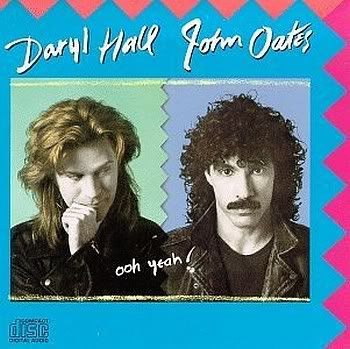
Hall & Oates


hall&oates-oohyeah1988


Hall & Oates - Ooh Yeah ! - 1988 - Arista Records (USA)

One of the duo's greatest albums encompassing a fusion of rock and roll , rhythm and blues, and soul styles. Buy their classic 1973 album, Abandoned Luncheonette.

TRACKS / COMPOSERS

01. Downtown Life - Daryl Hall, John Oates, Rick Iantosca, Sara Allen
02. Everything Your Heart Desires - Daryl Hall
03. I'm In Pieces - Daryl Hall, Janna Allen
04. Missed Opportunity - Daryl Hall, John Oates, Sara Allen
05. Talking All Night - Daryl Hall, John Oates
06. Rockability - Daryl Hall, John Oates, Sara Allen
07. Rocket To God - Daryl Hall
08. Soul Love - Daryl Hall, Holly Knight
09. Realove - Daryl Hall, John Oates
10. Keep On Pushin' Love - John Oates

CREDITS

Jerry Goodman (Vocals), Jerry Goodman (Violin (Electric)), Jerry Goodman (Electric Violin), Hall & Oates (Main Performer), Gary Wright (Assistant Engineer), Gary Wright (Mixing Assistant), Gary Wright (Assistant), Daryl Hall (Synthesizer), Daryl Hall (Bass), Daryl Hall (Guitar), Daryl Hall (Arranger), Daryl Hall (Guitar (Electric)), Daryl Hall (Keyboards), Daryl Hall (Vocals), Daryl Hall (Producer), Daryl Hall (Vibraphone), Daryl Hall (Performer), Daryl Hall (Synthesizer Bass), Al Smith, Janna Allen (Vocals), Janna Allen (Vocals (Background)), Bashiri Johnson (Percussion), Tony Beard (Drums), Jeff Bova (Synthesizer), Jeff Bova (Programming), Jeff Bova (Sequencing), Jeff Bova (Synthesizer Programming), Jimmy Bralower (Programming), Jimmy Bralower (Drum Programming), Jimmy Bralower (Sequencing), Pat Buchanan (Guitar), Pat Buchanan (Guitar (Rhythm)), Bob Clearmountain (Mixing), Sammy Figueroa (Percussion), James Hellman (Synthesizer), James Hellman (MIDI Technician), James Hellman (Keyboard Technician), James Hellman (Synthesizer Programming), Rick Iannacone (Percussion), Mike Klvana (Synclavier), Mike Klvana (Keyboard Technician), Keisuke Kuwata (Vocals), Rick Marotta (Drums), Sammy Merendino (Synthesizer), Sammy Merendino (Percussion), Sammy Merendino (Programming), Sammy Merendino (Timbales), Sammy Merendino (Drum Programming), Sammy Merendino (Sequencing), Narada Michael Walden (Arranger), Narada Michael Walden (Drums), Tommy Mottola (Direction), Tommy Mottola (Management), John Oates (Synthesizer), John Oates (Guitar), John Oates (Arranger), John Oates (Keyboards), John Oates (Programming), John Oates (Vocals), John Oates (Producer), John Oates (Performer), John Oates (Linn 9000), Lenny Pickett (Saxophone), Chris Porter (Mixing), Pael Presco (Guitar), Jimmy Ripp (Guitar), Mark Rivera (Saxophone), Philippe Saisse (Synthesizer), Philippe Saisse (Keyboards), Philippe Saisse (Synthesizer Programming), Danny Wilensky (Saxophone), Tom "T-Bone" Wolk (Bass), Tom "T-Bone" Wolk (Guitar), Tom "T-Bone" Wolk (Accordion), Tom "T-Bone" Wolk (Arranger), Tom "T-Bone" Wolk (Guitar (Bass)), Tom "T-Bone" Wolk (Keyboards), Tom "T-Bone" Wolk (Vocals), Tom "T-Bone" Wolk (Producer), Tom "T-Bone" Wolk (Vibraphone), Tom "T-Bone" Wolk (Synthesizer Bass), Tom T-Bone Walk (Producer), Mark Corbin (Mixing Assistant), Mark Corbin (Assistant), Randy Hoffman, Laura Levine (Photography), Laura Levine (Hand Tinting), Maude Gilman (Art Direction), Rick Iantosca (Tom-Tom), Rick Iantosca (Tom-Tom), Roger Tarkov (Mixing Assistant), Roger Tarkov (Assistant), Scott Forman (Mixing Assistant), Scott Forman (Assistant), Craig Vogel (Mixing Assistant), Craig Vogel (Assistant), Jeb Brien, Mike Scott (Engineer), Mike Scott (Mixing), Danny Wolensky (Saxophone), Vince Guttman (Drum Technician), Rob Klein, Jane Arginteanu, Brian Doyle, Mel Terpos (Guitar).

REVIEWS

Hall and Oates' early '80s albums, from VOICES to BIG BAM BOOM, represented a fusion of their soul and R&B roots with the energy of contemporary post-punk New Wave rock. OOH YEAH!, their last studio effort of the decade after a four-year layoff, leaned far more toward the R&B side of the equation, with only the occasional track rocking out, and then usually not for long.

For example, the opening "Downtown Life" begins as disco-ish dance/funk before sliding in and out of a big, anthemic rock bridge. Meanwhile "Keep on Pushin' Love" begins with a deadpan Lou Reed rap before climaxing with a big, wave-your-lighter inspirational chorus. Elsewhere, the album sounds like variations on the white-boy funk of David Bowie in his LET'S DANCE period, particularly on "Rockability," which matches scratchy rhythm guitar with a big synthesized bass line. © 2000-2007, Moonshadow eCommerce Inc. Patents Pending.

From 1980-1984, the Billboard chart could have been dubbed the Hall & Oates chart for their seemingly never ending assault of number one singles (amazingly, they never had a number one album). However, after Big Bam Boom and their live pre-sabbatical At the Apollo, Hall again embarked on his solo album for six/seven years and the overblown Three Hearts and its happy ending machine were born. When they returned on Arista in 1988, they delivered a very good album in Ooh Yeah. But the legendary Hall & Oates were treated as comeback artists. Pulling the rug from under their feet, critics slammed the album as the worst for a decade. A case of old news. Ooh Yeah is shock horror as good as H2O or Private Eyes, but the stigma of bad apple gave it a bad name. Ironically, Oates enjoyed U.S. Top Ten success at the time thanks to a collaboration with Icehouse on "Electric Blue," and with Hall, the lead single "Everything Your Heart Desires" managed an admirable number three. The album itself is more or less standard but shows a creative touch towards the end with its trilogy: "Soul Love," "reaLove," and "Keep On Pushing Love." © Kelvin Hayes, All Music Guide
So Daryl Hall and John Oates went out and got themselves a brand-new band and a brand-new record label. And guess what? They sound like the same old Daryl Hall and John Oates.
And that's not necessarily a bad thing. This is their first album in almost four years, and to hear it is to remember the desperately needed shot of soul they provided in the early Eighties, when black acts had a hard time getting on the radio. But by the time of Big Bam Boom, in 1984, their hits had become so ubiquitous that their sound had been glossed over to the point of embalmment.
Now they reunite with a refreshed attitude, if not a new context. Hall's voice regains the vigor that deserted him on later hits like "Out of Touch" and "Method of Modern Love." On Ooh Yeah!, Hall charges up "I'm in Pieces" – yet another doo-wop salute – and plunges into "Rockability" with the confidence of a man whose faith has been reaffirmed. And though there's a preponderance of slow love songs, they never sag: by stripping away a layer or two of the old polish, Hall finds a warmth that could melt the coldest drum machine.
Equally essential are Oates's confectionery harmonies. He tends to be overlooked, as Hall gets most of the lead vocals and writes most of the songs, but Oates is no Andrew Ridgeley. In fact most of Hall and Oates's best moments revolve around Oates's backup, not Hall's lead. When Oates does get a lead, he slides into it with a low, agitated breathiness, the change-up to Hall's high heater.
Oates even cops a sly, Lou Reed-like delivery on "Keep On Pushing Love," which is ironic, since Reed turns up in the lyrics to "Downtown Life," the victim of a cheap shot from Hall: "Velvet Lou was a neighbor of mine/Now he walks a dog in Jersey, Brother." This is especially unfortunate, because "Downtown Life" has got the kind of hooks that instantly implant themselves in your consciousness and then last through a season or two of heavy rotation. And in the end it's hard not to feel a little sorry for Hall anyway: he's trying to hold on to the culture and environment that he loves, and yet you still get the feeling it's all slipping away from him.
Hall turns off the nastiness on the rest of the album, and both he and Oates show that they have grown up a little. "Everything Your Heart Desires" is more of a plea than an indictment – no "Maneater" misogyny here. And in "Keep On Pushing Love," Oates writes about how a "homeless man on a frozen stoop ... gets the walk-on-by from the business suit." So at least they are up-to-date, if not ahead of the times.
Black music by black artists has come back in a big way since Hall and Oates have been gone, but that doesn't mean there's not room for them anymore. After all, the Rascals and the Righteous Brothers peacefully coexisted with Otis Redding and Wilson Pickett; there's no reason Hall and Oates can't continue to thrive during the heyday of Prince and Terence Trent D'Arby. ROB HOERBURGER, (Posted: Jun 30, 1988), © 2007 Rolling Stone

BIO (Wikipedia)

Hall & Oates is a popular music duo made up of Daryl Hall & John Oates. The act achieved its greatest fame in the late 1970s and early-to-mid 1980s. They specialized in a fusion of rock and roll and rhythm and blues styles which they dubbed "Rock and Soul". They are best known for their six #1 hits on the Billboard Hot 100: "Rich Girl", "Kiss on My List", "Private Eyes", "I Can't Go for That (No Can Do)", "Maneater", and "Out of Touch", as well as many other songs which charted in the Top 40. They last reached the pop top forty in 1990 and then slowly faded from public view, though they did not formally break up. They have continued to record and tour with some success. In total, the act had thirty-four singles chart on the US Billboard Hot 100. As of 2006, Hall and Oates have seven RIAA platinum albums along with six RIAA gold albums. A greatest hits compilation was released in 2001 from Bertelsmann Music Group. The BMG collection was expanded in 2004 and reissued the following year, after BMG merged with Sony. In 2003, Daryl Hall and John Oates were voted into the Songwriter's Hall of Fame. Forty years after they first met in Philadelphia -- and twenty years after they became the single most successful duo of all time -- Daryl Hall & John Oates continue to record and perform together their distinctive and enduring blend of soulful sounds. Starting out as two devoted disciples of earlier soul greats, Hall & Oates are soul survivors in their own right. They have become such musical influences on some of today’s popular artists that the September 2006 cover of Spin Magazine’s headline read: “Why Hall & Oates are the New Velvet Underground”. Their artistic fan base includes Rob Thomas, John Mayer, Brandon Flowers of the Killers, Ben Gibbard of Death Cab for Cutie and MTV’s newest hipsters Gym Class Heroes who dubbed their tour “Daryl Hall for President Tour 2007”.
Daryl Hall & John Oates first met back at Philadedelphia's Adelphi Ballroom in 1967. Both were attending Temple University, but they first discovered their shared passion for soul music during a show at which both of their groups -- The Temptones and The Masters, respectively -- were on a record hop bill with a number of then nationally known soul acts like the 5 Stairsteps and Howard Tate. When a gang fight broke out inside the Ballroom, the pair met each other in a service elevator while trying to get out.
Hall had already become a fixture in the Philly soul scene, recording a single with Kenny Gamble and the Romeos featuring future Gamble, Leon Huff and Thom Bell. Hall – now considered one of the great soul singers of his generation -- became a protégé of the Temptations at the young age of 17. Oates too had performed with a number of R&B and doo-wop groups on the Philadelphia scene, and recorded a single with famed Philly soul arranger Bobby Martin. In the early 1970’s Hall & Oates began performing as a duo, and a year later -- with the help of manager Tommy Mottola -- they signed to the legendary soul label Atlantic Records.
The group’s major label debut Whole Oats -- produced by legendary producer Arif Mardin who had already worked with The Rascals and Dusty Springfield -- combined the group’s soul and folk influences, but failed to make a significant commercial impact. That breakthrough would come with the duo’s following effort, 1973’s Abandoned Luncheonette, still considered one of the group’s finest albums by many of their admirers. Abandoned Luncheonette’s acoustic soul sound was groundbreaking and widely acclaimed, and the album’s stunning standout track “She’s Gone” would become a #1 R&B smash on the Billboard Magazine charts for Tavares in 1974, and eventually become a pop hit for Hall & Oates when it was re-released in 1976.
Hall & Oates took a rather dramatic turn with their third album, 1974’s War Babies, a rockier and more experimental song cycle recorded with producer Todd Rundgren. Leaving Atlantic, Hall & Oates signed with RCA Records and in 1975 released the Daryl Hall and John Oates (also unofficially known to fans as The Silver Album) which yielded the duo’s first critical and commercial smash “Sara Smile” .The group’s 1976 follow- up Bigger Than Both Of Us yielded the infectious “Rich Girl,” the group’s first #1 on the Pop Singles chart, and a track that once again artfully combining their rock and soul influences into a cohesive whole.
The group continued to experiment and expand their rock n’ soul sound with ambitious albums like 1978’s Along The Red Ledge (with David Foster as producer) and 1979’s X-Static. During that same period, Hall recorded and released on RCA his critically acclaimed first solo album Sacred Songs with experimental guitar innovator Robert Fripp. In 1980, Hall & Oates’ released the Voices album which would prove a true watershed moment in their illustrious career. Producing themselves for the first time, Hall & Oates created the template for a brightly infectious but still soulful sound that would help them become one of the dominant group’s of the Eighties. Voices included the group’s second #1 on the Pop Singles chart, “Kiss On My List,” as well as significant hits in “You Make My Dreams” and a cover of the Righteous Brothers’ “You’ve Lost That Lovin’ Feeling.” In addition, “Everytime You Go Away” from the Voices album became a #1 hit in America and around the world when later covered by British soul singer Paul Young in 1985.
1981’s Private Eyes album featured two more #1 hits, the title track and “I Can’t Go For That (No Can Do) ”and the Top Ten “Did It In A Minute.” This remarkable run continued with 1982’s H2O and more smashes in the form of "Maneater," “Family Man” and “One On One.” Two more hits -- “Say It Isn’t So” and “Adult Education” -- were included on the smash anthology Rock ‘n Soul, Pt. 1 that was released in 1983. Big Bam Boom continued the duo’s momentum with the help of another #1 hit, “Out Of Touch.”
Having achieved so much together -- including appearing on the “We Are the World” recording session, at Live Aid and performing and recording at the Apollo Theater along with former Temptations David Ruffin and Eddie Kendrick -- Hall & Oates took a hiatus to focus on individual efforts in the mid-Eighties. Hall recorded and released his second solo effort, Three Hearts in the Happy Ending Machine, produced by his now long time friend, Dave Stewart of the Eurythmics. The album would produce another hit for Hall in “Dreamtime”. The pair would then reunited to record their final 2 albums for Arista Ooh Yeah and Change of Season.
In the past decade, Hall & Oates have toured consistently and with considerable success around the world, and have continued to record both together and separately with impressive results including Hall’s third solo album, Soul Alone. Sensing the change in the business, they abandoned the major labels and released independently Hall’s fourth solo album, Can’t Stop Dreaming and the duo’s 1997’s Marigold Sky –– with both receiving considerable acclaim. Forming their own label, U-Watch Records, 2003’s Do It For Love rightly marked a major return to form with the album being embraced as the group’s finest in many years. It also had considerable commercial success with the passionate title track reaching #1 on the Billboard Adult Contemporary Charts, while “Forever For You” also hit the Top Ten on the same chart.
Most recently, Hall & Oates saluted their deep soul roots with 2004’s Our Kind Of Soul – an album that found them recording inventive re-workings of some of their favorite soul classics like the Spinners’ “I’ll Be Around” and the Four Tops’ “Standing in the Shadows of Love,” as well as three new originals with a decidedly classic soul feel, “Let Love Take Control,” and “Don’t Turn Your Back on Me”. 2004 also saw Hall & Oates’ body of work inducted together into the Songwriter’s Hall of Fame. In 2006, Hall & Oates released their first ever full Christmas album on U-Watch entitled Home For Christmas, a soulful seasonal effort highlighted by a cover of Robbie Robertson's “Christmas Must Be Tonight” and two moving originals-- “No Child Should Ever Cry At Christmas” written by John Oates and the albums title track written by Daryl Hall with Greg Bieck and longtime Hall & Oates player and collaborator T-Bone Wolk. The single “It Came Upon A Midnight Clear” became the #1 Holiday song of the 2006 season, The fortieth anniversary of their first meeting finds Daryl Hall & John Oates very much at the height of their powers making their own kind of soul, with a new generation of musicians recognizing not only their historic track record of success, but also their continuing influence and achievements.

2.12.07

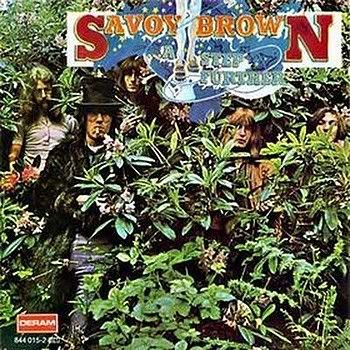
Savoy Brown


savoybrown-astepfurther1969


Savoy Brown - A Step Further - 1969 - Parrot

Terrific early sixties blues rock album from Savoy Brown. One of the earliest of British blues bands, Savoy Brown (with founder guitarist and longtime member Kim Simmonds at the helm) helped launch the U.K. blues/rock movement that paved the way for such acts as Led Zeppelin. In 1969 they captured the spirit of the band's exuberant live performances on this album with a twenty minute rendition of "The Savoy Brown Boogie," dedicated to fans in Detroit, where Savoy Brown were really appreciated. Check out their other albums, the hard rocking Rock And Roll Warriors (1981) and the acoustic blues album Slow Train (1986 on Relix). Great stuff.

TRACKS

1. Made Up My Mind - Chris Youlden
2. Waiting In The Bamboo Grove - Kim Simmonds
3. Life's One Act Play - Chris Youlden
4. I'm Tired/Where Am I - Chris Youlden, Willis, Brown
5. Savoy Brown Boogie (Live): Feel So Good/Whole Lotta Shakin' Goin' On/Little Queenie/Purple Haze... [Live][Medley] - Chuck Berry, Chris Youlden, Kim Simmonds, Williams, Willis, Ross Lomas

CREDITS

Kenny Wheeler (Trumpet), Bob Hall (Piano), Bob Hall (Trumpet), Bob Hall (Violin), Don Lusher (Trombone), Mike Vernon (Percussion), Mike Vernon (Bells), Mike Vernon (Producer), Mike Vernon (Cowbell), Chris Youlden (Trumpet), Chris Youlden (Violin), Chris Youlden (Vocals), Eddie Blair (Trumpet), Des Bradley (Violin), Savoy Brown (Handclapping), Savoy Brown (Main Performer), Raymond Davis (Flugelhorn), Raymond Davis (Horn), Roger Earl (Trumpet), Roger Earl (Violin), Roger Earl (Conga), Roger Earl (Drums), Roger Earl (Vocals), John Edwards (Trombone), Bob Efford (Saxophone), Bob Efford (Sax (Tenor)), David Grinsted (Engineer), Bobby Haughey (Flugelhorn), Bobby Haughey (Horn), Anthony Hawkins (Remastering), Don Honeywell (Saxophone), Don Honeywell (Sax (Baritone)), Butch Hudson (Trumpet), Rex Morris (Saxophone), Rex Morris (Sax (Tenor)), Terry Noonan (Arranger), Terry Noonan (Conductor), Lonesome Dave Peverett (Guitar), John Punter (Assistant Engineer), Phil Reid (Violin), Lionel Ross (Cello), John Shineborne (Cello), Kim Simmonds (Guitar), Kim Simmonds (Harmonica), Kim Simmonds (Trumpet), Kim Simmonds (Violin), Kim Simmonds (Cowbell), Tony Stevens (Bass), Tony Stevens (Percussion), Charles Vorzanger (Violin), Colin Freeman (Assistant Engineer), Tone Stevens (Bass), Tone Stevens (Trumpet), Tone Stevens (Violin), Tone Stevens (Conga), Tone Stevens (Drums), David Bellman (Viola), Percy Coates (Violin), Jack Fields (Violin), Maurice Loban (Viola), John Meek (Viola), John Ronayne (Violin), Louis Rose (Viola), John Tonayne (Violin), John Tracy (Liner Notes), John Tracy (Coordination), Terence Ibbott (Photography), Don Honeywill (Sax (Baritone))

REVIEW

With Kim Simmonds and Chris Youlden combining their talents in Savoy Brown's strongest configuration, 1969's A Step Further kept the band in the blues-rock spotlight after the release of their successful Blue Matter album. While A Step Further may not be as strong as the band's former release, all five tracks do a good job at maintaining their spirited blues shuffle. Plenty of horn work snuggles up to Simmonds' guitar playing and Youlden's singing is especially hearty on "Made up My Mind" and "I'm Tired." The first four tracks are bona fide Brown movers, but they can't compete with the 20-plus minutes of "Savoy Brown Boogie," one of the group's best examples of their guitar playing prowess and a wonderful finale to the album. This lineup saw the release of Raw Sienna before Lonesome Dave Peverett stepped up to the microphone for Looking In upon the departure of Youlden, but the new arrangement was short lived, as not long after three other members exited to form Foghat. As part of Savoy Brown's Chris Youlden days, A Step Further should be heard alongside Getting to the Point, Blue Matter, and Raw Sienna, as it's an integral part of the band's formative boogie blues years. © Mike DeGagne, All Music Guide, © 2007 Answers Corporation. All rights reserved

Hound Dog Taylor and the Houserockers


hounddogtaylotandthehouserockers-hounddogtaylorandthehouserockers1971


Hound Dog Taylor and the Houserockers - Hound Dog Taylor and the Houserockers - 1971 - Alligator


Great Chicago electric blues album This is a raw, and unpolished album of blues, boogie, rock and instrumentals. A great no frills recording from this almost unknown artist. Highly recommended by A.O.O.F.C. Buy his great "Natural Boogie " album.

TRACKS

SHE'S GONE (Taylor)
WALKING THE CEILING (Taylor)
HELD MY BABY LAST NIGHT (James)
TAYLOR'S ROCK (Taylor)
IT'S ALRIGHT (Taylor)
PHILLIPS THEME (Taylor)
WILD ABOUT YOU BABY (James)
I JUST CAN'T MAKE IT (Taylor)
IT HURTS ME TOO (James)
44 BLUES (Taylor)
GIVE ME BACK MY WIG (Taylor)
55TH STREET BOOGIE (Taylor)

BAND

Hound Dog Taylor, Brewer Phillips (guitar).
Ted Harvey (drums).

REVIEWS

A talent so mighty and so criminally overlooked that Bruce Iglauer started Chicago's Alligator Records just to put out his debut full-length, Theodore Roosevelt "Hound Dog" Taylor may be as important to blues and roots postmodernists as Robert Johnson and Muddy Waters were to the classic blues rockers. With a heavily distorted, highly amplified electric sound that eschewed the standard time-keeping of a bassist for the more propulsive chug of a rhythm guitar player, Taylor and his Houserockers brought the grimy juke-joint boogie back to the fore with this 1973 release. Influenced by Elmore James' loud and hard slide-guitar attack (James' standard "It Hurts Me Too" is given a rather fierce reading) and Freddy King's sweet melodicism, Taylor specialized in good-time dance-floor burners at a time when Chicago blues were sliding into a state of overblown reverence. Most of Taylor's originals are rocked-up party calls, greatly served by the minimal recording production they are given (it is a great lo-fi blues prototype for much of Fat Possum's work in the '90s). And while they may never be as lauded as the anthems of a John Lee Hooker or a Howlin' Wolf, chances are that purists are far more likely to boogie to 'em. ©1996 - 2007 CD Universe; Portions copyright 1948 - 2007 Muze Inc., For personal non-commercial use only. All rights reserved.
A lot of record companies talk quite a Bit about their blues "product" but it's always been the small-label independents who really record and release the best blues discs. Alligator is a new company out of Chicago, where Chess and Vee Jay used to operate from. Needless to say, this disc is far superior to the most recent B.B. King or Muddy Waters albums– if you're really into the blues, labels like Alligator and Adelphi, as well as Blue Goose, Jewel, Arhoolie and Duke, are well worth the checking out.
Hound Dog Taylor and his band are regulars at the Expressway Lounge on 55th Street in Chicago and this album vividly distills all the live-wire exuberance and hard-as-nails force of his Elmore James-oriented brand of the blues, exactly as performed live. From Taylor's slow, John Lee Hookerish boogie "She's Gone" and his beautiful re-doings of James' "Held My Baby Last Night" and "It Hurts Me Too" to wild instrumentals on the order of "Walking the Ceiling" and "55th Street Boogie" to originals like "Give Me Back My Wig," Taylor and his two-piece band (second guitar and drummer) demonstrate all the thrust and immediacy of the Chicago blues tradition at its apogee. Taylor's slide-guitar playing is nonpareil and incisive (Freddy King "borrowed" a Taylor tune and turned it into his best-seller "Hideaway"), he has worked literally every blues club in Chicago, broadcasted "live" on Big Bill Hill's blues show on WOPA and has been trying to make a living as a full-time bluesman since 1957. Up until this album his recording career consisted only of two local-label 45 (one re-collected on Blue Flame LP 101), and I sincerely hope that this disc is the turning point in his career. Re-issue efforts are wonderful, but let's not neglect the still volatile bluesmen still in operation, such as Hound Dog Taylor. © GARY VON TERSCH, Feb 3, 1972, © 2007 Rolling Stone

BIO (Wikipedia)

Theodore Roosevelt "Hound Dog" Taylor (April 12, 1915 - December 17, 1975) was an American blues guitarist and singer. Theodore Roosevelt "Hound Dog" Taylor was born in Natchez, Mississippi in 1915 (some sources say 1917). He began playing guitar when he was 20 and moved to Chicago in 1942. He became a full-time musician around 1957 but remained unknown outside of the Chicago area. After hearing Taylor with his band, the HouseRockers (consisting of Brewer Phillips, second guitar, and Ted Harvey, drums) in 1969, an idealistic young white man named Bruce Iglauer attempted unsuccessfully to get him signed by his employer, Delmark Records. Iglauer then decided to become Taylor's manager, formed a small record label with a $2500 inheritance and recorded Taylor's debut album, Hound Dog Taylor and the HouseRockers, with Alligator Records in 1971. It was the first release on Alligator records, now a major blues label. It was recorded live in just two nights. Their second release, Natural Boogie, was culled from the same 1971 recording sessions and led to greater acclaim. His third Alligator album, Beware of the Dog, was recorded live in 1974 but only released after his death. More posthumous releases occurred as well, all on the Alligator label. Hound Dog Taylor was inducted into the Blues Hall of Fame in 1984. Hound Dog Taylor is best known for his raw vocal style and searing slide guitar, using a cheap Teisco guitar and Sears Roebuck amplifier to great advantage. He was not a smooth virtuoso on either of his instruments (guitar or vocals), and was known to say, "When I die, they'll say, 'He couldn't play shit, but he sure made it sound good!'" The HouseRockers were also unique in the fact that they had no bass player; rather, Taylor and Phillips would take turns playing the rhythm/bass line while the other soloed. Freddie King admitted when interviewed that his classic, Hideaway, later covered by Eric Clapton, was inspired by an unnamed Hound Dog Taylor instrumental he had heard Taylor perform at the south side Chicago club Mel's Hideaway in the late 1950s. Stevie Ray Vaughan also covered Taylor's best known song Give Me Back My Wig, both in concert and in studio. Hound Dog Taylor died of cancer in 1975 and was buried in Restvale Cemetery in Alsip, Illinois.

Dr. John


drjohn-creolemoon1973


Dr. John - Creole Moon - 2001 - Blue Note Records (USA)

A brilliant album of bayou swamp funk blues from New Orlean's legendary keyboard player , Dr John. Creole Moon was nominated for the 2002 Grammy Award for Best Contemporary Blues Album.


TRACKS

1. You Swore
2. In The Name Of You
3. Food For Thot
4. Holdin' Pattern
5. Bruha Bembe
6. Imitation Of Love
7. Now That You Got Me
8. Creole Moon
9. Georgianna
10. Monkey & Baboon
11. Take What I Can Get
12. Queen Of Cold
13. Litenin'
14. One 2 A.M. Too Many


CREDITS

Dr. John - vocals, piano, Hammond B-3 organ, programming
Renard Poche (guitar, background vocals)
Sonny Landreth (slide guitar)
Michael Doucet (fiddle)
Charley Miller (flute, trumpet)
Theodore Arthur, Jr. (soprano & alto saxophone)
Eric Traub (tenor saxophone)
Alonzo Bowens (baritone saxophone)
Kevin Louis (trumpet)
David Barad (bass, background vocals)
Herman "Roscoe" Ernest III (drums, percussion, background vocals)
Producer - Mac Rebennack
Engineer - Tony Daigle

REVIEWS

Dr. John's latest recording, Creole Moon, demonstrates just how much the Doctor, under his various guises, carries in his little black bag of tricks. Whether it's the voodoo trickery of his Gris-Gris days, the Meters-style funk of his In The Right Place and Desitively Bonaroo days, the traditional New Orleans music that was the main course of his Gumbo album, or the piano professor tributes and jazz-inflected sounds of his more recent work, it's all right here. Whenever you put on a Dr. John album, you cannot escape the sense that you've heard it before. On his less inspired efforts, that might not be a good thing, indicating a slip into formulaic arrangements and playing that is not characteristic of Mac Rebennack's best work. On a good recording, though, which Creole Moon most definitely is, the sense of familiarity is comforting, offset by solid songwriting and the odd twist and turn that shows you've not yet heard everything Dr. John has up his sleeves.
The songs here seem pretty personal, even more so than usual, an impression that is supported by some of Mac's annotations in the CD booklet. "In the Name of You", a song co-written with the late Doc Pomus and dedicated to Art Blakey, with whom Rebennack worked on the Bluesiana Triangle album. "It's my personal take on how hard it is for people to separate the myth from reality, all the different ways people love me cause I am a musician." Heady stuff, indeed, balanced nicely by a second line rhythm and great sax fills by Eric Traub. It immediately follows the album opener, "You Swore", another Rebennack/Pomus collaboration that features a Stevie Wonder-like synth sound a la "Superstition" and a great call-and-response between Dr. John and the female backup singers. David "Fathead" Newman offers his usual great sax work (as he also does on the title track and "One 2 A.M. Too Many").
"Food For Thot" mines that Meters/Allen Toussaint groove that delivered such gold for Dr. John in the early '70s. The lyrics are a bit daft, but you won't notice, because your feet will be moving too much. "Holdin' Pattern" and "Bruha Bembe" provide a nice mysterious ambience. About "Holdin' Pattern" Mac's notes say: "This song was written for the sprouts. They all think they so hip. This tells them, put it on hold, have some patience. It's about the wisdom of waiting." Beuasoleil's Michael Doucet provides some nice Cajun fiddle. "Bruha Bembe" is one of those songs about a bayou herbal healer and voodoo woman. It has the requisite mystery and some nice percussion work that conjures up a Caribbean feel and flute from Charlie Miller. It starts with a spoken introduction that is reminiscent of Robbie Robertson's "Somewhere Down the Lazy River", and it has somewhat the same feel.
There's some incredibly beautiful music with an after-hours feel to it on this recording, particularly the trio of tracks "Imitation of Love", "Creole Moon", and the album's closer "One 2 A.M. Too Many". It should come as no surprise that two of these were co-written by Rebennack and Doc Pomus, who were well matched as songwriters and wrote a number of excellent tunes before Pomus' death. "Imitation of Love" is one of those ballads you might have heard Ray Charles sing in front of a big band in the '50s, complete with a big ending. The lyrics are poignant and, according to the album notes, pretty autobiographical. The other Rebennack/Pomus tune, "One 2 A. M. Too Many" is funky, but still beautiful in its description of a New Orleans old-timer. "I have these hip memories of Doc, and the song makes me think of him, especially when it goes through the changes" says Mac. It's a great ending to the album and a worthy tribute to the legendary songwriter.
"Creole Moon" is a bit like a suite in its structure, and demonstrates the sophistication that Dr. John has taken on while still being able to communicate and get people to dance. The opening is a gorgeous piano melody joined by Fathead Newman's alto sax turn that captures some of the tonal quality, if not the musical ideas, of Charlie Parker. There's a segue into a standard New Orleans piano-based sound during the vocal section. This part is not too different from a lot of Dr. John songs, so it may be that it was written first before being fitted into the larger piece. There's a return of the original piano melody, then for the last minute, in slips into a slightly funkier groove with horns backing Fathead's saxophone outro.
There's a lot more here, too, but if you know the Doctor, you have some idea what's in store and there's no point in talking about each track. If you don't know the Doctor, then you probably ain't feeling so great, bunky. I recommend you check out Dr. John's 10 best and place some orders right away. © 2001, Jazzitude, Marshall Bowden

Rhythm reigns supreme on Creole Moon, which cuts a sinuous, syncopated groove through the various styles that have informed the good Doctor's career. The bayou funk of "Bruha Bembe" recalls the juju mysteries of Dr. John's "Night Tripper" phase and the album-opening "You Swore" adheres to the hip-shaking tradition of "Right Place, Wrong Time," while the jazzier sophistication of "Holdin' Pattern," "Queen of Cold," and the title track show how far he has extended his musical terrain. Among the highlights are four songs cowritten with the late Doc Pomus, including the soulful balladry of "Imitation of Love." Guitarist Sonny Landreth and fiddler Michael Doucet contribute Cajun seasoning to this musical gumbo, while saxophonist David "Fathead" Newman and trombonist Fred Wesley provide stellar brass support. © Don McLeese, © 1996-2007, Amazon.com, Inc. or its affiliates
Proper funky New Orleans R'n'B, dished up in a swampy setting that would make a zombie dance. Mos' scocious it is too. A new album by Mac Rebennack and what's he gonna do this time? After years of trying popular standards, tributes to Duke Ellington and even the Tom Jones-styled duets nightmare Anutha Zone (which featured a whole cast of youngsters not fit to share the same studio space), The Night Tripper has finally decided to give us a slice of what he was famous for in the first place! Proper funky New Orleans R'n'B, dished up in a swampy setting that would make a zombie dance. Mos' scocious it is too.
Backed by his band The Lower 9-11, this album finds Mac in fine voice, whether declaiming the blues on "Imitation Of Love" or serving up the spicy salsa of "Litenin'". The food analogies are apt in this case, with Mac, himself comparing the set to an "etoufée" - a dish which reflects the multi-cultural roots of his home town. God knows, Dr John has played with most of these styles over the years, from Jazz to Boogie, not to mention his guest appearances with luminaries such as Frank Zappa, Van Morrison and even Art Blakey.
Overall the feeling is most definitely funky, however. Solidly danceable rhythms pin down work-outs such as "You Swore" and "One 2am Too Many", while he still has time to deliver some of the old Ju ju on "Bruha Bembe". Just feel those hairs on the back of your neck stand to attention! This really is one to compare with his classics like Gris Gris and Desitively Bonaroo. Touring in the UK soon, you'd be crazy to miss the creole confection cooked up by one of the few authentic voices of the Deep South left in the business. It's just the good Doctor doing what he does best. As the man says: " There's only so many bumps on a log, so many grunts in a hog, so many croaks in a frog..." Food for thought, indeed. © Chris Jones , www.bbc.co.uk/music/release/r9xm/

Funky Junction (A.K.A Thin Lizzy)


funkyjunction/thinlizzy-tribute2deeppurple1973


Funky Junction - Tribute to Deep Purple - 1973 - Stereo Gold Award

A very rare early 70’s recording from Thin Lizzy (Phil Lynott, Brian Downey and Eric Bell). This, the first known Purple tribute was recorded as early as 1972. In those early days, Thin Lizzy (which consisted of Bell, Downey & Lynott) were hardly known as a rock group. The group was struggling financially at the time and this project was designed to bring in some money. They were offered a lump sum of money to record some Deep Purple songs for Decca Records, in London, using the name " Funky Junction", with the help from two Irish guys, Benny White and Dave Lennox respectively, both from the Dublin band Elmer Fudd. The album came out in early 1973, and also had a few non-DP tracks. A photo of the group,Hard Stuff, who recorded for the Purple label was used for the album cover. The album was a dismal failure. Don't expect too much of this album, (including the imperfect vinyl rip sound), as these versions can in no way compete with the Purple originals. Thin Lizzy, in 1972, were only emerging as a rock band, and still had many skills to acquire. Also the line-up had not developed into the Thin Lizzy who went on to become one of the greatest rock bands of all time. The album may be for diehard Lizzy fans only, but definitely worth listening to. Has anybody any info on the non DP tracks, Palamatoon, & Corina, and also, the band Elmer Fudd? Posts appreciated.


BAND


Philip Lynott - bass
Brian Downey - drums
Eric Bell - guitar
Benny White - vocals
Dave Lennox - keyboards

Produced by Leo Muller


TRACKS (SIDE 1)

Fireball (original D.P song)
Dan
Black Night (original D.P song)
Palamatoon
Strange Kind of Woman (original D.P song)

TRACKS (SIDE 2 )

Hush (original D.P song)
Rising Sun
Speed King (original D.P song)
Corina