
A.O.O.F.C
recommends
Mizar6

babydancing


Get this crazy baby off my head!

22.11.07

Ronnie Earl


ronnieearl-healing2000


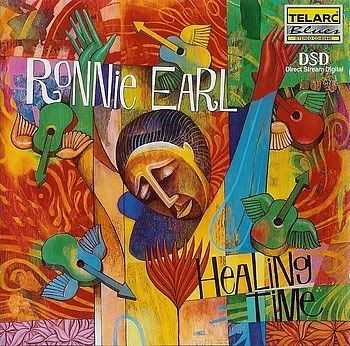
Ronnie Earl - Healing Time - 2000 - Telarc

Ronnie Earl presents a brilliant mix of intense organ-guitar jazz-combo sounds.This all-instrumental album does not go overboard with long over the top screeching guitar solos, all too common with young blues guitarists nowadays. This is blues presented in an intelligent, contemptlative style. Give this album a few listens. You will be impressed. Buy his albums, Language of the Soul, and The Colour of Love. they are majestic recordings from the great New York bluesman.

TRACKS

Churchin`
Catfish Blues
Ide Moments
Thembi
Blues For Shawn
Glimpses Of Serenity
Lunch At R & M`s
Song For A Brother
Bella Donna
Blues On A Sunday
Amazing Grace

Recorded at Blue Jay Studios, Carlisle, Massachusetts between July 23 & August 2, 1999.

BAND

Ronnie Earl (guitar)
Jimmy McGriff (Hammoond B-3 organ)
Anthony Geraci (keyboards)
Michael "Mudcat" Ward (bass)
Don Williams (drums)

REVIEWS

If you're in a blues-induced funk because you haven't heard any great blues/jazz lately, Ronnie Earl has the remedy with this CD. Earl, who played for eight years with Roomful of Blues, and then with his own band, The Broadcasters, adds to his string of fine solo albums with Healing Time, for which he joins forces with Hammond B-3 organ wizard Jimmy McGriff, Anthony Geraci on keyboards, Michael "Mudcat" Ward on bass, and Mark Greenberg and Don Williams trading off on drums and percussion.
"Churchin'" hits a nice blues groove right out of the gate. It's a McGriff original, and Jimmy solos like the tune is indeed his own. Earl, a guitarist of many sounds, is nice and laid-back on this one. He shows his down and dirty side with his introductory solo on "Catfish Blues," blending the best of Chicago and delta style. "Idle Moments" slips into the jazz vein with a slow, majestic, and thoughtful blues, great for late night contemplation.
The band taps an Afro-Cuban vein in Pharoah Sanders' "Thembi." There's some nice piano work by Geraci, and Earl makes his guitar sound almost like a fiddle on this one. "Blues for Shawn" follows. It's slow, deep, sensitive and meaningful, with some underlying B-3 work that provides a haunting presence. Even more contemplative is "Glimpses of Serenity," a fairly blues-free jazz number, slow and dreamy.
We're back to straight-out Chicago blues with "Lunch at R&M's," which boasts a flaming guitar/B-3 duet. "Song for a Brother" offers up a slow rock/fusion tempo with a lovely melodic line, followed by a free-form ballad with "Bella Donna." The nearly ten-minute "Blues on a Sunday" gives us a slow, intense blowing session, with hot solos being traded back and forth and a fine, moody coda that seems to lead into the final track, "Amazing Grace," a graceful reading that ends the album on a note of moving finality. Earl and McGriff work like one mind on this one.
Healing Time is a superb blues/jazz album, one that I can't imagine fans of either genre not digging. Earl's virtuosity is evident in every note, and McGriff's driving, rolling organ work puts the icing on the cake. Highly recommended. © Roomful of Blues.
Not unlike such disparate artists as John Coltrane, John Lennon, or Al Green, Ronnie Earl preaches music`s underlying power to cure an ailing soul, and mend a broken heart. On HEALING TIME Earl sets out to encourage us to, as he says, "feel the music, not just be awed by the technique," and the 11 songs included here lead listeners in this direction. "Churchin`," is an electrifying blues shuffle, while the tunes that follow take us on a musical journey through slow 12/8 blues ("Blues for Shawn") to a cheerful quasi-Latin feel ("Thembi"). Earl`s lyrical, always bluesy, improvisations are strongly featured throughout. Organ legend Jimmy McGriff is also heard in superb form on many of the selections including "Blues on a Sunday" and "Catfish Blues." The album closes with a stately version of the traditional song, "Amazing Grace." On this African-American spiritual, Ronnie Earl leaves us with a sense of hope and optimism. HEALING TIME is an emotionally charged album that delivers a unique and potent balm for the soul.

BIO

Ronnie Earl was born Ronald Horvath in Queens, NY, on March 10, 1953. He didn't start playing guitar until after he entered college at Boston University in the early '70s and became fascinated with the local blues scene. Developing his craft quickly, he landed a job in the house band of the Speakeasy Club in Cambridge, MA, and changed his last name to the bluesier-sounding Earl in tribute to Earl Hooker, one of his favorite influences. Prior to the name switch, he'd made some recordings for the small Baron label under his original moniker beginning in 1977, first backing Guitar Johnny & the Rhythm Rockers, then as a founding member of Sugar Ray & the Bluetones with harmonica player/singer Sugar Ray Norcia. In 1979, Earl was invited to replace Duke Robillard in the prominent Rhode Island band Roomful of Blues, whose swinging jump blues revivalist sound demanded a jazz sensibility as well as ample blues feeling. Earl spent the next eight years with Roomful of Blues and watched their national profile grow steadily larger.

Meanwhile, Earl also made a few recordings on his own for Black Top Records, forming the first versions of the Broadcasters in the early '80s. He released his first solo album, Smokin', in 1983 and followed it with They Call Me Mr. Earl in 1984 (both of those albums were later compiled on the CD Deep Blues). Still, they were a sidelight to his main gig with Roomful of Blues, that is until he left the band in 1987 to make a go of it as a solo artist and bandleader in his own right. A new version of the Broadcasters debuted in 1988 on Soul Searchin', which featured vocalist Darrell Nulisch, harmonica player Jerry Portnoy (ex-Muddy Waters), bassist Steve Gomes, and drummer Per Hanson. Peace of Mind followed in 1990, as did I Like It When It Rains, a live album on Antone's that actually dated from 1986. 1991's Surrounded by Love reunited Earl with Sugar Ray Norcia and also proved the last in his long string of Black Top releases.

By the early '90s, Earl had addressed and overcome his problems with alcohol and cocaine and began to rethink his approach. He formed a new version of the Broadcasters, featuring organist Bruce Katz, bassist Rod Carey, and longtime drummer Per Hanson, and boldly elected to go without a vocalist. Earl debuted his new instrumental direction -- which was more informed by jazz than ever before -- on 1993's Still River (released by AudioQuest) and embarked on a tour of Europe. He signed with the Bullseye Blues label and issued a string of acclaimed albums, including 1994's Language of the Soul, 1995's Blues Guitar Virtuoso Live in Europe (a live album from his 1993 tour originally titled Blues and Forgiveness), and 1996's Grateful Heart: Blues and Ballads (which featured David "Fathead" Newman). The latter two were particular critical favorites, with Live in Europe winning Pulse magazine's year-end poll as Best Blues Album and Grateful Heart doing likewise in DownBeat.

Thanks to all the positive attention, Earl signed a major-label deal with Verve. His label debut, The Colour of Love, was issued in 1997 and sold more than 65,000 copies, making it one of the biggest hits of Earl's career; that year, he also won a W.C. Handy Award as Best Blues Instrumentalist. However, feeling that he was under too much pressure to move more units, Earl soured on the deal and around the same time suffered a bout with manic depression. He wound up not only leaving Verve, but taking a break from bandleading and live performance; he disbanded the Broadcasters and signed with the smaller Telarc label as a solo act. His Telarc debut, 2000's Healing Time, teamed him with legendary soul-jazz organist Jimmy McGriff. The follow-up, 2001's Ronnie Earl and Friends, was a loose, jam session type of affair featuring a number of special guests, including the Fabulous Thunderbirds' Kim Wilson, Irma Thomas, Luther "Guitar Jr" Johnson, and the Band's Levon Helm. In 2003, Earl returned with an album of mainly instrumental material I Feel Like Goin' On on the Canadian based label Stony Plain. A second album from Stony Plain, Now My Soul, appeared in 2004, while a third, The Duke Meets the Earl, which paired Earl with fellow ex-Roomful of Blues guitarist Duke Robillard, was released in 2005. © 2007, Steve Huey, All Music Guide

20.11.07

Vaughan Brothers


vaughanbrothers-familystyle1990


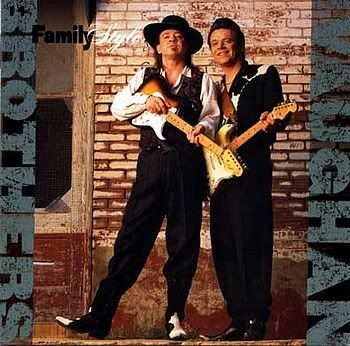
Vaughan Brothers - Family Style - 1990 - Sony

Family Style is a blues-rock album by the Vaughan Brothers, released September 1990. The album features guitarists and vocalists Stevie Ray Vaughan and his brother Jimmie Vaughan in their first studio collaboration. It also proved to be Stevie Ray Vaughan's last studio performance. In his earlier years, Stevie Ray Vaughan often remarked that he would like to do an album with his brother. There is quite a contrast in guitar styles here, and the album is not equal to any of Stevie Ray Vaughan's pure blues solo outings, nevertheless it's a very good blues rock album.

TRACKS

"Hard to Be" (S.R. Vaughan, D. Bramhall) – 4:41
"White Boots" (B. Swan, J. Leslie) – 3:50
"D/FW" (J. Vaughan) – 2:48
"Good Texan" (J. Vaughan, N. Rodgers) – 4:22
"Hillbillies From Outerspace" (J. Vaughan, S.R. Vaughan) – 3:34
"Long Way From Home" (S.R. Vaughan, D. Bramhall) – 3:15
"Tick Tock" (J. Vaughan, N. Rodgers, J.L. Williams) – 4:54
"Telephone Song" (S.R. Vaughan, D. Bramhall) – 3:28
"Baboom/Mama Said" (J. Vaughan, S.R. Vaughan, D. Freeman) – 4:29
"Brothers" (J. Vaughan, S.R. Vaughan) – 5:05

PERSONNEL

Stevie Ray Vaughan
Tawatha Agee
Brenda White-King - background vocals
Stan Harrison - saxophone
Richard Hilton - piano, organ
David Spinner
Preston Hubbard - acoustic bass
Steve Elson
Jimmy Vaughan - vocals, guitar
Larry Aberman
Curtis King Jr.
Al Berry - bass

Also: Nile Rodgers, Doyle Bramhall, Rockin' Sidney

REVIEW

With slick production from Nile Rodgers and employing neither guitarist's band (Double Trouble nor the Fabulous Thunderbirds , this is bluesy, but far from purist. Jimmie makes his vocal debut on "White Boots" and "Good Texan," and the brothers blur the lines between their expected guitar styles -- Stevie sometimes going for a less sustainy twang, Jimmie moving into Albert King territory. When standard blues is the order of the day (the slow instro "Brothers"), the key word is "standard" -- bordering on run-of-the-mill. Instrumentals "D/FW" and "Hillbillies from Outer Space" fare better -- offering ZZ Top crunch and Santo & Johnny steel, respectively. © Dan Forte, All Music Guide

BIO

Sibling blues guitarists Jimmie Vaughan (born in 1951) and Stevie Ray Vaughan (1954-1990) were born and raised in Dallas, TX. Each began playing guitar during childhood, Stevie Ray inspired to take up the instrument by his older brother. Jimmie Vaughan played in various groups in Dallas and Austin before hooking up with singer/harmonica player Kim Wilson and forming the Fabulous Thunderbirds in 1974. The group was signed to Chrysalis Records, for which they made four albums, starting with a self-titled 1979 debut. The second and third of them, What's the Word (1980) and Butt Rockin' (1981), made the lower reaches of the charts, but the band was dropped by the label after the commercial failure of T-Bird Rhythm in the fall of 1982.

Meanwhile, Stevie Ray Vaughan had been playing around Texas, at first with Triple Threat featuring singer Lou Ann Barton, and then, after her departure, with drummer Chris Layton and newly recruited bassist Tommy Shannon as Stevie Ray Vaughan & Double Trouble. His appearance at the Montreux Jazz Festival in 1982 led to a recording contract with Epic Records and the release of his debut album, Texas Flood, a Top 40 hit, in 1983. He followed it with the even more successful Couldn't Stand the Weather (1984) and Soul to Soul (1985), each of which went gold within two years. (All three albums have since gone platinum.)

Stevie Ray Vaughan's success stimulated Epic's interest in his brother's band. The Epic subsidiary CBS Associated signed the Fabulous Thunderbirds and issued Tuff Enuff (1986), which spawned a Top Ten single in the title-track and itself made the Top 20, going gold within six months and eventually platinum. The same year, Stevie Ray Vaughan issued Live Alive, which eventually went platinum.

The careers of both brothers subsided soon after. Stevie Ray Vaughan went into rehab, while the Fabulous Thunderbirds' follow-ups to Tuff Enuff, Hot Number (1987) and Powerful Stuff (1989), did not match its commercial success. Jimmie Vaughan amicably parted from the band in June 1990. Stevie Ray Vaughan returned after more than two and a half years with In Step (1989), which became his biggest seller yet, eventually going double platinum. The brothers had long planned a duo project, and in 1990 they finally found time for it, recording Family Style. But the month before the album's scheduled release, Stevie Ray Vaughan was killed in a helicopter crash on August 27, 1990. The album appeared in September and it soared into the Top Ten, selling over a million copies.

Jimmie Vaughan helped oversee posthumous releases of his brother's recordings, such as the two-million-selling Top Ten hit The Sky Is Crying (1991). He launched his own solo career in the spring of 1994 with Strange Pleasure, released by Epic. © William Ruhlmann, © 2007 All Media Guide, LLC

Savoy Brown


savoybrown-collection1994

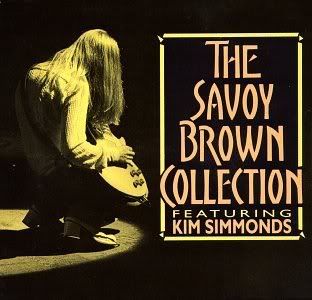
Savoy Brown - The Savoy Brown Collection (Featuring Kim Simmonds) - 1993 - Chronicles/Deram

With one of the smoothest and most compelling guitarists of the blues-rock style, Savoy Brown and the finger wizardry of Kim Simmonds unleashed some of the smoothest and most mesmerizing rock & roll of the 1970s. Their ingenious blend of contented blues and hard-edged rock resulted in some wholesome yet somewhat bypassed guitar music. The Savoy Brown Collection is a two-disc compilation that takes their best tunes from 14 different albums and presents the listener with a sufficient amount of material that never becomes tiresome. Some of the meatier material comes from 1971's Street Corner Talking, like the ultra-smooth "I Can't Get Next to You" and Willie Dixon's "Wang Dang Doodle." Equally impressive is the haunting "Poor Girl" or the desperate guitar cry of "Leavin' Again," both from the sensational Looking In album. The real treasures are the lone tunes taken from some of their lesser-known albums. "I'm Tired," from A Step Further, emanates pathos through instrumentation, while "Stranger Blues" is a startling example of prime guitar manipulation. Early material from albums like Shake Down and Blue Matter have former lead singer Chris Youlden at the helm, who departed before the Looking In album, replaced by Lonesome Dave Peverett who later formed Foghat. Overshadowed by bands like the Yardbirds and Led Zeppelin, Savoy Brown didn't get the acclaim they actually deserved. Rightfully so, the words "Featuring Kim Simmonds" are underneath the title of this two CD set, since his craftsmanship is truly the heart of this talented band. Everything that is even the least bit important from this group is strewn across this compilation. © Mike DeGagne, All Music Guide, 07/13/2005 5:27 AM, AMG

TRACKS & COMPOSERS

DISC ONE

1. I Ain't Superstitious 3:28 (Dixon)
2.Shake 'Em On Down 6:03 (Trad. Arr. Hall/Brown)
3. Stay With Me Baby 2:38
(Youlden/Simmonds/Peverett)
4. Mr. Downchild 5:28 (Youlden/Simmonds)
5. Train To Nowhere 4:08 (Youlden/Simmonds)
6. She's Got A Ring In His Nose And A Ring On
Her Hand 2:59 (Youlden)
7. Louisiana Blues 8:52 (Morganfield)
8. Made Up My Mind 2:56 (Youlden)
9. I'm Tired 3:19 (Youlden)
10. A Hard Way To Go 2:17 (Youlden)
11. Needle And Spoon 3:17 (Youlden)
12. Stay While The Night Is Young 3:06 (Youlden)
13. Poor Girl 4:03 (Stevens)
14. Money Can't Save Your Soul 5:33 (Simmonds/Peverett)
15. Sunday Night 5:21 (Simmonds)
16. Leavin' Again 8:27 (Stevens/Peverett)

DISC TWO

1. Tell Mama 5:16 (Simmonds/Raymond)
2. I Can't Get Next To You 6:31
(Whitfield/Strong)
3. Street Corner Talking 4:01 (Simmonds)
4. All I Can Do 10:50 (Simmonds/Raymond)
5. Wang Dang Doodle 6:55 (Dixon)
6. Hellbound Train 9:10 (Simmonds/Silvester)
7. Shot In The Head 4:43 (Vanda/Young)
8. Second Try 4:15 (Simmonds)
9. Coming Down Your Way 4:50 (Lynton)
10. EveryBody Loves A Drinking Man 3:04
(Anderson)
11. Stranger Blues 3:30 (Simmonds/Raymond)
12. Walkin' And Talkin' 4:39
(Simmonds/Raymond)
13. Double Lover 6:07 (Simmonds/Ellis)


CREDITS

Kenny Wheeler (Trumpet), Bob Hall (Piano), Don Lusher (Trombone), Miller Anderson (Guitar), Miller Anderson (Vocals), Sue Glover (Vocals (Background)), Sunny Leslie (Vocals (Background)), Jackie Lynton (Vocals), Mike Vernon (Producer), Mike Vernon (Horn Arrangements), Chris Youlden (Vocals), Chris Youlden (Producer), Stan Sulzmann (Sax (Soprano)), Ron Berg (Percussion), Dave Bidwell (Drums), Eddie Blair (Trumpet), Savoy Brown (Producer), Savoy Brown (Main Performer), Savoy Brown (Horn Arrangements), Ray Chappell (Bass), Raymond Davis (Flugelhorn), Eric Dillon (Drums), Roger Earle (Drums), John Edwards (Trombone), Bob Efford (Sax (Tenor)), Ian Ellis (Bass), Ian Ellis (Vocals (Background)), Tom Farnell (Drums), Terry Flannery (Trombone), Bobby Haughey (Flugelhorn), Don Honeywell (Sax (Baritone)), Butch Hudson (Trumpet), Rivers Jobe (Bass), Robert John "Mutt" Lange (Producer), Bill Levenson (Compilation Producer), Jim Leverton (Bass), Jim Leverton (Vocals (Background)), Leo Manning (Drums), Keith Martin (Trombone), Alan Moore (Trombone), Rex Morris (Sax (Tenor)), Barry Murray (Percussion), Barry Murray (Producer), Terry Noonan (Horn Arrangements), Joseph M. Palmaccio (Mastering), Brian Perrin (Trombone), Lonesome Dave Peverett (Guitar), Bryce Portius (Vocals), Andy Pyle (Bass), Andy Rae (Bass), Andy Rae (Vocals), Paul Raymond (Guitar), Paul Raymond (Keyboards), Paul Raymond (Producer), Frank Ricotti (Percussion), Andy Silvester (Bass), Harry Simmonds (Producer), Kim Simmonds (Guitar), Kim Simmonds (Piano), Kim Simmonds (Producer), Kim Simmonds (Slide Guitar), Neil Slaven (Producer), Martin Stone (Guitar), Derek Wadsworth (Trombone), Dave Walker (Vocals), Tone Stevens (Bass), Terri Tierney (Coordination

BIO (Wikipedia)

Savoy Brown is a British blues band formed in the 1960s. Originally known as the Savoy Brown Blues Band, their 1969 single "Train to Nowhere" (with singer Chris Youlden), was viewed by many as the last gasp of the blues scene in Great Britain. Although Savoy Brown never reached much acclaim in their home nation, they developed a loyal core following in the United States, due to songs such as "I'm Tired" (from their album, A Step Further), a driving, melodic song. They were one of the bands that UK Decca (US London/Parrot) stuck with through the lean times until they started selling records (it took 4 or 5 albums until they started to sell in the US). In the late 1960s and 1970s, the band managed to penetrate the Billboard Hot 100. Superstardom perpetually evaded them, perhaps in part because of their frequent lineup changes, but despite that, "Hellbound Train" was a big album for them in the US.
While the band is still active today, only Kim Simmonds has stayed since the beginning. Guitarist "Lonesome" Dave Peverett, bassist Tone Stevens, and drummer Roger Earle went on to form Foghat. Original member and harmonica player, John O'Leary, is still active on the British blues circuit with The John O'Leary Band. Savoy Brown's first album, Shake Down, featured lead vocalist Bryce Portius. Portius was one of the first black blues musicians to be a part of a British rock band. Another singer, Dave Walker, would later join Fleetwood Mac and Black Sabbath.
Savoy Brown also provided an outlet for the keyboardist and guitarist, Paul Raymond, who later went on to join UFO. Other notable members include Jeff Howell, who went on to play with Foghat and the Outlaws before returning to central New York, where he is considered the best carpet installer in Ithaca.

ABOUT KIM SIMMONDS

For over 30 years Kim Simmonds has been synonymous with 'legendary British blues guitar', being mentioned in the same breath as Eric Clapton, Peter Green and Mick Taylor in the hierarchy of England's best guitar slingers from the 60s golden era of British blues. Kim started his career in London, England in 1966 by forming the group Savoy Brown and has since enjoyed international fame. He's been featured on the front cover of Guitar Magazine, made over 3 dozen records and performed around the world. He has an international fan club based in Wales and a web site at www.savoybrown.com. Kim's records with Savoy Brown (many produced by himself) have sold millions, with albums such as Looking In and Hellbound Train reaching the Billboard Top 40 charts. Many of his songs have been covered by such diverse artists as Rare Earth, Hugo Montenegro and Great White. In 1995, a two CD boxed set, The Savoy Brown Collection released by Polygram Records, chronicled his and the band's astonishing career. As a solo artist and in the acoustic field Kim has released three CDs - Savoy Brown's 1986 Slow Train, his own 1997 Solitaire, and the 2001 release Blues Like Midnight. Born in Wales in 1947 and playing the pubs of London with Savoy Brown at the very tender age of 18, Kim Simmonds recorded albums that helped start the 60s blues boom. While others have strayed from their roots, Simmonds has stayed the course .... a true journeyman and road warrior, who's comfortably settled into an elder statesman role at the same time as burning up the fretboard on the concert stage while remaining at the top of his game. (c) The British Blues All Stars 2004, www.thebritishbluesallstars.co.uk/kim_simmonds.htm

Average White Band


averagewhiteband-feelnofret1979


Average White Band - Feel No Fret - 1979 - Atlantic


Regarded by many as the AWB's weakest album. It is not up to the band's usual standards, but is still better than average, and well worth having for the one brilliant track, "Atlantic Avenue." Check out their "Cut the Cake," and "Person to Person" albums for a real taste of just how good this group was.

TRACKS

1 When Will You Be Mine (Average White Band/Gorrie)
2 Please Don't Fall in Love (Ball/Gorrie)
3 Walk on By (Bacharach/David)
4 Feel No Fret (Average White Band/Ferrone/Gorrie/Stuart)
5 Stop the Rain (Gorrie/Stuart)
6 Atlantic Avenue (Average White Band/Ferrone/Gorrie)
7 Ace of Hearts (Ferrone/Gorrie/Stuart)
8 Too Late to Cry (Stuart)
9 Fire Burning (Average White Band/Gorrie)

PERSONNEL

Alan Gorrie- Bass, Guitar (1, 2, 3, 6), Vocals, Hamish Stuart- Bass (1, 2, 3, 6), Guitar, Vocals, Onnie McIntyre- Guitar, Vocals Roger Ball- Keyboards, Saxophone, Horn & String Arrangements Malcolm Duncan- Saxophone, Sax (Tenor) Steve Ferrone- Drums, Percussion Production Credits The Average White Band - Producer Gene Paul - Engineer Benji Armbrister - Assistant Engineer
Additional Musicians
Airto Moreira- Percussion (4, 6)
Luis Carlos Dos Santos - Surdo (6) Zeca da' Cuica - Cuica (6) Michael Brecker- Sax (Tenor) Randy Brecker- Trumpet, Louis Del Gatto- Saxophone Luther Vandross - Background Vocal (8) Arif Mardin - String Arrangement on Ace Of Hearts

REVIEW

From their self-titled sophomore album of 1974 to 1978's Warmer Communications, the Average White Band enjoyed a commercial winning streak in the '70s; all of the albums they recorded for Atlantic during that period went either gold or platinum in the United States (and that is in addition to their impressive sales in Europe). But if any AWB album demonstrated that all good things must eventually come to an end, it was Feel No Fret. This 1979 LP marked the first time since 1973's Show Your Hand (also known as Put It Where You Want It) that an AWB album didn't enjoy either gold or platinum sales in the U.S., and it was also the most uneven album they recorded in the '70s. So what went wrong? Perhaps the absence of Arif Mardin was a factor; Mardin had produced all of AWB's previous Atlantic releases, whereas they produced Feel No Fret themselves. If Mardin had been encouraging the Scottish soul/funk band to go that extra mile, they settled for decent or competent on this record. Feel No Fret is far from a total meltdown, and the material is generally likable -- especially the good-natured "Atlantic Avenue," the slow-grinding "When Will You Be Mine," and a remake of the Burt Bacharach/Hal David favorite "Walk On By" (which became a minor hit and made it to number 32 on Billboard's R&B singles chart). But after Mardin-produced treasures like AWB, Soul Searching, Cut the Cake, and Warmer Communications, AWB followers had become extremely spoiled -- they expected excellence, not a record that was merely adequate. Nonetheless, hardcore devotees (as opposed to casual listeners) will want to hear this album, which Rhino reissued on CD as Feel No Fret...and More (with four bonus tracks added) in 1994. © Alex Henderson, All Music Guide

BIO

This unique act, an R'n'B/ soul group from Scotland with only two black musicians became one of the best selling and sounding funk bands in the world. The horn section started out as "The Dundee Horns". They can be heard on Johnny Nash's reggae hit "I Can See Clearly Now". Eric Clapton and Bonnie Bramlett (of Delaney & Bonnie) helped them on their way to becoming a household name. But it wasn't until they reached the US and were signed to Atlantic Records that the Average White Band really took off (Jerry Wexler signed them on the spot, after they hit him at home on one of his parties, where they played him the basic tracks for what would become the White Album: "AWB"). Arif Marden became their producer and together they couldn't do wrong. All of their seventies albums reached gold or even platinum status and hits such as the timeless "Pick Up The Pieces" and "Cut The Cake" were number 1 hits on the U.S. Billboard Charts. Tragedy hit the young group in 1974 when their drummer, Robbie McIntosh died at a Hollywood party in a drug-related incident, but their act only became stronger. The Double album "Person To Person", recorded during their American 1975 Tour, is among the best selling live funk albums ever. They reached the white market with their unique sound without losing respect from the core Soul/ R'n'B lover in the black communities. © 2007 Discogs

Mother Earth


motherearth-satisfied1970


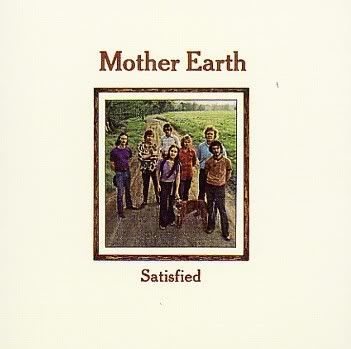
Mother Earth - Satisfied - 1970 - Mercury

Rare seventies blues rock album with some great tracks. A very honest album with none of the pseudo psychedelic trippy hippy influences which plagued many albums of this genre. A very good album. Please make allowances for the average sound quality. See if you can find Tracy Nelson's great album, "Deep Are the Roots."

TRACKS & COMPOSERS (Where known)

1. Satisfied - Martha Carson
2. Groovy Way
3. Get Out Of Here
4. Ruler Of My Heart
5. Andy's Song - Tracy Nelson
6. Take Me In Your Arms, Rock Me A LIttle While - Lamont Dozier, Eddie Holland, Brian Holland
7. You Won't Be Passing Here No More
8. This Feeling - Scotty Miller

CREDITS

Tracy Nelson (Piano), Tracy Nelson (Keyboards), Tracy Nelson (Vocals), Tracy Nelson (Vocals (Background)), Mother Earth (Main Performer), Jimmy Day (Guitar (Steel)), Ben Keith (Dobro), Ben Keith (Musician), John Andrews (Guitar), John Andrews (Guitar (Electric)), John Andrews (Musician), Sadie Cantrell (Vocals (Background)), Sadie Cantrell (Group Member), Bob Cardwell (Guitar), Bob Cardwell (Guitar (Electric)), Bob Cardwell (Vocals (Background)), Bob Cardwell (Musician), Bob Cardwell (Group Member), Sammy Dodge (Fiddle), Sammy Dodge (Musician), Karl Himmel (Drums), Karl Himmel (Musician), Farrell Morris (Percussion), Farrell Morris (Musician), Irma Routen (Vocals (Background)), Irma Routen (Group Member), Dave Zettner (Bass), Dave Zettner (Vocals (Background)), Dave Zettner (Musician), Dave Zettner (Group Member), Travis Rivers (Producer), James Day (Pedal Steel), James Day (Guitar (Steel)), James Day (Musician), John Gimbel (Fiddle), John Gimbel (Musician), Charles Talent (Engineer), Andy McMahon (Organ), Andy McMahon (Piano), Andy McMahon (Musician), Andy McMahon (Group Member), Andrew McMahon (Organ), Andrew McMahon (Piano), Andrew McMahon (Keyboards), Andrew McMahon (Vocals (Background)), Tracy Lee Nelson (Piano), Tracy Lee Nelson (Vocals), Tracy Lee Nelson (Musician), Tracy Lee Nelson (Group Member)

REVIEWS

By the time of Satisfied, Mother Earth had become pretty much a vehicle for Tracy Nelson plus backing band. There's just one original on this set, Nelson's "Andy Song," and the album sticks to a loose but R&B-focused groove, sometimes stretching the songs out in a fashion that probably would have been more tightly edited had such an approach not been in vogue in 1970. Nelson's vocals are consistently strong and stirring, and the material is commendably diverse, though overall it's just an okay album that could use a little more oomph. The white R&B vibe is tempered by strong streaks of gospel, New Orleans music, and even a bit of jazz, particularly on the smoother parts of "Groovy Way." © Richie Unterberger, All Music Guide
Countrified rock from Tracy Nelson and Mother Earth -- done in a warm and sincere style that goes way beyond any of the cliches of the genre! There's something about the way the group put together the tunes that really makes us like this one -- an honesty that's not bogged down in any hippy dippy expectations, and which never tries to be anything other that what it is. And yes, that's not much of a good description of the set -- but it's also our way of identifying the uniqueness that set Mother Earth apart from a lot of their contemporaries. Titles include "Satisfied", "Groovy Way", "Andy's Song", "Ruler Of My Heart", "This Feeling", and "You Won't Be Passing Here No More". © 1996-2007, Dusty Groove America, Inc
Tracy Nelson doesn't touch everyone, but once she does, she carries you away. She can be sexual and spiritual not successively but on the same note and breath; she seems to suffer and to transcend suffering simultaneously. Vocally, Mother Earth is now Tracy Nelson, and although in theory I miss the male voices--especially Robert St. John's, whose songwriting always added something too--I'm not really complaining. Yet this record is a slight disappointment. I love it, but I know that my prejudices are strong and that only once--on her own composition, "Andy's Song"--does Tracy burst calmly into free space as she does so often on the two previous Mother Earth lps and on Tracy Nelson Country. Recommended unequivocally to her cadre and equivocally to the benighted. A- © Robert Christgau, www.robertchristgau.com/get_artist.php?name=Mother+Earth

BIO

The late-'60s/early-'70s blues-rock outfit Mother Earth was led by singer Tracy Nelson and issued several somewhat underappreciated releases during their time span. Nelson was originally from Madison, WI, and it was while attending the University of Wisconsin that the singer was discovered by producer Sam Charters and was eventually signed to a recording contract with the Prestige label. 1965 saw the release of Nelson's solo debut, the folk-based Deep Are the Roots, and when it didn't exactly burn up the charts, Nelson decided to relocate to San Francisco, with the hopes of forming a more conventional rock outfit. Shortly after arriving on the West Coast, Mother Earth was formed, which led to performances at the famed Fillmore West, opening for the likes of Janis Joplin, Jimi Hendrix, and Eric Burdon. After an appearance on the soundtrack to the 1968 motion picture Revolution (which also featured the Quicksilver Messenger Service and the Steve Miller Band), Mother Earth signed with Mercury Records and issued a steady stream of releases until the early '70s.

These albums included 1968's Living with the Animals 1969's Tracy Nelson Country and Make a Joyful Noise, 1970's Satisfied, 1971's Bring Me Home, 1972's Tracy Nelson/Mother Earth, and 1973's Poor Man's Paradise, before Nelson pursued a solo career. Subsequently, Nelson earned a Grammy nomination in 1974 for the track "After the Fire Is Gone" (a duet with Willie Nelson) and continued to issue solo albums until the early '80s, when she became disillusioned with the direction that popular music was going in (although she did sing backup for Neil Young for a spell in the mid-'80s, including appearing with Young at the mammoth Live Aid concert in 1985). Nelson returned to music in the '90s, beginning with 1993's In the Here and Now, continuing to issue solo recordings (and in 1998, earned another Grammy nomination for the release Sing It!, a collaboration with Marcia Ball and Irma Thomas). © Greg Prato, All Music Guide

Average White Band


averagewhiteband-cupidsinfashion


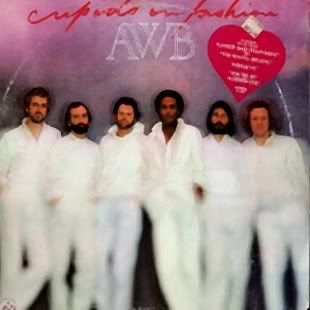
Average White Band - Cupid's In Fashion - 1982 - Arista & RCA

One of the great soul funk groups, The Average White Band made some brilliant albums. Check out "Cut the Cake," and "Person to Person." This is not one of their best albums, but is still well worth listening to for the AWB's unique sound. Apologies for the 128 kbps.

TRACKS

A1.You're My Number One (3:21) - (Hartman)
A2.Easier Said Than Done (4:08) - (Kashif)
A3.You Wanna Belong (4:25) - (Ball/Cherry)
A4.Cupid's In Fashion (4:21) - (Stuart/Gorrie/Ball/AWB)
A5.Theatre Of Excess (4:31) - ( Gorrie/AWB)

B1.I Believe (4:32) - (Falsey/Faltermeyer)
B2.Is It Love That You're Running From (4:13) - (Gorrie)
B3.Reach Out I'll Be There (3:53) - (Holland/Dozier/Holland)
B4.Isn't It Strange (3:23) - (Stuart/Doheny)
B5.Love's A Heartache (4:49) - (Doheny)

PERSONNEL

Arranged By [Horns & Synthesizer] - Roger Ball
Arranged By [Vocals] - Alan Gorrie , Hamish Stuart
Backing Vocals - Joe Melotti (tracks: A4)
Drums - Steve Ferrone
Engineer - Michael R. Hutchinson*
Engineer [Additional] - Jay Mark
Engineer [Assistant] - Glenn Rosenstein
Guitar - Richie Stotts (tracks: A5)
Guitar, Vocals - Onnie McIntyre
Keyboards, Saxophone [Alto] - Roger Ball
Lead Vocals, Bass, Guitar, Keyboards - Alan Gorrie
Lead Vocals, Guitar, Bass - Hamish Stuart
Percussion - Sammy Figueroa
Piano, Backing Vocals - Dan Hartman
Producer - Dan Hartman
Saxophone [Tenor], Flute - Malcolm Duncan
Synthesizer - Jeff Bova , Mark Gray (2) (tracks: B4)
Trumpet, Flugelhorn - Randy Brecker

BIO

The Average White Band had their name jokingly bestowed on them by Bonnie Bramlett of Delanie & Bonnie; during their prime, AWB's solid grooves and overall chemistry were anything but average. But the name did reflect their paradoxical position: they were an American-style soul band made up of native Scots. The group was formed in Glasgow, Scotland, in early 1972 by Alan Gorrie (b. Jul. 19, 1946, Perth, Scotland) on bass, vocals, Michael Rosen; (soon replaced by Hamish Stuart; [b. Oct. 8, 1949, Glasgow, Scotland] [guitar, vocals]), Onnie McIntyre, (b. Sep. 25, 1945, Lennox Town, Scotland) on vocals, guitar, Robbie McIntosh (b. 1950, Scotland - d. Sep. 23, 1974, Los Angeles), Roger Ball, (b. Jun. 4, 1944, Dundee, Scotland) on keyboards, saxophone, and Malcolm Duncan, (b. Aug. 24, 1945, Montrose, Scotland) on saxophone. After their 1973 debut album, Show Your Hand, went unnoticed, they hooked up with producer Arif Mardin to record Average White Band (frequently called AWB because of the initials on the cover). Released in August 1974, the album topped the charts and spawned the near-instrumental dance hit "Pick Up the Pieces," which also went to number one. Meanwhile, tragedy struck the band, when drummer Robbie McIntosh died of a drug overdose; he was replaced by Steve Ferrone (b. Apr. 25, 1950, Brighton, England). AWB nearly replicated its success with the third album, Cut the Cake, and its title single, both of which reached the Top Ten. But the sameness of the group's approach and such side projects as an album with Ben E. King broke its momentum. Also, the rise of disco left its funky soul style sounding dated. AWB managed a couple more gold albums in Person to Person (January 1977) and Warmer Communications (March 1978), and its popularity lasted longer in the UK than in the US, but by the start of the '80s the band was permanently out of fashion. The band members have worked as session sidemen for artists ranging from Chaka Khan to Paul McCartney and Badfinger. © Rick Clark & William Ruhlmann, All Music Guide

19.11.07

Air Jazz Quartet (Deep Purple related)


airjazzquartet-jazztribute2deeppurple


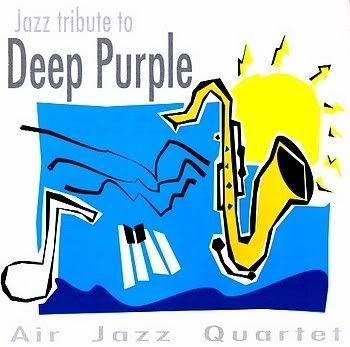
Air Jazz Quartet - Jazz Tribute to Deep Purple - 1995 - Transe Music

This is something very different. A four man French band remake nine classic Deep Purple songs with jazz style. Some of the tracks are so intricately arranged, that you would hardly recognise that they were Deep Purple songs. But the album is very well done, especially Black Night.This is a very good, and unusual album. Try and free your mind from the heavy Deep Purple riffs, and try and focus on the expertly executed jazz arrangements. It's modern tuneful acoustic jazz, and you may well get to like it, whether or not you like Deep Purple, or jazz! VHR by A.O.O.F.C

MUSICIANS

Philippe Ballot : drums
François Barisaux: piano
Alain Gaillet: bass
Philippe Miraille: tenor & soprano sax

TRACKS

01] Hush
02] Highway Star
03] Black Night
04] Smoke On The Water
05] Woman From Tokyo
06] Strange Kind Of Woman
07] Burn
08] Fireball
09] Child In Time

The Modern Jazz Quartet


modernjazzquartet-pyramid1959


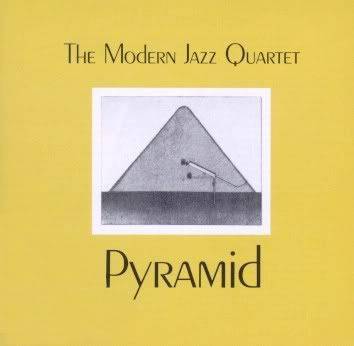
The Modern Jazz Quartet - Pyramid - 1959 - Atlantic

This is a strong recording from The Modern Jazz Quartet with inventive versions of John Lewis's "Vendome," and Ray Brown's "Pyramid," Jim Hall's "Romaine," Lewis's famous "Django," and cooking jams on "How High the Moon" and "It Don't Mean a Thing." The MJQ had become a jazz institution by this time, but they never lost their creative edge, and their performances (even on the remakes) are quite stimulating, enthusiastic and fresh. © Scott Yanow, All Music Guide

TRACKS

1. Vendome (2:30) Composed by John Lewis
2. Pyramid (Blues for Junior) (10:46) Composed by Ray Brown
3. It Don't Mean a Thing (If It Ain't Got That Swing) (5:02) Composed by Irving Mills
4. Django (5:23) Composed by John Lewis
5. How High the Moon (6:15) Composed by Nancy Hamilton
6. Romaine (7:28) Composed by Jim Hall

MUSICIANS

Percy Heath - bass
Milt Jackson - vibes
Connie Kay - drums
John Lewis - piano


BIO (Wikipedia)


The Modern Jazz Quartet was established in 1952 by Milt Jackson (vibraphone), John Lewis (piano, musical director), Percy Heath (bass), and Kenny Clarke (drums). Connie Kay replaced Clarke in 1955. Through the years the quartet had performed in several jazz styles, including bebop, cool jazz and third stream. Milt Jackson, Lewis, and Clarke had originally played together in a quartet while in the Dizzy Gillespie orchestra from 1946 to 1950. Together with Ray Brown they played during interludes designed to give the trumpeters time to recover from the challenging upper register trumpet parts. This line-up recorded as the Milt Jackson Quartet in 1951.
Jackson and Lewis originally shared the role of musical director but Lewis eventually took over the entire responsibility of this position.
In their middle years the group often played with classical musicians, but its repertoire consisted mainly of bop and Swing era standards. Among the original compositions from the band's book are "Django" by Lewis (a tribute to the Belgian jazz guitar player Django Reinhardt), "Afternoon In Paris", also by Lewis and "Bags' Groove" by Jackson (Bags was his nickname).
The group was first signed by Prestige and later in the 'fifties with Atlantic. In the late 1960s, in between their two periods with Atlantic, they signed with Apple, the Beatles label (the sole jazz group on the label), and released two albums – Under the Jasmine Tree (1967) and Space (1969).
Jackson left the group in 1974 partly because he liked a freer blowing style of playing and partly because he was tired of playing for little money (compared to rock and roll stars). As there could be no Modern Jazz Quartet without the two principals Lewis and Jackson, the group disbanded. In 1981 the MJQ reorganized to play festivals and later on a permanent six months per year basis. The MJQ's last recording was issued in 1993. Heath, the last surviving member, died in 2005. The enigma of the MJQ's music-making was that each individual member could improvise with an exciting vibrancy but in toto the group specialised in genteel baroque counterpoint. Their approach to jazz attracted promoters who sponsored 'jazz packet' concerts during the 1950s. One show would consist of several contrasting groups. The MJQ were ideal participants because no other group sounded like them. They provided a visual contrast as well, attired in black jackets and pin-striped trousers.
The group played blues as much as they did fugues, but the result was tantalising when one considered the hard-swinging potential of each individual player. Their best-selling record, Django, typified their neo-classical approach to polyphony.

18.11.07

Jackie McLean


jackiemclean-aficklesonance1961


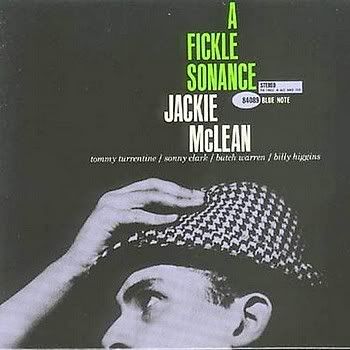
Jackie McLean - A Fickle Sonance - 1961 - Blue Note

One of Jackie McLean's most swinging early Blue Notes, this is a set of great originals by band members McLean, Tommy Turrentine, Sonny Clark and Butch Warren. Billy Higgins lights the fire for the whole proceedings.

MUSICIANS

Jackie McLean (alto saxophone)
Tommy Turrentine (trumpet)
Sonny Clark (piano)
Butch Warren (bass)
Billy Higgins (drums)

TRACKS

1. Five Will Get You Ten 7:06
2. Subdued 5:54
3. Sundu 4:54
4. A Fickle Sonance 6:49
5. Enitnerrut 5:47
6. Lost 4:48

REVIEWS

Alto saxophonist Jackie McLean was one of the few jazz players to come up through bebop and incorporate free jazz into his style. Even though A Fickle Sonance preceded McLean's intense 1962 album Let Freedom Ring, the playing remained in a swinging blues-oriented style, showing no hint of the direction his music was about to take. The sidemen on the date (Tommy Turrentine [trumpet], Sonny Clark [piano], and Butch Warren [bass]) prove to be an invigorating combination of musicians, however not as involved in the burgeoning free music as drummer Billy Higgins. At the time of these sessions, Higgins had already played with Ornette Coleman, providing a link to the avant-garde, but nevertheless his playing follows the hard bop pace of the others. McLean provides two original compositions, Subdued and the title track, while Clark, Turrentine, and Warren fill the remaining tracks. © Al Campbell, All Music Guide © 2007 All Media Guide
All of Jackie McLean's early-'60s Blue Note sessions are worth one's time, but this album features a particularly sparkling ensemble including the under-recorded trumpeter Tommy Turrentine and the rhythm team of Sonny Clark, Butch Warren and Billy Higgins. Add a set of finely crafted original compositions and you have the perfect jazz album. .McLean's trademark alto wail is in classic form here, and Turrentine proves as virile a partner as Donald Byrd had on many other exemplary dates with the saxophonist. Sonny Clark, who provides the swinging compositions "Five Will Get You Ten" and "Sundu," is, likewise, at the top of his game here. Warren, an excellent bassist in the tradition of the great Oscar Pettiford, provides ample rhythmic variety and penned the rollicking closer "Lost." Higgins, a Blue Note regular by this time, is at his swinging best, supporting the whole group with his shimmering cymbals.Allmusic.com:Alto saxophonist Jackie McLean was one of the few jazz players to come up through bebop and incorporate free jazz into his style. Even though A Fickle Sonance preceded McLean's intense 1962 album Let Freedom Ring, the playing remained in a swinging blues-oriented style, showing no hint of the direction his music was about to take. The sidemen on the date (Tommy Turrentine [trumpet], Sonny Clark [piano], and Butch Warren [bass]) prove to be an invigorating combination of musicians, however not as involved in the burgeoning free music as drummer Billy Higgins. At the time of these sessions, Higgins had already played with Ornette Coleman, providing a link to the avant-garde, but nevertheless his playing follows the hard bop pace of the others. McLean provides two original compositions, "Subdued" and the title track, while Clark, Turrentine, and Warren fill the remaining tracks.

Klangwelt


klangwelt-xoio2006


Klangwelt - XOIO - 2006 - Spheric Music

Obviously influenced by Tangerine Dream, & Klaus Schulze, nevertheless this is an excellent work in the electronica genre. Check out his brilliant 2003 CD, The Age Of Numbers, and his first release, “Weltweit”

TRACKS

1 Okzident (10:38)
2 XOIO (11:56)
3 Fun-Fair (6:01)
4 Bed Of Clouds (9:36)
5 River (For Alina) (5:33)
6 Spirits (8:52)
7 La Bella (6:45)
8 No Response (8:12)
9 Fade Away (8:45)

All tracks composed by Gerald Arend

CREDITS

Real Name: Gerald Arend. Gerald is a German keyboard player and audio-designer who is mainly working for the multimedia- and computer-games-industry. Released a few albums under the project-name Klangwelt, influenced by Jean-Michel Jarre, Tangerine Dream, Michael Rother, Vangelis, Kitaro and Klaus Schulze. Producer - Gerald Arend. Mastered By - Gerald Arend , Udo Wiesner

REVIEW

Delicate notes swim in a sea of darker electronics, pulsating with icy disposition amid the shadowy textures. The result is one of optimistic light glimmering in a nocturnal void, a melodic promise emerging from a realm of conventional mundanity. The electronics exhibit a bouncy vigor that is pleasant and engaging. Some of the sounds possess a buzzing edge to their resonance, bestowing a subliminal vibration to the harmonics.
Complex keyboards provide undulating auxiliary melodics that stream through the compositions, adding engaging depth. An air of a futuristic carnival is accomplished, replete with robotic exhibits and twinkling amusement rides that dip in and out of interdimensional realms.
Some of the pieces adopt a more pensive disposition, conveying introspection through smooth atmospherics and sedate riffs designed to pacify the audience, providing a rest stop before the tuneage resumes its customary ebullient delivery.
A rhythmic presence flows in tandem with the harmonic elements generating a soft undercurrent of lively tempos surrounded by fanciful chords and fluid textures. The percussives are synthetic, but display no mechanical mien, hopping along with a congenial manner as they inject discriminating pep to the tuneage.
After this rollercoaster voyage of peppy highs and contemplative valleys, the CD concludes with a moody piece that blends harpsichord with growling diodes. © 2006 Matt Howarth. All rights reserved. http://soniccuriosity.com/sc279.htm

BIO

Klangwelt (“sound-world” or “world of sound”) is the musical project of Gerald Arend, a German audio-designer from Norderstedt (near Hamburg) who’s working for the multimedia- and computer-games-industry. Gerald bought his first synthesizer back in 1982 and started to self-educate keyboard-playing. Together with a friend, he started several musical projects in the area of the German “Neue Deutsche Welle”-movement and independent-pop/rock. They produced a number of homerecorded tapes in the 80’s and finally a CD in 1993. He also was a keyboarder in a rock-band for some two years back in the middle 80’s, playing pop/rock with German lyrics. During the years, Gerald collected more and more equipment to set up and complete his own small recording-studio. In 1995 he finally started to create the electronic “soundworlds” he had always dreamt of - project Klangwelt was born. Klangwelt’s music combines rich, atmospheric soundpads, pulsating rhythms and catching melodies to both relaxing and stimulating instrumental tracks, professionally produced in wide-sounding 3-D-stereo. The first CD “Weltweit” was released in early 2002 and became a big success. It got great reviews from EM-magazines and WWW-sites from all over the world, tracks from the album were played in numerous radio-shows like the US-program “Echoes”. The end of 2003 saw the release of the second album “The Age Of Numbers”, an electronic journey into the fascinating world of numbers and mathematics. The second CD soon received lots of positive reviews and became a big success as well. In late summer 2006, the latest album “XOIO” is released. Gerald and his albums received some of Germany’s most important awards for electronic music. © www.klangwelt.info/welcome-e.html

17.11.07

Jackie McLean


jackiemclean-onestepbeyond1963


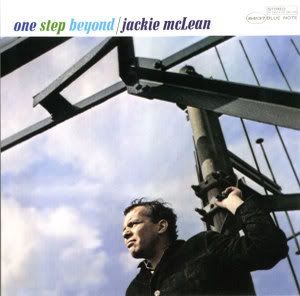
Jackie McLean - One Step Beyond - 1963 - Blue Note

This is a masterpiece of sixties jazz. The interplay between the musicians is unbelievable. You've got to hear this recording. VHR by A.O.O.F.C. You should buy McLeans' albums, Lights Out, & A Long Drinking of the Blues. They don't make them like this anymore.

TRACKS & COMPOSERS

1 Saturday and Sunday (McLean)
2 Saturday and Sunday [alternate] (McLean)
3 Frankenstein (Moncur)
4 Blue Rondo (McLean)
5 Ghost Town (Moncur)

PERSONNEL

Grachan Moncur III (tb)
Jackie McLean (as)
Bobby Hutcherson (vib)
Eddie Khan (b)
Tony Williams (d)

Recorded at the Van Gelder Studio, Englewood Cliffs, New Jersey on April 30, 1963


REVIEWS

One Step Beyond is the first of three albums Jackie McLean made with Grachan Moncur III on trombone and Bobby Hutcherson on vibes (also Eddie Khan on bass and Tony Williams on drums). These three (the other two are Destination...Out! and Moncur’s Evolution ) are the crowning achievement of McLean’s Ornette Coleman-inspired pianoless “outside work” of the early Sixties. McLean has said that in the late Fifties he felt as if he was going nowhere until Ornette’s nascent harmolodics put the wind back in his sails. Not that he sounds much like Ornette on his albums that celebrate “free” playing (most notably Let Freedom Ring ), but compared to his earlier work with Miles, Trane and others, his post- Ornette Blue Notes give a more expressive voice to his characteristic exuberance. He was a trailblazer in bringing the techniques and innovations of the “free” players into the hard bop mainstream.On One Step Beyond that exuberance is very much in evidence, although somewhat tempered by the brooding and dark meditations of Moncur. On “Saturday and Sunday” it is McLean’s mood that is infectious; his typically joyful alto sax solo is followed by an entry from Moncur that in no way changes the tone. Hutcherson, as usual, is masterful at adapting himself to the conditions of the moment. Here he knows that McLean’s one step beyond doesn’t take him far out enough to have lunch with Eric Dolphy, or even to arrive at the point of departure of Andrew Hill. His solo is beautifully precise in straddling the inside/outside fence McLean is building.“Frankenstein,” along with “Ghost Town,” was written by Moncur. The title “Frankenstein” foreshadows the stalking, spooky rhythms the trombonist cultivates on “Ghost Town” and the two later albums, but this piece is about as upbeat as Moncur gets. Moncur is much admired by McLean, who suggested he still deserves wider recognition in a Jazz Times piece just recently. Like Ornette, Moncur’s playing style and composing talent more than compensate for a certain lack of conventional technical facility. While his solos don’t have the sharpness or speed of those of J. J. Johnson or Curtis Fuller, Moncur’s strong melodic imagination gives his work a good emotional wallop. Here McLean explores “out” territory and borrows a few squeals and squawks from Ornette Inc. He uses them more sparingly than his source, but not without effect.“Blue Rondo” takes us briefly back into McLean’s hard bop happyland, only to lead into Moncur’s “Ghost Town.” This is a ready-made soundtrack for a stalker movie, as bassist Eddie Khan paces through a horror house full of drummer Tony Williams’ falling objects. McLean’s solo is thoughtful and well-constructed; Moncur’s is fine, but Hutcherson steals the show with a Milesian exploration of space and silence that splendidly brings together the inside and the outside.This album is somewhat lumpy gravy; the front line of McLean, Moncur, and Hutcherson works better together on Destination...Out! and Evolution. Still, any Jackie McLean album can lift the spirits wonderfully. Pick it up during your next Jackie Mac attack. © Robert Spencer, Allaboutjazz.com
One Step Beyond is a classic in every sense of the word. The musicianship is stellar. The interplay between the band members is telepathic. And the compositions are fascinating and distinctive. If you're following Bobby's development on record, coming to this music after listening to the Al Grey-Billy Mitchell group is like stepping out of a familiar sedan and finding yourself on a rocket-ship.
Several of the compositions remind me of Monk's music, particularly "Saturday and Sunday" and "Frankenstein." But there's also a strangely wide-open aspect to this music that's different from Monk's sound. The wide-open feeling is both literal and figurative. The absence of a piano has a huge effect on creating the limitless, airy sound. (I assume that Jackie's decision to play without a piano comes from Ornette's influence.) On a composition like "Ghost Town," you can practically see crumbling buildings, dusty tumble-weeds blowing by. (Or at least that's why I think of.) But that openness is wonderful because Jackie's slashing, magisterial, harshly bluesy tone can fill up all that space, propelled by Tony Williams' careening drums. (No wonder Miles "stole" Tony from this band.) Incidentally, I think that the cover of this album is one of Blue Note's best. It does a perfect job of pictorially representing the music.
Of course, Bobby plays magnificently here too. Apparently, when Alfred Lion first heard this band rehearsing, he'd only heard one song before proceeding to offer Bobby a contract. Hutcherson ended up staying with Blue Note longer than any other artist except Horace Silver. © Scott Mortensen 2006, http://musicweb-international.com

BIO (Wikipedia)

John Lenwood (Jackie) McLean (May 17, 1931 – March 31, 2006; some sources erroneously give 1932 as his year of birth) was an American jazz alto saxophonist, composer, bandleader and educator, born in New York City. His father, John Sr., who died in 1939, played guitar in Tiny Bradshaw's orchestra. After his father's death, his musical education was continued by his godfather, by his stepfather, who owned a record store, and by several noted teachers. He also received informal tutoring from neighbours Thelonious Monk, Bud Powell, and Charlie Parker. During high school he played in a band with Kenny Drew, Sonny Rollins, and Andy Kirk Jr. (the tenor saxophonist son of Andy Kirk).
He recorded with Miles Davis, on Davis's Dig album, when he was 19 years old. Rollins played on the same album. As a young man McLean also recorded with Gene Ammons, Charles Mingus, and George Wallington, and as a member of Art Blakey's Jazz Messengers. McLean reportedly joined the Jazz Messengers after being punched by the notoriously volatile Mingus. Fearing for his life, McLean pulled out a knife and contemplated stabbing Mingus in self-defence and later stated that he was grateful that he did not stab the bassist[1]. His early recordings as leader were in the hard bop school. He later became an exponent of modal jazz without abandoning his foundation in hard bop. Throughout his career he was known for his distinctive tone (often described with such adjectives as withering, piercing, or searing), his slightly sharp pitch, and a strong foundation in blues.
McLean was a heroin addict throughout his early career, and the resulting loss of his New York City cabaret card forced him to undertake a large number of recording dates; consequently, he produced a large body of recorded work in the 1950s and 60s. He was under contract with Blue Note Records from 1959 to 1967, having previously recorded for Prestige. Blue Note offered better pay and more artistic control than other labels, and his work for Blue Note is highly regarded.
In 1962 he recorded Let Freedom Ring for Blue Note. This album was the culmination of attempts he had made over the years to deal with harmonic problems in jazz, especially in soloing on his piece "Quadrangle." (*"Quadrangle" appears on BST 4051, Jackie's Bag, recorded in 1959). Let Freedom Ring began a period in which he performed with avant-garde jazz musicians rather than the veteran hard bop performers he had been playing with. His recordings from 1962 on, in which he adapted the innovations of modal and free jazz to hard bop, made his body of work distinctive.
In early 1964, he served six months in prison on drug charges.
In 1967, his recording contract, like those of many other progressive musicians, was terminated by Blue Note's new management. His opportunities to record promised so little pay that he abandoned recording as a way to earn a living, concentrating instead on touring. In 1968, he began teaching at The Hartt School of the University of Hartford. He later set up the university's African American Music Department (now the Jackie McLean Institute of Jazz) and its Jazz Studies degree program.
In 1970, he and his wife, Dollie McLean, founded the Artists Collective, Inc. of Hartford, an organization dedicated to preserving the art and culture of the African Diaspora. It provides educational programs and instruction in dance, theatre, music and visual arts.
He received an American Jazz Masters fellowship from the National Endowment for the Arts in 2001 and numerous other national and international awards.
Mr. McLean is the only American jazz musician to found a department of studies at a University and a community based organization almost simultaneously. Each has existed for over three decades.
After a long illness, McLean died on March 31, 2006, in Hartford, Connecticut. McLean recorded with dozens of well-known musicians and had a gift for spotting talent. Saxophonist Tina Brooks, trumpeter Charles Tolliver, pianist Larry Willis, trumpeter Bill Hardman, and tubist Ray Draper were among those who benefited from McLean's support in the 1950s and 1960s. Drummers such as Tony Williams, Jack DeJohnette, Lenny White, Michael Carvin, and Carl Allen gained important early experience with McLean. McLean's later bands were drawn from his students in Hartford, including Steve Davis and his step-son René, who is a jazz saxophonist and flautist as well as a jazz educator. Also, in McLean's Hartford group was Mark Berman, the jazz pianist and broadway conductor of Smokey Joe's Cafe and Rent.
McLean recorded as a leader with a wide range of musicians, including Donald Byrd, Sonny Clark, Ornette Coleman, Dexter Gordon, Billy Higgins, Freddie Hubbard, Grachan Moncur III, Bobby Hutcherson and Mal Waldron, among many others.

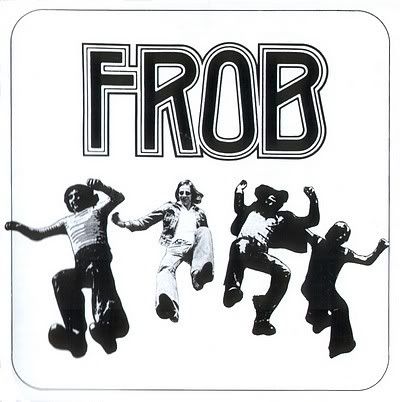
Frob


frob-frob1976


Frob - Frob - 1976 - Musikladen

Frob came from Rheda-Wiedenbrück in the east of Westphalia and played instrumental jazz-rock with a progressive touch of frenetic soloing guitars, Sinclair-like keys, and a pulverizing rhythm section, all played with a discernible Canterbury edge. This, their one and only LP is very relaxing and very well played in a straightforward style. It was recorded in winter 1975 / 1976 in Southern France. With Philippe Caillat who then worked as a music teacher (and by now has released quite some jazz records) they had a guitarist of top quality at hand but the other three musicians were his equals in every way. “Frob” was released in 1976 in a number of 1000 copies on the Musikladen label. It was re-released in 2004 on CD. This obscure jazz rock album is very good. If you have any more info about this band, your posts are welcome.

TRACKS

1. Wassertropfen
2. Spaces
3. Calypso
4. Spheres
5. Flash
6. Locomotive
7. Hektik
8. La sieste

BAND

Philippe Caillat (g),
Peter Schmits (key),
Klaus-Dieter Richter (b),
Peter Meuffels (dr)

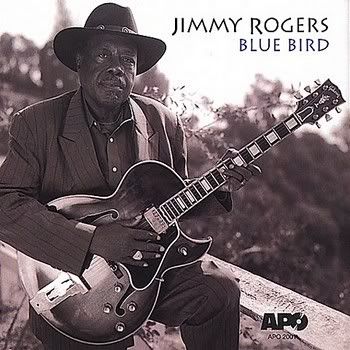
Jimmy Rogers


jimmyrogers-bluebird1994


Jimmy Rogers - Blue Bird - 1994 - JVC/XRCD (Released as a digitally remastered CD on APO (Analogue Production Originals in 2001)

This is one of the great blues albums, and VHR by A.O.O.F.C. Keith Richards of the Rolling Stones, credits Jimmy as being one of his three greatest musical influences along with Muddy Waters and Chuck Berry. Rogers, who was the last living original member of Muddy Waters' band spent his career in relative anonymity. His great music, even today is largely ignored by the media, which is a crying shame. Try and track down some of his great albums. " Gold-Tailed Bird " from 1973 is well worth buying.

TRACKS

1. I'm Tired of Crying over You (3:45)
2. Blue Bird (4:46) Composed by Jimmy D. Lane
3. Walkin' by Myself (2:30) Composed by James A. Lane
4. Rock Me (4:22) Composed by Melvin "Lil' Son" Jackson
5. I Lost a Good Woman (4:18) Composed by Jimmy D. Lane
6. Howlin' for My Darlin' (4:12) Composed by Willie Dixon
7. Why Are You So Mean to Me (5:28)
8. Blues Falling (2:23)
9. Lemon Squeezer (3:57) Composed by Jimmy D. Lane
10. That Ain' It ( Baby I Need Your Love) (2:08)
11. Smokestack Lightning (4:25) Composed by Howlin' Wolf
12. Blue and Lonesome (4:08) Composed by Jimmy D. Lane
13. Big Boss Man (3:06) Composed by Al Smith
14. Jam Session/Jammin' With Johnnie/Saint Louis Blues (8:15) Composed by W.C. Handy

MUSICIANS

Jimmy Rogers - vocals, guitar
Carey Bell - harmonica
Johnnie Johnson - piano
Dave Myers - bass
Jimmy D. Lane - guitar
Ted Harvey - drums


REVIEW


This was Jimmy Rogers' last "proper" Chicago blues album, and it deservedly won a W.C. Handy Award in 1995. There are no moonlighting rock stars here; they would come out in droves for Rogers' subsequent album Blues Blues Blues. And with the exception of the last track -- which is basically pianist Johnnie Johnson showing off for eight minutes -- Rogers sits squarely in the spotlight for the duration of Blue Bird. As expected, Rogers revisits a fair amount of his earlier repertoire ("Walking By Myself," "I Lost a Good Woman"), but he also digs up several original tunes that he had never gotten around to recording until now. Throw in a few Chicago standards ("Big Boss Man," "Rock Me," "Smokestack Lightning"), and you have a solid, laid-back, and tremendously satisfying album by one of the underrated masters. The backing band is a mix of Chicago blues brethren (Carey Bell on harp, Dave Myers on bass, Ted Harvey on drums) and family (Rogers' son Jimmy D. Lane on lead guitar), plus Johnson, who is perhaps a rock star by association since he played with Chuck Berry for 18 years. This one's a must-have. ~ Ken Chang, All Music Guide

BIO

James A. Lane is born in Ruleville, Mississippi, on 3 June 1924. He will later take the surname of his stepfather of Rogers.
He taught himself how to play harmonica and guitar by listening to the records of popular artists such as Big Bill Broonzy, Memphis Minnie and to the radio performances of Sonny Boy Williamson and Joe Willie out of KFFA in Helena, Arkansas.
In his late teens Jimmy moved to Helena and then Memphis, where he played with Robert Nighthawk and Robert Junior Lockwood. He then moved to St. Louis with Sunnyland Slim before settling in Chicago in 1945.
In 1946, through a friend in the factory where he is working he is introduced to McKinley Morganfield later to become known as Muddy Waters. He cuts a side for Ora Nelle in 1948 but it is not issued and a year after Jimmy plays on some Muddy Waters recordings for the first time.
Jimmy's debut single for the Chess Record label, 'That's All Right' / 'Ludella', is released in 1950, he goes on to chart 13 tunes on the R&B charts. This track record puts him in the top 10 all time best sellers in the blues filed. Some of his recognizable hits that have become the staple of blues bands around the world apart from those mentioned earlier include 'Chicago Bound', Sloppy Drunk' and 'The Last Time'.
He leave the Muddy Waters band in 1955 and a year later cuts what will become his best known single, ' Walking by Myself'.
Jimmy has long been considered one of the most important and influential figures on the American blues scene. He is considered to have co-founded and developed the Chicago blues sound with his band mate Muddy Waters - together they pioneered the sound that became known as "Chicago Blues" between 1947 and 1954.
In the late 1950's Jimmy worked with Howlin' Wolf and Sonny Boy Williamson and fronted his own band on the Chicago club circuit.
After some difficulty getting gigs, he decides to quit music in 1961.
In 1969 he returns to the Chicago music scene.
Jimmy's album Gold-Tailed Bird is released in 1973 to good reviews.
Jimmy's career nearly ground to a halt in the mid-70's when his classic recordings went out of print and were unavailable to a new generation of record buyers. Thanks to numerous books and publications calling attention to his career caused the re-issuing of Jimmy's Chess products on a the major MCA Record label, a Grammy nomination and numerous W.C. Handy Awards, Jimmy's career in now bigger than ever.
He is re-united with Muddy Waters in 1978 for the latter's fine album I'm Ready. In Bremen, Germany in 1991, he records the live album Jimmy Rogers with Ronnie Earl & The Broadcasters.
Jimmy has been a major influence on numerous rock superstars. Eric Clapton called him, "one of my all-time great guitar heroes, one of my earliest influences". Keith Richards said, "I recognize myself in there between Chuck Berry, Muddy Waters and Jimmy Rogers". Mick Jagger offered, "The first time I heard Jimmy was when I was buying my first blues records and listening to Muddy Waters and eventually I found out that Jimmy was the guitarist on these records that I loved".
At the behest of Clapton and Jagger, Jimmy was flown to London in June of 1992 for a series of blues tribute shows. One performance had Jimmy with the Eric Clapton Band at the Wembly Soccer Stadium in front of 100,000 people, and the shows with the Rolling Stones took place at the world famous Hammersmith Odeon. Clips of both shows are seen throughout the year on MTV and were a feature item in Rolling Stone magazine.
During the summer of 1993 Jimmy was a headliner in the famous Muddy Waters Tribute show which played to an audience of over 7,500 people on many dates. The Jimmy Rogers band appears on several nationally syndicated television and radio programs including NBC Late Night with Conan O'Brien, and Dan Ackroyd's House of Blues Show.
Bluebird, an album that Jimmy considers his best collection of work since his 1950's recordings is released in 1994.
Still a popular live performer at the age of 71, in 1995, Jimmy is booked to tour Europe.
Is is decided to make some CD's to provide for Jimmy's later years and he forms the Jimmy Rogers All Stars which include Eric Clapton, Jeff Healey, Mick Jagger, Keith Richards, Taj Mahal, Jimmy Page, Robert Plant, Stephen Stills and Lowell Fulson and Jonnie Johnson on Piano, but they only have enough for one CD before Jimmy dies on 19 December 1997, at the Holy Cross Hospital in Chicago from cancer.
On 5 January 1999, Atlantic Records / Warner release the CD Blues Blues Blues with some great tracks like:-
'Blow Wind Blow' featuring Jeff Healey.
'Blues All Day Long' and 'That's All Right' featuring Eric Clapton.
'Trouble No More', 'Don't Start Me To Talkin' and 'Goin' Away Baby' featuring Mick Jagger and Keith Richards.
'Bright Lights Big City' and ' Ludella' featuring Taj Mahal.
'Gonna Shoot You Right Down' (Boom Boom) featuring Jimmy Page, Robert Plant and Eric Clapton.
"Tell your friends to tell their friends that if they don't dig the blues, they must have a hole in their soul". - Jimmy Rogers.
http://www.john-meekings.co.uk/jalane.html

16.11.07

9 Lazy 9


9lazy9-electriclazyland1996


9 Lazy 9 - Electric Lazyland - 1996 - Ninja Tune USA

A very enjoyable, and better than average album of this genre. Electronic hip-hop with a touch of smooth jazz. Reissue of the 1994 record. "Electric Lazyland is without a doubt one of the best down-tempo records to ever emerge on Ninja, or on any label for that matter. Even if you're not a hip-hop fan, there are enough different musical elements here to keep you interested. Check out their albums, " Paradise Blown ," and " Sweet Jones. "

TRACKS

1 Life Goes On & On
2 Electric Lazyland
3 Skarakesh
4 B Hip & Shop
5 NO.2
6 Monk's Dream
7 Train
8 Very Gently
9 Swingpool
10 Checkin' On You
11 Special 8
12 NO.9
13 What's New
14 High Fashion
15 Meet The Voda
16 Roughport Invention
17 Golden Oldie

All tracks written, arranged and produced by Braddell & Fraser, except Track 8, written, arranged and produced by Braddell, and Track 6, written by Thelonius Monk, and arranged and produced by Braddell & Fraser

9 Lazy 9 includes: James Bradell.

Additional personnel: Julie Barton (vocals); Giuliana Pella (piano).

Recording information: Studio Joy 9, Rome, Italy.


BIO (Wikipedia)


9 Lazy 9 is an acid jazz/downtempo group on the Ninja Tune label. Operating out of Italy in 1992, they soon gained respect for their first album Paradise Blown. Their sound, distinctively more sun than North Sea, is a smoky Mediterranean mix of vines and good times. Keir Fraserello and James Bradell (also of Funki Porcini and performing here under the guise of Giacomo Braddellini) had been making music for many years in different guises before combining forces in Rome in the early nineties. They have been working with some of Italy's finest musicians on their latest album, Sweet Jones, recorded in the Umbrian Hills near Orvieto. Gianluca Petrella plays trombone, Mishael Levron guitar; Manù Bandettini plays flute with Adriano Tirelli on bassoon.

15.11.07

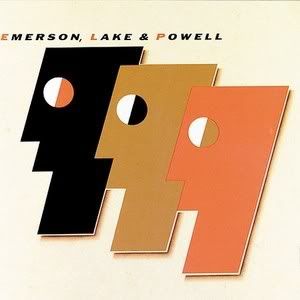
Emerson, Lake & Powell


emersonlakeandpowell


Emerson, Lake & Powell - Emerson, Lake & Powell - 1986 - Polydor

Emerson, Lake & Powell is the only studio album recorded by the ELP off shoot band of the same name. It was recorded in 1985 and released in 1986 on Polydor Records. However, two further albums comprising rehearsals and live material were subsequently issued in 2003. This album has received some very poor reviews, yet Greg Lake, himself said it was a really great LP and the one of which he's the proudest. Maybe the diehard ELP fans shied away from it as it was a change from the normal 70's ELP prog rock sound, and had more of the 80's synth sound. Who knows? Cozy Powell's drumming is excellent on this album, and was arguably as good as Carl Palmer. A very underrated album, and well worth a listen.

TRACKS

"The Score" – 9:08
"Learning to Fly" – 4:02
"The Miracle" – 6:50
"Touch and Go" – 3:38
"Love Blind" – 3:11
"Step Aside" – 3:45
"Lay Down Your Guns" – 4:22 (Emerson, Lake, Steve Gould)
"Mars, the Bringer of War" – 7:54 (Gustav Holst, arr. Emerson, Lake, Cozy Powell)
"The Loco-Motion" – 4:40 (Gerry Goffin, Carole King) - CD bonus track
"Vacant Possession" – 4:42 - CD bonus track

Tracks written by Keith Emerson and Greg Lake except as noted.

PERSONNEL

Keith Emerson - Keyboards
Greg Lake - Vocals, Bass and Guitars
Cozy Powell - Drums

14.11.07

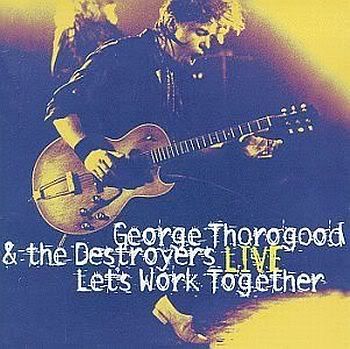
George Thorogood & The Destroyers


georgethorogood&thedestroyers-letsworktogetherlive


George Thorogood & The Destroyers - Live: Let's Work Together - 1995 - Capitol

George Thorogood was always better as a live performer than as a studio act. This album captures his great bar rock sound.. Terrific rock 'n' roll blues and boogie. The sound quality could be better, but all in all, a great live album.

TRACKS

1. No Particular Place To Go
2. Ride On Josephine
3. Bad Boy
4. Cocaine Blues
5. If You Don't Start Drinkin' (I'm Gonna Leave)
6. I'm Ready
7. I'll Change My Style
8. Get A Haircut
9. Gear Jammer
10. Move It On Over
11. You Talk Too Much
12. Let's Work Together
13. St. Louis Blues
14. Johnny B. Goode

CREDITS

Hank Carter Keyboards, Saxophone, Vocals (Background)
Billy Blough Bass
Jeff Simon Drums
George Thorogood Guitar, Vocals
Johnny Johnson Performer - Piano on St. Louis Blues, & Johnny B. Goode
Elvin Bishop Performer - Slide guitar on Let's Work Together

BIO (Wikipedia)

George Thorogood (born December 31, 1950) is a blues-rock performer from Wilmington, Delaware. He was raised on Clearview Avenue in Naamans Gardens, a suburb of Wilmington. Thorogood cut his debut album titled Better Than the Rest in 1974, and released it that same year. In 1976 he recorded his second album, the eponymous George Thorogood & The Destroyers with his band, The Destroyers (sometimes also known as The Delaware Destroyers or simply GT and D) and issued the album in 1977. Thorogood released his next album titled Move It On Over in 1978 with The Destroyers, which included the hit "Move It On Over". "Please Set A Date" and "Who Do You Love" both followed in 1979. Before devoting himself exclusively to music, Thorogood played semi-pro baseball. In the late 1970s, Thorogood played on a team in Delaware in the Roberto Clemente League which was created in 1976. He was the second baseman and was chosen rookie of the year in the league. Soon after this achievement, The Destroyers forced him to quit playing the sport. In the 1970s, George and the band were based in Boston.
George and the Delaware Destroyers were friends with Jimmy Thackery and the Nighthawks. While touring in the 1970s, the Destroyers and the Nighthawks happened to be playing shows in Georgetown (DC) at venues across the street from each other. The Destroyers were engaged at The Cellar Door, the Nighthawks at Desperados. At midnight, by prior arrangement, while both bands played the same song ("Madison Blues") in the same key (E), George and Jimmy left their clubs, met in the middle of M street, exchanged guitar cables and went on to play with the opposing band.
George and the Destroyers are also notable for undertaking a rigorous touring schedule after appearing throughout the Rolling Stones tour in 1981. After two shows in Boulder, Colorado, George and his band flew to Hawaii and played for only one night. The next night they appeared in Alaska for one show. The following day the band flew to Washington State, met their roadies who had their Checker car and a truck, and continued a one show per state tour for all fifty states in exactly fifty nights. In addition, they played Washington, DC on the same day that they performed a show in Maryland.
During the 1980s and 1990s, Thorogood recorded some of his most well known works. "Bad to the Bone" was used frequently in television and the big screen. Several appearances include Terminator 2: Judgment Day, the comedy Problem Child, John Carpenter's Christine, and during many episodes of the television sitcom Married with Children. This track also was used during the intro to the movie "Major Payne". The same song is also featured in the game Rock 'n Roll Racing. It is also played during football pregame festivities at Mississippi State University. Quincy Jones once said to Thorogood, "The three things important in a record is the tune, tune, and the tune".

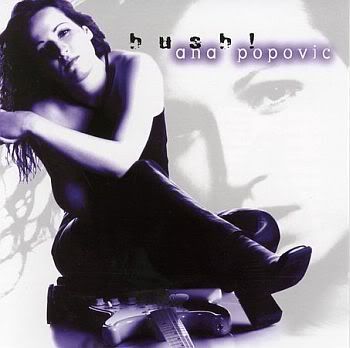
Ana Popovic


anapopovic-hush2002


Ana Popovic - Hush! - 2002 - Ruf Records

The universal appeal of the blues could not be better demonstrated than on this great breakout album by youthful Yugoslavian singer/guitarist Ana Popovic. Her 2000 debut disc Hush! effectively shows off her great talent. Buy her great albums, "Comfort To The Soul ," & " Still Making History. "

TRACKS

Love Fever
Mended
Hometown
I Won't Let You Down
The Hustle Is On
Downtown
How Lonely Can A Woman Get
Walk Away
Girl Of Many Worlds
Minute 'till Dawn
Bring Your Fine Self Home
How The Mighty Have Fallen

PERSONNEL

Steve Potts - drums
Jack Holder - guitar
Ana Popovic - vocals, guitar
Scott Thompson - trumpet
Dave Smith - bass
Ernest Williamson - piano, organ
Susan Marshall - background vocals
Jacqueline Johnson
Sam Shoup - upright bass
William Lee Ellis - acoustic guitar

Also: Bernard Allison

REVIEWS

Can a young lady from Yugoslavia really have a handle on the blues? You betcha! Popovic's mild European accent adds an interesting character to her sassy vocals, and she sings the blues with obvious comfort and confidence. Add to this the fact that Ana is also quite handy with a guitar, and you have the complete blues package. The CD's overall feel is upbeat and spunky, but not heavy. There is a consistent presence of guitar through out the CD, but I would stop short of calling this a guitar oriented disc. Elsewhere I've read comparisons of Popovic's style to Hendrix and SRV, but this is not accurate... nor is it fair to Ana. She truly has a very individual style that is pretty much unique to her. There's a bit of bite dialed into the guitar's tone, but it's not over-stated or heavily over-driven. She plays both standard and slide guitar, and she's very capable in either mode. I like her slide work the best. She grinds out a strong, bluesy feel, often mixing in a little wah-wah... very nice. When she's fretting the guitar, there's sometimes a light, jazzy feel to her playing, and a couple of songs were obviously arranged to compliment that style. There are an equal number of covers and originals, and there is no fall off as the CD transistions between them. There are clearly some talented songwriters in this group. I like nearly all the songs on the CD equally well, but my favorites are the ones featuring Popovic's on slide. I think it's pretty safe to say that most every blues guitar freak's favorite song will be Ana's duet with Bernard Allison, "Bring Your Fine Self Home". It's an excellent, moving, and fun redition of this popular song. The pair trade licks on slide guitar, and it's a good match up. Hush! is an overall well balanced CD. Popovic's vocals and guitar each share equally in delivering the music. Neither outweights, nor is more significant, than the other. The backing musicians provide an interesting variety of rhythms and are solid backdrop for Ana to work from. The production and technical aspects of the disc are top notch. Hush! doesn't really fit a typical mold for any certain style of blues. It's a rather unique and fresh blend of moods and styles, while still maintaining a strong connection with the blues. So there you have it. This young lady from Yugoslavia can definitely play the blues, and it's easy for me to recommend this CD to any blues fan. (Review Published July 22, 2002 , © www.electricblues.com)

While the U.S., Britain, and to a lesser extent Canada don't have a stranglehold on the blues, these countries account for the majority of music being produced in that genre. Therefore, when someone from a different nationality releases a strong album in the States, it usually makes news, at least in the rarefied blues universe. Born and raised in Yugoslavia, Ana Popovic would seem to have been brought up in an unusual area to soak in the deep soul, robust swamp rock, and husky R&B she reveals on her first album. But music is a universal language, and Popovic, along with noted blues-rock producer Jim Gaines, has delivered a rugged, confident, and eclectic debut that showcases the artist's many strengths (especially on slide guitar) in songs that shift from jazz ("I Won't Let You Down," "Minute 'Til Dawn") to deep funk (an innovative cover of Tom Waits' "Downtown") and soulful pop ("How Lonely Can a Woman Get?"). With a husky, sensuous voice similar to the Pretenders' Chrissie Hynde, she digs into these tunes with authority, even if English isn't her first language. A duet (guitar and vocal) with Bernard Allison on Johnny Copeland's "Bring Your Fine Self Home" is both sexy and gritty, as the two trade verses and riffs with obvious excitement and mutual respect. A raging version of Buddy Guy's "A Man of Many Words" (here titled "Girl of Many Words") rescues that song from obscurity as Popovic whips out a slimy version with rollicking horns that updates the tune while making it her own. Her originals don't push the limits of the genre, yet they are compressed slices of blues-rock that are excellent showcases for Popovic's tough vocals, wiry, Hendrix-styled leads, and robust stance. The self-penned "Hometown," a greasy, slinky trip down to New Orleans with hypnotic tribal drums, is but one of the album's gripping centerpieces. Recorded in Memphis and sounding like it, Popovic has captured the city's evocative, unvarnished R&B charm on this polished but far-from-slick album. A welcome shot of sex and showmanship in the blues world, Ana Popovic's American debut is a tour de force for this newcomer brimming with sass, brains, and talent. © Hal Horowitz, All Music Guide

13.11.07

Gentle Giant


gentlegiant-freehand1975


Gentle Giant - Freehand - 1975 - Chrysalis/Capitol / One Way

A brilliantly played, and faultless album from one of the great experimental progressive rock groups from the 1970s. A hugely underrated group, this classic album is VHR by A.O.O.F.C

TRACKS

Just The Same (5:34)
On Reflection (5:41)
Free Hand (6:14)
Time To Kill (5:08)
His Last Voyage (6:27)
Talybont (2:43)
Mobile (5:05)

All tracks composed by Ray Shulman, Derek Shulman and Kerry Minnear


MUSICIANS

Gary Green – Vocals, Guitar
Kerry Minnear – Vocals, Keyboards
Derek Shulman – Lead Vocals, Bass, Guitar, Saxaphone
Ray Shulman – Vocals, Bass, Percussion, Violin
John Weathers – Drums, Vocals

REVIEWS

I don’t know, maybe its me, but when ever I try and think of someone who sounds like Gentle Giant from their mid 70s period, the time they released my favorite recordings, I keep coming back to the one same group, and the comparison is not quite satisfying for me. That is, some, only some, of the music on this, and the previous year's, The Power And The Glory, reminds me of Steely Dan, or vice versa. I just wanted to get that over with. I’ll touch on that again later.
Its it saddening for me, and probably others who know the work and the times of Gentle Giant, that so much of their most productive time and energy were squandered in crippling battles with various record labels and management companies, who wanted to fleece the band, and tried again and again to force them down paths that were not suitable to the work of this group of extraordinary human beings, amazing musicians and song writers.
1975’s release Free Hand is one of the crowning achievements of progressive rock in general and Gentle Giant in particular. It has some of the best examples of their madrigal singing style, the beautiful "On Reflection," some of their most streamlined, accessible music, as evidenced by the songs "Time To Kill" and "Just The Same," the latter of the two becoming a live favorite. It features some of the most gentle, lovely moments ever committed to tape, the wonderful, "His Last Voyage," another example of keyboardist Kerry Minnear’s outstanding singing voice. Did Kerry get all the most touching songs to sing? I’ll have to look into that. In contrast to its lilting beginning, "His Last Voyage" also gives Giant guitarist Gary Green the opportunity for a gritty wah-wah-ed solo, before dissolving into total beauty once more.
We get "Talybont," an exploration of Celtic rhythms and melody, as seen through the distorted electric guitar, then breaking into pipes and clavinet, and Gary Green uses his array of sound processors, well, what passed in the middle 70s for such. Wah-Wah, Echoplex and the like.
Ending with "Mobile," a reflection of earlier Gentle Giant releases, this is lyrically, at least, another reminder that Gentle Giant was a band beset with demons. The lyrics, as a number of their song lyrics do, tell the story of a group that feels put upon, forced to live out someone else’s ideas, forced to record and tour at some one else’s whim. The song itself is a powerful musical statement as well, featuring counterpoint lines on acoustic instruments, and a powerful wash of electric sound leading to a grand march, and into the verse proper. Kerry’s use of his Hammond, always a welcome moment, leads into a typical Gentle Giant bridge. I guess that is just an easy way for me to describe the indescribable, as nothing I have ever heard from the Giant is typical. Let’s say that the center of this composition has a familiar use of incredible counterpoint instrumentation, an arrangement that seems to go in several directions at once and……you know, typical Gentle Giant.
Let’s go back to the comparison with Steely Dan now. Maybe it’s that Minnear had a preference for clavinet and electric piano in their arrangements. He used less B-3 and Moog than most keyboardists I might name, and if one plays a bouncy melodic line with these funkier sounding keyboards, it will sound a bit like the style of Donald Fagen. Maybe. Perhaps it is that the Giant boasted members that played sax and a variety of instruments that were used in the studio by Fagen and Becker. Perhaps it is the back up vocals on "Time To Kill," which sound exactly like the vocals on the early Steely Dan releases. Steely Dan and Gentle Giant were contemporaries, but I would hate to ascribe some poorly researched theory of any motive to either of them. It’s just an innocent observation, really. If I were to advance any foolish theory, it would be that Steely Dan stole much of their stylistic elements from Gentle Giant. But, remember. I’m not saying anything about it. I never even mentioned anything on the topic at all.
Back to the music of Free Hand, then. This is really one of the few albums I know of that seems to zip by at an incredible rate. The sequence of the songs is somehow magical, in my opinion, and I always end up playing it four or five times in a row, before I’ve had my fill and can go on to something else. It is a textbook of the elements that are crucial to good symphonic progressive rock. There are the mind blowing acappella vocals of "On Reflection," the dizzying changes of time and texture, and most of all, their ease with incredibly difficult contrapuntal technique. They were able to do all this, AND fight with their labels and managers. Think what might have been, had their road been less rocky. On the other hand, the rough road they traveled inspired some of the best music ever written. Just ponder for a moment, will you, the finger snapping that opens this album. Get a few friends together, and see if you can master it. I would wager that you cannot. Just a thought. No offense intended.
By modern standards, almost all the progressive rock classics are short by comparison. The limits of the LP format gave a band little more than fourty minutes to say whatever had to be said. Some of the CD re-issues of Gentle Giant have additional material that pad out the total time. But, unfortunately, I bought the first re-issues I could get my hands on, and this, as is the case with most Gentle Giant CDs I own, lack the extras that later versions had.
I will recommend this release highly, as I will no doubt say of any and all releases by the Giant, whom I think deserve a place at the table with the best groups of the golden age of progressive rock, and indeed, any music, by anyone in the distant past of the 1970s or now. They are truly a brilliant group, one that has influences that continue to this day. Without Gentle Giant as a basis to work from, many of the bands and much of the music we listen to now would not exist.
If you do not have the work of Gentle Giant in your collection, I would advise you to go out and buy some of their mid 70s releases now. This release, along with the previous year’s release, The Power And The Glory, will present to the listener a band at the peak of their creative powers, and will prepare one to enjoy their entire catalog. © Tom Karr, March 2004, © Copyright 2004 ProgressiveWorld.net/Tom Karr, www.progressiveworld.net/gentlegiant5.html
Gentle Giant's 1975 release Free Hand is the third peak of their output from my perspective. It features a move to a somewhat more conventional style, but which is still ultimately successful. The album featured a move to their new label, Capitol, and the theme of emancipation is apparent throughout the album. The cover features a portrait of two hands bound together, in front of which floats a disembodied hand in claw formation.
The opener "Just the Same" features a maddeningly intricate polyrhythm, as the vocals appear to be in 7/8 while the rest of the music is in 6/8. "On Reflection" features a four-part fugue at the beginning, and some delicate recorder playing in the middle to accompany Minnear's vocals. The instrumental "Talybont" once again recalls a canon or fugue.
At the same time that this musical bag of tricks is being opened and used, the album stays in a fairly accessible style. The music is never difficult or overly academic like some of their earlier work. The title track is a hard-rocking denunciation of the band's old label and the limitations it imposed. In fact, a listener may well miss a lot of what is at work here because of the ear-friendly way in which it is presented. It is only after some time that this album fully reveals itself as a veritable classic. © Sean McFee © ground and sky 1999-2007
I'm surprised how often Gentle Giant are accused of being emotionless; it seems to me that thematically albums like Free Hand and Three Friends are among the most sentimental in the prog-rock canon. While Three Friends deals with the bittersweet remembrance of schoolboy days, Free Hand focuses in great part on feelings of betrayal and rejection (apparently the band had just broken with their old label, which makes sense in terms of the issues explored on this record). Not surprisingly, then, these are my two favorites of the Gentle Giant albums I've heard, as they balance lyrical beauty and complicated musicianship almost perfectly.
Free Hand was the most rock-focused release to date for the group. The songs are very tight and structured overall and I find much more restraint in these tracks than on earlier albums. Needless to say, this is a good thing, and I imagine the more straightforward (but no less complicated) approach of Free Hand plays a big part in its being a perennial fan favorite. One of the things I appreciate most about Gentle Giant is the way they use the human voice as an instrument instead of something total separate (which may explain why they are sometimes regarded as emotionless); nowhere is this better exemplified than "On Reflection," a fantastic track that features multiple vocal parts that bounce back and forth in a way in a unique fashion (Spock's Beard's song "Thoughts" makes liberal use of this technique, but they fail to match the original in terms of effectiveness). While I'm not in love with this album, it is very, very good and a natural recommendation to most prog fans. © Jon Fry © ground and sky 1999-2007
Gentle Giant is one of my favorite bands of all time period. These guys are just so talented and they can do everything. They can rock, play extremely complex music and make it sound like they are playing 3 chord songs, great vocals, simply put - they had it all. There are a few different periods of GG, this would be at their peak, IMHO. The later albums had a stripped down straight ahead approach that caused many fans to hate this period though there is still some good music. The early releases were progressive, but you could hear a lot of bluesy roots to the music. The middle period is my favorite (Three Friends through Free Hand), which seems the most progressive. This diverse blend of songs includes "Just the Same" which flat out rocks. The counterpoint within the song is great and the live version of this song is even better. "On Reflection" has a great vocal arrangement, with some piano and recorders to accompany the vocal. "Free Hand" is also a heavy piece with alot of keyboard/guitar/and bass interplay, these songs are fairly complex and yet never sound forced. "Time to Kill" is upbeat with more surprises musically and vocally, very smooth feel with a lot of changes. "His Last Voyage" is a nice acoustic song with a church like vocal over the arrangement, very ethereal feel to the song, quite beautiful. The ending arrangement is very jazzy. The instrumental "Talybont" has a medieval feel, with harpsichord, recorders playing throughout the song. "Mobile" is the weakest song on the CD. It's ok, but shows the change coming within the band to do more straight ahead material. If you are a fan of progressive music then this and most Gentle Giant should be in your collection. Each of their albums have something to offer. © Eric Porter © ground and sky 1999-2007

Lenny White


Lenny White - Venusian Summer - 1975 - Nemporer Records

A great jazz/fusion album from the 70's. Terrific musicianship, great grooves, and every track is outstanding. For more outstanding jazz fusion, you should buy Lenny's great 1978 album, " Adventures Of Astral Pirates . "

TRACKS

1. Chicken-Fried Steak (4:35)
2. Away Go Troubles Down The Drain (3:33)
3. The Venusian Summer Suite (10:14)- a) Pt. 1: Sirènes- b) Pt. 2: Venusian Summer
4. Prelude To Rainbow Delta (1:11)
5. Mating Drive (7:43)
6. Prince Of The Sea (11:38)

MUSICIANS

Doug Rodrigues / Rhythm Guitar, Lead Guitar
Raymond Gomez / Rhythm Guitar
Larry Coryell / Electric Guitar
Al DiMeola / Electric Guitar
Lenny White / Drums, Wandering Clavinet, Minimoog, Eu Synthesizer, ARP 2600, Snap Bass, - Tympani, Snare Drum, Roto-Toms, Wood Block, Triangle Gong, Marimba, Suspended Cymbal, Gong
Doug Rauch / Bass
Jimmy Smith / Organ
David Sancious / Minimoog, Organ
Weldon Irvine / Organ
Onaje Allan Gumbs / Electric Piano, Clavinet, Acoustic Piano, Mellotron, Organ
Tom Harrel / Minimoog
Hubert Laws / Flute
Peter Robinson / Clavinet, Minimoog
Patrick Gleeson / Eu Synthesizer, ARP 2600, Minimoog
Dennis MacKay / Backwards Gong, Engineering, Re-Mix Engineering
Larry Young / Organ
Tom Harrel / Flugelhorn

REVIEW

Venusian Summer was issued on Atlantic subsidiary Nemporer Records, probably to little fanfare, but it was possessed of the fine musicianship one might expect from the Return To Forever drummer. Actually it has several diversions from the standard Mach 10 fusion blasts so common to that era, and its energy is still fresh.Many people were involved in the making of Venusian Summer and that enabled a variety of sounds. Aside from the requisite moments of proper 70's fusion (and they are most proper indeed) there are equal nods to progressive rock, electronic and orchestral musics. Science fiction themes are implied in Larry Kresek's cover art and in the music. "The Venusian Summer Suite" is dedicated to the crew of the Starship Enterprise (I kid you not) and "Prince Of The Sea" is a "story of the young prince becoming Neptune." Gotta be cool, right?Happily in this case it is. The guest list is impressive and the playing is focused, intense at the appropriate moments, and soothing in others. David Sancious, Hubert Laws, Larry Young (Khalid Yasin), Dennis MacKay, Onaje Allan Gumbs, Raymond Gomez, Doug Rodrigues, Larry Coryell, and "I'm" Al DiMeola all make worthy appearances.Of particular importance among White's compatriots was one Doug Rauch. As bassist he was White's partner in the rhythm section, and his playing over the course of the album is outstanding. He co wrote the first two pieces, the bizarre funky fusion-rock of "Chicken Fried Steak" and "Away Go Troubles Down The Drain." The former is an oddly lurching way to start an album, but it works, with an appearance on organ by the legendary Jimmy Smith. Rodrigues pitches in with a burnin' little guitar solo. The latter is also deeply funk-inflected and features some wicked low-frequency interplay between White, Rauch and the minimoog of David Sancious; he turns in a wicked but brief solo in the last third of the piece. It "progs" and "grooves" at the same instant, preceding "The Venusian Summer Suite" which is performed in two parts."Sirenes" features some delightfully spacey music by the "Brooklyn Syntharmonic Orchestra & Inner-mission Choir Realizations by Patrick Gleeson." White shows his versatility via his performance(s) on minimoog, Eµ synthesizer, ARP 2600, and acoustic piano. The eponymous title-part 2 provides a fine display from all players. Minimoogs are once again all over the place, from Gleeson, Sancious and Peter Robinson, and the sound is fleshed out by Laws' flute.The second half of the album is heralded by the "improvised percussion over a major orchestral theme" that is "Prelude To Rainbow Delta." It is notable partly because of MacKay's appearance on backward gong, and is only 1:40 long, before fading into the fast-paced, full-on fusion-in-4/4 of "Mating Drive." It's Gomez' turn to burn on the frets, and Young/Khasin on the organ takes a turn in the fusion whirlpool, soloing over Gumbs' delicious electric piano chord patterns. Ah, the 70's . . . . . ."Prince Of The Sea" is 11:37 long and of course it provides the goods. The beginning sounds like music from an alien planetscape; Gumbs' work is again a graceful mood-setter, in concert with Tom Harrel's flugelhorn. The band eases into the stratosphere, and Coryell takes the solo ante higher with a particularly sharp performance showcasing a more traditional (but well amplified) jazz guitar sound. Gumbs takes a turn in the spotlight, on acoustic and electric pianos, before DiMeola's more modern, sustain-driven soloing answers Coryell. It wouldn't be complete if the two guitar-maestros failed to trade licks, and they do, while White and Rauch increase the intensity.Indeed it makes quite a finale to a fine showcase of A-list 70's funk-fusion-spaceprog. The starship's guest list in this case enhances the voyage, and Captain White is a gracious and potent musical host. Review © Reginod @ Progressive Ears