A New Beginning

The rapidly shrinking, sinking and stinking Rapidshare has blocked my account and deleted hundreds of my files. Is this the end of A.O.O.F.C? Watch this space, & thanks for all your support and encouragement. Keep on rockin' in the free world. Paul

A.O.O.F.C
recommends
Mizar6

babydancing


Get this crazy baby off my head!

31.8.08

Reneé Austin


Reneé Austin - Dancin' with Mr. Blue - 1996 - Utr Music Group

Dancin' With Mr. Blue, her great debut CD demonstrates Reneé Austin's six-octave range and she covers everything from house rockers to ballads in a great "roadhouse soul" style. The album was honoured as Best Blues Recording by the Minnesota Music Academy. She also received additional awards for Best Blues Artist and Best Female Vocalist. The album enjoyed airplay throughout the U.S., and news of her electrifying performances began to spread. Unfortunately, Reneé is no longer performing, after an operation for a thyroid problem cut her singing career short. Buy her "Sweet Talk" and "Right About Love" albums.

RENEE AUSTIN'S CAREER CUT SHORT [ taken from www.bluesmatters.com/modules.php?name=News&file=article&sid=1632 ]

It is with a great deal of sadness that Blind Pig Records announces that Renee Austin is ending her burgeoning career as a singer. A paralyzed vocal chord has forced her to abandon her profession. Austin's 2003 national debut CD, Sweet Talk, sparked critical raves and predictions of greatness, with many comparing her to Janis Joplin and Tina Turner. It also led to a "Best New Artist Debut" W.C. Handy nomination and a slot on the PBS-TV film entitled Blues Divas. Her second Blind Pig release, Right About Love, impressed critics with her stunning vocal dynamism, her passion, and her remarkable versatility. Again, many predicted her sassy "roadhouse soul" style of music would soon land her in the mainstream. As Harp magazine put it, "If talent still counts in the music biz, she'll be an established star." Label executive Edward Chmelewski said, "We've been greatly impressed with Renee's immense talent since we first heard her. It's tragic that something like this occurs just as her career was taking off. We really feel for her and wish her the best. Besides being an incredibly gifted artist, she's a wonderful person who's been great to work with." In an open letter to her fans and supporters, Austin broke the heart-rending news, "I want to start by thanking all of my friends, family, fellow musicians, and fans for all the love and support you have given me over the years. As most of you know I released my second CD with Blind Pig Records Right About Love on August 16th. It is a piece of me that I am very proud of and a culmination of lots of hard work from many people. As some of you know I had to have surgery on September 13th to remove a lump on my thyroid gland. I feel blessed to be able to tell you that I am doing fine and the lump turned out to be cancer free. I regret to inform you all that as a result of the surgery my left vocal chord has been left paralyzed and is not working. The result of this is I can talk softly but I cannot sing. In the last couple of weeks after lots of medical opinions and various hospital visits my condition has been diagnosed as likely permanent. This means that I probably will never be able to sing again. I am working hard with a speech therapist to see if I can beat the odds and God willing raise my voice in song once again someday. Until that time comes I must say goodbye to you all as a singer and thank you again for all of the love and support you have given me. I thank God for the opportunities He gave me to live out my dream even if only for small window of time. I trust that He has a plan for my life and whatever that is, I will put my heart and soul into it just as I did my music. From the bottom of my heart - please know I thank all of you for your kindness to me and I will remember it always. May God Bless each of you."

TRACKS

Little Bit a Texas
Calling It Quits
The Accused
One Man
Lonely Road
Pillow
It's All a Game
Catfish Woman
Heartless World
Swing
Dancin' With Mr. Blue

All songs composed by Reneé Austin, except "Lonely Road" by Reneé Austin, & Al Larson

MUSICIANS

Reneé Austin (Vocals) , (Guitars)
James Walsh (Organ), (Piano), (Vocals (Background))
Charles Fletcher (Bass)
Melanie Moos (Vocals (Background))
Kenny Wilson (Guitar)
Catherine Battocletti (Vocals (Background))

REVIEW

You wouldn't ordinarily assume a blues-belting mama to hail from central Texas. Nor would you expect a move to Minneapolis to enhance a devotee's appreciation for greasy, Southern-fried, hip-shaking R&B. But give a listen to Reneé Austin for a lesson in how soulful pipes can effortlessly transcend geography. Born in San Diego, Austin actually grew up in Kingsland, TX. Moving to Minneapolis as a college student, Austin jumped into the thriving live music scene and released her 1996 debut, Dancin' With Mr. Blue, from which "Little Bit A Texas" is drawn. Blues guru Delbert McClinton became a mentor to Austin and the two recorded a duet, a signature event in Austin's musical evolution. With her sophomore effort, Sweet Talk, nominated for a W.C. Handy Award (as "Best New Artist"), Austin is poised to take the next big step into the blues/R&B mainstream. As the result of thyroid gland surgery, Reneé is no longer able to perform. © 2008 Texas Music Project


ABOUT RENEE AUSTIN
"When you first hear her voice - that voice - it makes the skin on the top of your head tingle and your ears take notice that here is something - someone - very special." - Blues Wax. Singer-songwriter Reneé Austin turned quite a few heads with her 2003 national debut on Blind Pig Records, Sweet Talk. Critics marveled at her nearly five-octave range, her stunning vocal dynamism, her poignant and insightful songwriting, and her remarkable versatility, comparing her to Janis Joplin and Tina Turner. Calling the CD "an impressive grab bag of original roots music," Blues Revue said, "Her stunning vocal range grabs the listener from first song to last...The auspicious Sweet Talk is a harbinger of great things to come for this talented and soulful vocalist." With her highly-anticipated follow-up release, Right About Love, Austin validates those early raves and predictions of greatness. Austin offers razor-sharp reinterpretations of American roots music styles and brings them to life with an arsenal of vocal twists - husky and swaggering, breathy and vulnerable, angelic and clear-as-a-bell. A multi-instrumentalist and prolific songwriter, she's been honing her craft since early childhood, and has nurtured her singing voice to astounding, operatic heights. Although Reneé could be most broadly categorized as a blues artist, her sound has been molded by an expanse of influences, and she credits that to her early environment. Born in San Diego, California, Reneé relocated to Texas by the time she was three. Growing up in the small town of Kingsland, Reneé immersed herself in Texas' spirited musical melting pot - one that has helped shape dozens of other seminal artists from the American Southwest. "In Texas, the older, more seasoned artists garner the most respect. So, I learned early on to respect styles by musicians of all ages, makes and models - there's a tremendous reverence for tradition," says Austin. Many critics noted this ability to sashay with ease from one style of music to the next. The Philadelphia Inquirer said Austin "embraces a deliciously wide range of roots styles: She belts the blues with sass, swings nimbly on R&B, and fires off some rousing gospel. For good measure, she also shows she can take it uptown with a sultry, soulful ballad." No Depression magazine said, "Ostensibly a blues singer, Austin is really more a genre-buster, alchemizing a variety of blues, R&B, soul and gospel styles while giving it all a country flavor." Added Hi Fi Plus, "Austin is an artist capable of covering so many musical bases and she does it all with a purr, a growl, a sexy moan and a throaty roar that constantly delights the listener." Living Blues weighed in with, "Categories like 'blues,' 'rock,' 'soul,' or 'neo-soul' seem too restrictive for her - if anything, she's a torch singer in the Bette Midler tradition, minus the camp and with a welcome dollop of backstreet grit. As of now, she's also a gloriously radiant diamond in the rough." "Austin's tough, husky growl can be as gutsy as Tina Turner or as tender as Maria Muldaur, said All Music Guide, adding, "her presence is so powerful that she's comfortable in a variety of grooves and, at least on the basis of this album, succeeds at all of them." Reneé has known she wanted to be a singer since the age of four, when she first performed the Andre Crouch classic, "Through It All," as a solo during a service in a tiny, hill country church. "I was too short to reach the podium, so they made me stand on a chair," laughs Austin. "That was my induction into the musical world." From then on, she never stopped - every hairbrush and curling iron became a microphone as she began putting on shows for her mom and dad in their living room. Reneé continued to sing in school and church, and, later, in college choir and cover bands. By 15, she'd written her first song and - as the numerous church groups traveling through her area gradually inspired her - it became ever more clear that she too wanted to tour, perform and record. Austin relocated to Minneapolis to pursue a relationship with her college sweetheart. Although the relationship fell apart, her music career began pulling wholly new opportunities together. She was able to assemble a whip-smart band, and in 1997 independently released her debut CD, Dancin' With Mr. Blue, which was honored locally as Best Blues Recording by the Minnesota Music Academy (MMA). She also received additional awards for both Best Blues Artist and Best Female Vocalist. The album enjoyed airplay throughout the U.S., and news of her electrifying performances began to spread. Soon, Austin was securing opening slots for heavy-hitters Robert Cray, Lonnie Brooks and Delbert McClinton, to name just a few. In fact, Renee specifically rallied with promoters to secure a show with McClinton, and their resulting two-night, two-city bill in March 2003 planted the seed that eventually grew into the duet ballad, "Pretend We Never Met," on Sweet Talk. Delbert witnessed the band's entire first night performance and was so taken with her voice that he immediately approached her at the foot of the stage after the show. "Girl ... you ring my bell!" he exclaimed. He offered her a prestigious performance spot on his annual Sandy Beaches Cruise in January 2004. Austin's camp approached McClinton's management about recording together. As Reneé puts it, "I bit my fingernails for a month awaiting a response while he was on tour in Europe." When word finally came, Austin was delighted to find that, not only was he up for doing it, but that his manager, "could count on one hand the number of times Delbert's been as excited about an artist as he is about Reneé." So it was off to Nashville for recording. "I was so nervous on the drive down," says Austin. "I've been a huge Delbert fan ever since my days in Texas. But as soon as I walked through that studio door, everything just melted away. He's so genuine - generous, funny, laid back. It put me right at ease." Although they'd not had any prior rehearsals, the entire session went almost effortlessly, with everything wrapping up in less than two hours. Austin was most struck during the first minutes of tracking, when McClinton suddenly stopped and said, "Wait a minute, Reneé, show me how you're singing it again - I wanna sing it how you're singing it." As she puts it, "already I'm thinking how blessed I am just to be standing next to him and recording, and then he asks for my input? It was like the master asking the grasshopper!" Said McClinton, "Reneé Austin gives me a lot of room to breathe when I sing with her; if you can't get her, you better get Tina Turner!" Sweet Talk and the critical reaction that followed put Reneé on the map. Downbeat magazine awarded it 3 ½ stars. The blues community took notice by nominating the CD for a W.C. Handy Award for "Best New Artist Debut." At the Handy Awards Show in Memphis she put on a memorable performance that generated an industry buzz. Another highlight was being invited to the Ground Zero club in Clarksdale, Mississippi to take part in the filming of a PBS-TV production called "Blues Divas." It was quite an honor, considering the heady line-up of the other singers in the program - Mavis Staples, Ann Peeples, Denise LaSalle, Odetta, Irma Thomas, and Bettye Lavette. Just as Reneé was spellbound as a child by the strength and determination of female artists like Aretha Franklin, Etta James and Tina Turner, today she brings similar passion to her own songs - and undeniable physical grit to her live performances. She's become a commanding presence at major shows and festivals across the country, having shared the stage with Los Lobos, Jonny Lang, Charlie Musselwhite, Blues Traveler, Big Head Todd & The Monsters, Keb' Mo, Vonda Shepard (Ally McBeal), Marcia Ball, and Sonny Landreth. And, Delbert McClinton has asked Reneé to open as many shows for him as her schedule allows throughout the upcoming year. Austin's new CD, Right About Love, delivers on the promise of her previous release, reaffirming that her dramatic voice is an instrument that commands respect and knows few boundaries, and that her talent is a force to be reckoned with. Right About Love also continues Austin's musical journey, mixing blues, roadhouse rock and gospel anchored by her formidable vocal prowess, emotional commitment to every note and evocative spins on time-honored American roots music. Right About Love finds Austin blossoming fully as a vocalist, writer, and co-producer. One standout tune is "Mouth of the Delta," which she co-wrote with David Grissom, musical director for the Dixie Chicks. Commenting on the CD, Austin said, "I approached writing for this project with the intent of making music that would again take the listener on a ride thru everyday life. When I sat down to create this disc, I wanted to focus in on one thing. Who is Renee' Austin? I came to the conclusion that my Texas roots are the foundation to my music. People ask me all the time 'What kind of music do you do?' I tell them Roadhouse Soul - blending Blues/Roots, Country and Gospel/Soul." Whatever genre of music she performs, she invests each style with an individuality that few artists can match. Whatever the song demands, Reneé Austin can deliver - with power, presence, and soul. © 2006 Blind Pig Records, a division of Whole Hog, Inc. - All Rights Reserved

BIO

While she's by no means a straight-ahead blues artist, vocalist and songwriter Reneé Austin has great potential to bring many new fans to the idiom. Attractive, intelligent, and a good showperson, Austin was born in San Diego and raised in Texas, growing up steeped in Texas roadhouse blues and soul-blues, as well as gospel music. Sweet Talk, Austin's 2003 debut for the San Francisco-based Blind Pig Records label, has been very well received. Austin grew up in Kingsland, TX, and began singing as a toddler. Encouraged to continue singing by her parents, by the time she was a teenager she'd written her first few songs. Austin sang at school and in church, and by her later high-school years she knew she'd like to try singing and recording for at least part of her living. She counts among her many singing influences the great female blues and soul vocalists, including Aretha Franklin, Etta James, and Tina Turner. After moving to Minneapolis during her college years, she began performing in that city's lively blues club scene and released her first album, Dancin' With Mr. Blue, which won kudos from the Minnesota Music Academy and won an award for Best Blues Recording. She was also recognized as Best Female Vocalist and Best Blues Artist, and Austin began opening shows for Robert Cray, Delbert McClinton, and Lonnie Brooks when they made tour stops in Minneapolis. Austin teams up with vocalist McClinton for a duet on "Pretend We Never Met" on her debut. The two hooked up in Nashville to record the track, written by keyboardist Bruce McCabe. Austin's debut showcases seven of her originals, Joanna Cotten's "When Something Is Wrong," and two songs by producer Kevin Bowe. Stylistically, it runs the gamut from slow, sultry ballads like "Fool Moon" to the more rockin' roadhouse blues-belting numbers like her duet with McClinton and "Pour the Sugar Slowly." While future recordings from this talented singer/songwriter may be more focused, its OK for this up-and-coming singer to show off on her first internationally distributed album, to show radio programmers and blues festival booking agents what she's capable of. She's already shared festival and concert stages with Jonny Lang, Blues Traveler, Big Head Todd & the Monsters, and Keb' Mo'. If she can avoid burning herself out with the grueling tour schedules that so many blues performers seem to keep, good things are in the offing for Reneé Austin. A second album, Sweet Talk, was released on Blind Pig in 2003, followed by Right About Love in 2005, also on Blind Pig Records. © Richard J. Skelly, All Music Guide

A.C. Reed


A.C. Reed - I'm In The Wrong Business - 1987 - Alligator

Good soul blues album with tough, original songs, often with sardonic and self-mocking, but humorous, lyrics, from the late, great Chicago bluesman, who was regarded as the Windy City's No.1 blues sax man. Not a household name, but A.C. Reed was a good vocalist and great saxophonist, and was a sideman for Buddy Guy and Albert Collins. He was hugely influenced by the great saxophonist, Gene Ammons. He played with many of the great blues artists, inckuding Albert Collins, Buddy Guy, Magic Sam, Earl Hooker, and Son Seals. Reed was once labelled as "the definitive Chicago blues sax player." Bonnie Raitt and Stevie Ray Vaughan were working hard to bring recognition to older blues musicians around the time this album was released. They make solid contributions to a strong effort by A.C. This is a good album by an artist who should be remembered for his huge contribution to the development of blues and electric blues music. Buy his great funky "Take These Blues and Shove 'Em" album. His two final solo albums – the 1998 "Junk Food" on Delmark and the 2002 "I Got Money" on the French Black And Blue label received critical acclaim and ensured Reed's status as a seminal Chicago blues figure. Give these great albums a listen and KEEP THE BLUES ALIVE!!

TRACKS / COMPOSERS (Where known)

I'm in the Wrong Business
I Can't Go on This Way
Fast Food Annie
This Little Voice [Reed]
My Buddy Buddy Friends
She's Fine [Reed]
These Blues Is Killing Me [Reed]
Miami Strut
The Things I Want You to Do
Don't Drive Drunk
Hard Times [Corthen]
Going to New York [Reed]
Moving Out of the Ghetto

MUSICIANS

A.C. Reed (vocals, tenor saxophone)
Bonnie Raitt (guitar, background vocals)
Stevie Ray Vaughan, Maurice John Vaughan, Marvin Jackson, "Triple Horn," Steve Ditzell, Larry Burton, Phil Guy (guitar)
Jimmy Markham (harmonica)
"George" (piano)
Freddie Dixon, Douglas Watson, Johnny B. Gayden, Nate Applewhite, Aron Burton (bass)
Casey Jones (drums)
Miranda Louise, Vicki Hardy (background vocals)

BIO

To hear tenor saxist A.C. Reed bemoan his fate onstage, one might glean the impression that he truly detests his job. But it's a tongue-in-cheek complaint -- Reed's raspy, gutbucket blowing and laidback vocals bely any sense of boredom. Sax-blowing blues bandleaders are scarce as hen's teeth in Chicago; other than Eddie Shaw, Reed's about all there is. Born in Missouri, young Aaron Corthen (whether he's related to blues legend Jimmy Reed remains hazy, but his laconic vocal drawl certainly mirrors his namesake) grew up in downstate Illinois. A big-band fan, he loved the sound of Paul Bascomb's horn on an obscure Erskine Hawkins 78 he heard tracking on a tavern jukebox so much that he was inspired to pick up a sax himself. Arriving in Chicago during the war years, he picked up steady gigs with Earl Hooker and Willie Mabon before the '40s were over. In 1956, he joined forces with ex-Ike Turner cohort Dennis "Long Man" Binder, gigging across the southwest for an extended period. Reed became a valuable session player for producer Mel London's Age and Chief labels during the early '60s; in addition to playing on sides by Lillian Offitt, Ricky Allen, and Hooker, he cut a locally popular 1961 single of his own for Age, amp;"This Little Voice." More gems for Age -- amp;"Come on Home," amp;"Mean Cop," amp;"I Stay Mad" -- followed. He cut 45s for USA in 1963 (amp;"I'd Rather Fight than Switch"), Cool (amp;"My Baby Is Fine," a tune he's recut countless times since) and Nike (amp;"Talkin' 'Bout My Friends") in 1966, and amp;"Things I Want You to Do" in 1969 for T.D.S. Reed joined Buddy Guy's band in 1967, visiting Africa with the mercurial guitarist in 1969 and, after harpist Junior Wells teamed with Guy, touring as opening act for the Rolling Stones in 1970. He left the employ of Guy and Wells for good in 1977, only to hook up with Alligator acts Son Seals and then the Master of the Telecaster, Albert Collins. Reed appeared on Collins's first five icy Alligator LPs, including the seminal Ice Pickin'. During his tenure with Collins, Reed's solo career began to reignite, with four cuts on the second batch of Alligator's Living Chicago Blues anthologies in 1980 and two subsequent LPs of his own, 1982's Take These Blues and Shove 'Em! (on Ice Cube Records, a logo co-owned by Reed and drummer Casey Jones) and I'm in the Wrong Business! five years later for Alligator (with cameos by Bonnie Raitt and Stevie Ray Vaughan). Until his death from cancer in February of 2004, Reed remained an active force on the Chicago circuit with his band, the Spark Plugs (get it? AC sparkplugs? Sure you do!). © Bill Dahl, All Music Guide

MORE ABOUT A.C. REED

Born Aaron Corthen on May 9, 1926, in Wardell, Missouri and studied at Chicago Conservatory of Music. Moved to Chicago and took job in steel mill, 1942; began playing jazz and blues after work hours; performed in bands of Willie Mabon and Earl Hooker, late-1940s; toured with Dennis Binder's Rhythm All-Stars, 1950s; recorded numerous singles for small Chicago labels, 1960s; joined Buddy Guy band, 1967; with Guy and Junior Wells toured Europe with Rolling Stones, 1970; toured with Son Seals and Albert Collins, late-1970s; formed own band, the Sparkplugs; contributed four tracks to Living Chicago Blues anthology, 1980; released solo debut, Take These Blues and Shove 'Em, 1982; I'm in the Wrong Business!, 1987; toured extensively, early-1990s; released Junk Food, 1998. The saxophonist A.C. Reed stands out from the ordinary run of Chicago blues musicians in at least three respects. He formed and led a successful band of his own--something few saxophone players in the blues tradition have done. He was a classically-trained musician, having attended music school and aspired to a big-band career before he started to play the blues. And most distinctive of all is Reed's unique sense of humor. While many other blues musicians have incorporated humor into their music and stage presence, none has, like Reed, mined a comic vein rooted in a tongue-in- cheek dislike of blues music itself. Reed was born Aaron Corthen on May 9, 1926, in Wardell, Missouri in the state's southeastern boot heel; he took the name of Reed in emulation of his friend (and according to some accounts his cousin), Jimmy Reed. He grew up there and in nearby southern Illinois, and the family was musical; one brother played piano and another a handmade bass constructed from a wash tub. Reed himself was drawn to the saxophone after hearing records by swing saxophonists Jay McShann and Paul Bascomb. During World War II he joined the many thousands of other young African Americans who migrated north to take factory jobs. Landing in Chicago in 1942, Reed found work at a steel mill. He took his first paycheck to a pawnshop to buy a saxophone. A fan of jazz tenor sax player Gene Ammons, Reed set his sights on a jazz-band career and took courses at the Chicago Conservatory of Music. The rising style in Chicago at the time was not jazz but blues, however, and Reed began to sit in with blues musicians after a day's work at the steel mill. Saxophonist J. T. Brown of the Elmore James band showed him the ropes, and Reed, recalling Brown's influence in comments quoted on the website of the Alligator music label, offered a concise definition of the differences between jazz and blues. "The first thing he taught me," Reed said, "was to play less notes, play simpler and try to tell a story with my solos." It wasn't long before Reed was performing in South Side blues clubs with vocalist Willie Mabon and guitarist Earl Hooker. In the 1950s Reed toured with Dennis Binder's Rhythm & Blues All-Stars, performing for white college-age audiences across the nation's midsection in the same milieu that nurtured other rhythm-and-blues stars such as Ike & Tina Turner (with whom Binder had earlier been associated). Even Mabon had made a number of records that were rock and roll music in everything but name, and Reed was distinctly unimpressed by the rise of Elvis Presley and his cohorts. By the early 1960s Reed was an in-demand session player in Chicago's well-established blues recording industry, and, with a profusion of small record labels having sprung up in the city, was given a chance to record singles on his own from time to time. Recording for the Age, Nike, and T.D.S. labels, Reed enjoyed a modest hit with "Talkin' 'Bout My Friends" (1966). Some of his singles followed closely in the Jimmy Reed mold, but Reed began to find a voice of his own: in the words of blues historian Gérard Herzhaft, "'I Stay Mad' and the excellent 'My Buddy Buddy Friends' were pieces full of the disenchanted and caustic humor that was A. C.'s mark." In the late 1960s and 1970s Reed was an integral part of the electric blues scene that grew as an adjunct to big-name rock music. He joined the band of guitarist Buddy Guy--another likely source for Reed's subtle, self-mocking humor--in 1967, and when Guy and harmonica player Junior Wells joined forces as an opening act for the 1970 European tour of the Rolling Stones, Reed went with them. Reed remained with Guy and Wells until 1977, staying on the road after that with Son Seals and the showman guitarist Albert Collins, the self-proclaimed "Master of the Telecaster." Collins, who recorded for the Alligator record label, exemplified the beginnings of a third phase of electric blues that followed its homegrown Chicago roots and its phase of interaction with rock: blues as one of what New York Times writer Peter Watrous called "the rituals of good-time music." On breaks from tours with Collins, Reed began to see new possibilities in blues performances that were danceable and playful. He put together a band of his own, the Sparkplugs (the name referred to the popular AC automotive spark plug brand), and by 1980 had contributed four tracks to an Alligator series of releases called Living Chicago Blues that showcased emerging artists--which Reed, at the age of 54, had once again become. Reed's solo debut album, Take These Blues and Shove 'Em, released in 1982 on the Ice Cube label (co-owned by Reed), offered material that fit with the stage routine Reed had developed--that of a bluesman who had the blues about playing the blues, comically looking to more optimistic ways of making a living but completing the joke with virtuoso sax blasts that bespoke a veteran's enjoyment of what he was doing. Anticipating the hip-hop practice of releasing "clean" and unexpurgated versions of songs with raunchy or obscene lyrics, Reed released two versions of a single drawn from the album, "I Am Fed Up with This Music." That single earned Reed a W. C. Handy Award nomination for blues single of the year. With his 1987 release I'm in the Wrong Business!, Reed graduated to the Alligator label himself and enjoyed strong promotional support. The depth of affection that Reed commanded in the blues community was shown by the album's roster of guest stars, which included guitarist Stevie Ray Vaughan, vocalist Bonnie Raitt, and singer-guitarist Maurice Vaughn (with whom Reed also recorded a duet album, I Got Money). I'm in the Wrong Business! showcased Reed's own songwriting on numbers such as the autobiographical "These Blues Is Killing Me." For several years after the release of I'm in the Wrong Business! Reed was a fixture of the blues-club circuit. He retired briefly in the 1990s, but he kept writing songs and resurfaced in 1998 with the album Junk Food, featuring Albert Collins and released on the Delmark label. The album showed Reed in fine songwriting form as he neared the end of his sixth decade of professional music making; it mixed Reed's trademark themes with new observations on subjects ranging from the saxophone-playing U.S. president Bill Clinton ("The President Plays") to weight-loss entrepreneur Florine Mark ("Florine"). © James M. Manheim, © 2008 Answers Corporation. All rights reserved, www.answers.com/topic/a-c-reed-1

Far Cry


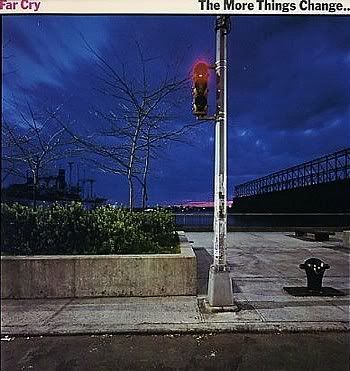
Far Cry - The More Things Change - 1980 - Columbia

In July 1973, Phil Galdston, a 23 year old New York songwriter met Peter Thom, a Montrealer, who had already released his solo album "Peter Thom" in 1972 on UA. The two talented musicians started songwriting together, and distributed demo tapes to various labels. One of their songs, "Why Don't We Live Together" recorded by Barry Manillow in 1975 was successful enough to get them an album deal. The album, "American Gypsies" by Galdston & Thom was produced by John Simon, and released in 1977. It received many good press reviews, but sold poorly.They eventually succeeded in getting Elliot Scheiner, the legendary record producer and engineer to produce " The More Things Change." Scheiner, famous for his work with Steely Dan , Bruce Hornsby, Sting, and Van Morrison assembled the "creme da la creme" of studio musicians, including Donald Fagen, Elliott Randall, and Bernard Purdie to produce this jewel of eighties pop rock. If you are into Steely Dan or good melodic jazz rock/pop fusion, you will love this album which is HR by A.O.O.F.C. Any info on the "American Gypsies" by Galdston & Thom would be most welcome.

TRACKS

The Hits Just Keep On Comin'
Eldorado Escape
The One And Lonely
Because It's There
It's Not As Simple As That
Fight, Fight, Fight
Ocean Eyes
Suddenly Strings
Tell Jack
Some Things Will Never Change

All songs composed by Phil Galdstone, & Peter Thom

BAND

Phil Galdston (Piano), (Piano (Electric)), (Vocals (Background)), & Peter Thom (Vocals (Background))

ASSISTED BY -
Donald Fagen (Vocals (Background))
Elliott Randall (Guitar (Electric))
Bernard "Pretty" Purdie (Drums)
Steve Khan (Guitar (Electric))
Rob Mounsey (Synthesizer), (Piano), (Vocals (Background)),(Clavinet)
Mark Doyle (Guitar), (Guitar (Electric))
Jeff Mironov (Guitar (Electric))
Chris Parker (Drums)
Ed Greene (Drums)
Liberty DeVitto (Drums)
Ralph MacDonald (Percussion)
Marvin Stamm (Trumpet),(Flugelhorn)
Randy Brecker (Trumpet), (Flugelhorn)
Timmy Cappello (Saxophone)
Ronnie Cuber (Saxophone)
David Tofani (Saxophone)
Barry Rogers (Trombone)
Neil Jason (Bass)
Will Lee (Bass)
Tony Levin (Bass)
Doug Stegmeyer (Bass)
Patti Austin (Vocals (Background))
John Barranco (Vocals (Background))
Zachary Sanders (Vocals (Background))
Frank Floyd (Vocals (Background))

Produced by Elliot Scheiner

ABOUT THE ALBUM [ © Mark Doyle , www.markdoyle.com/themorethingschange.html ]

This record must’ve taken a long time to come out, because I distinctly remember that I was still in bad personal shape during the recording. Elliott Scheiner was the producer, and the two guys that made up Far Cry were Phil Galdston and Peter Thom. Phil has gone on to become a hit songwriter, although I’ve lost track of Peter. The connection with them came because they were managed by a guy from Robert Stigwood named Jeff Tornberg, who was also managing David Werner at the time. New York was a small world in those days. We recorded at AR Studios, and Phil Ramone was executive producer and would pop in from time to time. The session musicians who played with me were all great. I got to play with Bernard Purdy, one of the great drummers of all time, who had the most amazing shuffle I had ever heard. He had a little Premier kit with an 18” bass drum. Too much! But this was my first introduction to the Steely Dan school of recording. Everything was written out, even the guitar parts. I had been up for 3 days before the session and walked in completely disheveled. Galdston said “You look suitably dazed”, which was my natural state in those days. I was in no mood to read, but had to. I also gave Elliott Scheiner a hard time about his clean guitar sounds because I had been recording with Clearmountain for so long and was used to some dirty sounds with a lot of room ambience on them. Of course now I cringe when I think that Elliott Scheiner’s only memory of me is of the surly rock character that I was. Called in later to overdub my solos, it was more of the Steely Dan approach. You had heard that they would have four different guitar players in for a solo, punching in each note, even using combinations of different players for the same solo. Well, it was like that. I couldn’t get more than two bars into it before I would be stopped, hummed some phrase, punched in, hummed some other phrase, etc. Micro-managed into the ground, they’re not really solos that I think represent me or for that matter did them much good either. But that’s show biz, I guess.

30.8.08

Can


Can - Anthology - 1994 - Spoon/Mute Records

Terrific compilation from the German rock and experimental pioneers. Can draws heavily from classic albums (Ege Bamyasi, Tago Mago) and from interesting but more obscure later albums (Rite Time, Landed). It's better for fans looking to expand their catalogue knowledge than those looking for a primer on a band whose early '70s work remains miles ahead of what most are doing now. Can is difficult, dense and groundbreaking; this disc proves those qualities from 1968-1993. Can were light years ahead of their time and never conformed to any set rock patterns. Yet, they produced music of the highest calibre, exploring new musical territories that other rock bands were neither interested, nor musically capable of exploring. This album is HR by A.O.O.F.C. It is worth listening to two of their groundbreaking alnums, the brilliant "Tago Mago" and "Ege Bamyasi." There is info on Irmin Schmidt's " Impossible Holidays" album on A.O.O.F.C. Check out Can's brilliant "Rite Time" album @ CAN/RITETIME

TRACKS / COMPOSERS

1-1 Father Cannot Yell - Can, Mooney
1-2 Soup - Can, Suzuki
1-3 Mother Sky - Can, Suzuki
1-4 She Brings The Rain - Can, Mooney
1-5 Mushroom - Can, Suzuki
1-6 One More Night - Can, Suzuki
1-7 Outside My Door - Can, Mooney
1-8 Spoon - Can, Suzuki
1-9 Halleluwah - Can, Suzuki
1-10 Aumgn - Can, Suzuki
1-11 Dizzy Dizzy - Can, Fallowell
Lyrics By - Duncan Fallowell
1-12 You Doo Right - Can, Mooney

2-1 Uphill - Can, Mooney
2-2 Mother Upduff - Can, Mooney
2-3 Doko E - Can, Suzuki
2-4 Musette - Can, Suzuki
2-5 Blue Bag - Can, Suzuki
2-6 TV Spot - Can, Suzuki
2-7 Half Past One - Can, Gilmour
2-8 Moonshake - Can, Suzuki
2-9 Future Days - Can, Suzuki
2-10 Cascade Waltz - Can, Gilmore, Glimour
Lyrics By - Can , Peter Gilmour
2-11 I Want More - Can, Gilmour, Gilmore
Lyrics By - Can , Peter Gilmour
2-12 Animal Waves - Baah, Can, Gee
2-13 Don't Say No - Baah, Can, Gee, Gilmore
Lyrics By - Can , Peter Gilmour
2-14 Aspectacle - Can, Czukay, Gee, Karoli, Liebezeit, Schmidt
2-15 Below This Level - Can, Mooney
2-16 Hoolah Hoolah - Can, Mooney
2-17 Last Night Sleep - Can, Karoli, Liebezeit, Mooney, Schmidt

CREDITS

Bass - Holger Czukay
Drums - Jaki Liebezeit
Guitar - Michael Karoli
Keyboards - Irmin Schmidt
Producer, Written-By, Composed By - Can
Vocals - Damo Suzuki , Holger Czukay , Irmin Schmidt , Jaki Liebezeit , Malcolm Mooney , Michael Karoli

REVIEWS

Can, a German band begun by a forward thinking orchestral conductor and student, Irmin Schmidt, laid a foundation of experimental music that is still in use today. There are multiple elements within the fabric of Can songs that sound, at times, like late ‘60s underground, and then like late ‘70s art-punk. Can opened the door for all of us who found excitement by their songs, allowing us commerce with other pioneers in experimental music such as Tangerine Dream, Steve Roach, and yes, even Talking Heads by way of Eno, AND Velvet Undergorund. Can was influenced by bands and thought but maintained an originality that makes up the structures of their own songs. This recently re-released Can Anthology, like Shout! Factory’s developing ELP remasters, precedes the revitalization of Can albums that begin with the reissue of Tago Mago (1971), and Ege Bamyasi (1972). Can Anthology is a 2CD set that explores early period Can and later period Can with one stop for Can circa 1988. Otherwise, the best Can years began in the late ‘60s and ended a decade later in the late ‘70s. This previously released 2CD retrospective approaches the music of Can well, culling the standout tracks from their 13 albums, and presenting them to us in a bounce-around pattern, from one album to another, regardless of any chronological release phase. Can changed and matured, the songs taking on differences that are recognizable. However, with this collection’s track-listing, there is little to do but sit back and enjoy Can in their imaginative settings, one period to another and then back again. The Can albums were remastered not long ago and released as SACDs. If you can acquire these, you are encouraged to do so, as they will soon become collector items, fetching far more money than you would pay for them now. For those on the edge, not yet sure if Can is a band to pay attention to, this Anthology is a perfect set to introduce you to this unique band. You’ll be amazed at what you hear. © Matt Rowe, 1/11/08, © 2002-2006 Matthew Rowe, http://www.musictap.net/


Can's Anthology serves as a pretty comprehensive, wide-ranging sampler of the band's key works, and the material's never sounded better - benefiting from a beautiful remastering treatment. Spanning Can's work from 1969's Monster Movie right up to 1991's soundtrack for the Wim Wenders film Until The End Of The World this two-disc compilation takes in a variety of line-ups, with the first disc drawing from the band's work up until 1974, with particular emphasis on the Tago Mago/Ege Bamyasi era. The second disc is fairly in keeping with chronological order too, drawing heavily upon Unlimited Edition and later works from Saw Delight and the period of Can's Damo Suzuki-less reformation for Rite Time. There are a few leaps backwards however, with a couple of tracks from Future Days making a welcome appearance (namely 'Moonshake' and the sublime 'Future Days'), but broadly speaking the first disc covers most of the band's most celebrated, pioneering work, which still sounds more experimental and current than most modern rock music. Flawless material. © http://www.boomkat.com/


Can's music is all around you, even if you've never actually heard it. The band has had such a deep impact on rock and experimental music that it's impossible not to have heard something that bears its fingerprints. Can were as unlikely as they were influential: Holger Czukay and Irmin Schmidt, both students of early electronic and serial composer Karlheinz Stockhausen, and the latter an associate of Fluxus musicians LaMonte Young and Terry Riley; Jaki Liebezeit, a drummer who'd made the rounds of Europe's free jazz scene; and Michael Karoli, a young guitarist who happened to be a student of Czukay. These four musicians would remain the core of Can for most of the band's life. It doesn't look like a recipe for a rock group, but that's probably why the music they made was so unprecedented. Aside from Stockhausen, their influences ranged from ethnic field recordings to jazz to the elemental funk of James Brown to Frank Zappa, Jimi Hendrix, the Velvet Underground, and Pink Floyd. They made free improvisation and tape editing their basis for composing, building songs around Liebezeit's repetitive, driving percussion parts, which allowed the other members plenty of room to roam without getting lost. It was intellectual but funky-- serious music that was also fun and interesting. Though they'd initially intended to make ethnic music a central part of the band's sound, the members found themselves more and more taken by psychedelia and quickly came to sound more like a true rock band. They recruited African-American sculptor Malcolm Mooney to handle vocals. As a singer, Mooney was a decided amateur, but he was intensely creative and totally unshackled by any conventional sense of what a rock vocalist was supposed to do. His most inspired performances bordered on psychotic, emphasizing rhythm and interacting with the instruments as though he were one of them. Mooney's time with the band was limited-- he was only a member from 1968 to 1969 and again for a brief period during a late 1980s reunion-- but he still made a lot of recordings with them, and he features heavily on Anthology. The quintet recorded its first album, Prepared to Meet Thy PNOOM, in 1968, but it was flatly rejected by every record label they approached, so they returned to the studio, recording with a very basic two-track setup, and produced Monster Movie, which became their debut in 1969 (PNOOM finally came out in 1981 under the title Delay 1968). Three of Monster Movie's four tracks appear here on the first disc, sounding as fresh and ferocious as ever. The Velvet Underground-inspired "Father Cannot Yell" was the first Can song, and it features Mooney's motor-mouthed, rhythmic vocal low in the mix, with Czukay's bass right next to it. "Outside My Door" is ripped open by distorted bells, and the 20-minute "Yoo Doo Right", edited down from an hours-long jam, points toward the stripped-down future funk that characterized Can's classic early-70s output. Mooney wasn't part of that lineup. His instability was part of what made him great, but it was also what made him leave the band and return to the U.S. on the advice of a psychiatrist in 1969. In search of a new vocalist, the band found Japanese wanderer Damo Suzuki busking outside a café and invited him to join. He performed with them the same night and proved to be a perfect fit. Lyrics had always been secondary to the sound of the voice in Can's music, but Suzuki took this to a new level, often reducing his vocals to the most apt syllable for the moment. He joins the funky crunch of "Halleluwah", from 1971's masterful double LP Tago Mago, with a series of rhythmic "da da"s, and it's impossible to imagine anyone singing anything else over it. "Halleluwah" is one of the songs that benefits most from the superb remastering treatment given to all of Can's output in the last couple of years. The song's militaristic drum pattern and staccato bass line hit like a hammer now, and the mix on every song is exceptionally clear, with none of the hiss and murkiness that plagued early CD issues of Can's albums. The band continued to develop its bracing, improvisatory style on Tago Mago, 1972's Ege Bamyasi and 1973's Future Days, piecing together its albums from edits of massive jam sessions in much the same way that Miles Davis and Teo Macero pieced together Bitches Brew and On the Corner at roughly the same time. Each of those albums is well-represented on Anthology, though "Vitamin C" or "Sing Swan Song" would've made a better, more representative selection from Ege Bamyasi than the short edit of the chaotic "Soup" that appears here. (EB's "Spoon", one of Can's most accessible songs, is included.) Oddly, the two tracks from Future Days are sequenced in the middle of the second disc. "Moonshake" is perhaps the most prototypical example of the minimal, rhythmic style that came to be called motorik, with its metronomic drum pulse and guitar parts that obediently serve the rhythm. The lack of chronological sequencing is likely due to the fact that so many of Can's best songs are quite long, often stretching past 15 minutes, but it also means that any listener who starts here will have a tough time hearing their progression from album to album. Suzuki left the band in early 1974 after getting married and becoming a Jehovah's Witness, and the remaining members were unable to find a suitable replacement. Schmidt and Karoli assumed vocal duties for 1974's underrated Soon Over Babaluma, only represented here by the spooky, methodically rhythmic "Dizzy Dizzy", which features Karoli's gypsy-ish violin part. Soon is a complex, melodic, and strange record that deserves a higher standing in the band's catalog, and it also effectively marks the end of the band's classic period. That isn't to say they didn't make good music afterward, but nothing they recorded had the sheer innovative and primal power of their first six years of work. Apart from the two Future Days tracks, the second disc focuses on the band's late output and early outtakes, with one track from Delay 1968 and a fairly absurd five selections from Unlimited Edition, a compilation of previously unreleased tracks from 1968-1975 that, while full of interesting material featuring both Mooney and Suzuki, is really a fans-only release. What the second disc does do with its 17 tracks is convey a good idea of the wide range of styles Can covered. Delay's early Mooney track "Uphill" is a chugging, intense song covered in spastic fuzz guitar and one of the punkest things they ever did, while "I Want More", from 1976's Flow Motion, is post-punk before punk even happened, anticipating the keyboard-driven new wave of the Human League and the dancefloor-friendly sound of A Certain Ratio. It even became an international hit. Former Traffic members Rosko Gee and Rebop Kwaku Bah joined the band for its final two albums, 1977's Saw Delight and 1978's Can. Gee took over the bass duties from Czukay, who focused on sound effects, noise generators and shortwave radio on Saw Delight and finally left the band over personal disagreements that descended to a true low when band members began unplugging each other on stage. The self-titled album would be their last. There is some interesting music on these albums, which feature a combination of frenetic percussion and slow, ambient textures that still sounds somewhat unique-- even when they weren't at their best, Can were capable of breaking new ground. The band's last hurrah came a full 10 years later, when the original quintet lineup reunited for Rite Time, an album that has an interesting sonic character-- the way the backing vocals are layered and compressed, for example, is neat-- but you have to be a die-hard fan to get too far into this stuff. Certain artists are represented just fine by their most-loved songs, but Can isn't one of them. A 2xCD career anthology does a good job of presenting Can's astounding versatility, but it's best to hear the full albums, and if you like the first disc of Anthology, you'll want to get all of them. © Joe Tangari, October 30, 2007, © 2008 Pitchfork Media, Inc.

BIO [ © Gary Smith, © Spoon Records, All rights reserved ]

June 2003 marked the 35th anniversary of the founding of Can when Holger Czukay (bass), David Johnson (flute), jazz drummer Jaki Liebezeit and beat guitar player Michael Karoli met in classical conductor and piano player Irmin Schmidt's Cologne apartment in 1968. Their first gig, a collage of rock music and tape samples, took place at Schloss Nörvenich (Castle Nörvenich, near Cologne).The show is documented on the audio cassette Prehistoric Future. The nameless collective had established its first studio, Inner Space, at the castle when American sculptor Malcolm Mooney, visiting Irmin and Hildegard Schmidt, joined the band. His intuitive drive led the musicians toward a unique take on rock music and the track Father Cannot Yell originated from one of these early sessions. David Johnson, who by then had become the band's sound engineer, left at the end of 1968. Around this period, the lack of a name was solved by Mooney and Liebezeit who came up with The Can. The first Can album, Monster Movie (1969), defined Can music. Played and recorded spontaneously and driven by repetitive rhythms, the album was recorded directly on to a 2-track machine and then extensively edited. Soundtracks featuring film scores from 1969 and 1970, was the next album. Just after the record was released, Malcolm Mooney left the band and returned to the U.S. The Mooney era is extensively documented on Can - Delay, released in 1982. In May 1970, Japanese singer Kenji "Damo" Suzuki joined Can after being spotted by Holger Czukay and Jaki Liebezeit busking in Munich. The very same evening he performed with the band at the Blow Up club. In December 1971, Can founded the Can Studio - known as Inner Space until 1978 when Can soundman René Tinner took over running the operation - in a former cinema in Weilerswist, close to Cologne. All subsequent Can albums were produced there except Rite Time. The studio has now been painstakingly disassembled and is being reconstructed to scale as a working exhibit at the German Rock'n'Pop Museum in Gronau, near the Dutch border. The period 1970-2 was a breakthrough time for the band with Tago Mago (1971) impressing critics in England and France as well as Germany. Ege Bamyasi, released in 1972, featured the track Spoon, the theme tune for the crime thriller Das Messer and also the band's first chart success in Germany. The track, which was the first time that Can used an early version of a drum machine, led to a Goldene Europa TV award in recognition of Can's soundtrack work. Ege Bamyasi also included the music from another TV crime series in the form of Vitamin C. The success of Spoon inspired the band to try to reach a wider audience which led to the Can Free Concert. The event was filmed by Martin Schäfer, Robbie Müller and Egon Mann for director Peter Przygodda at the Cologne Sporthalle on February 3rd, 1972. British music weekly Melody Maker wrote: "Can are without doubt the most talented and most consistent experimental rock band in Europe, England included." French magazine Rock & Folk portrayed Can's music as "one of the most impressive musical experiments offered by contemporary bands." Future Days (1973) was the last Can album with Damo Suzuki. First Michael Karoli took over the vocal duties, followed by short interludes with a succession of singers, among them Tim Hardin. The recording of Soon Over Babaluma that same year marked the end of the era of recording straight onto 2-track. Landed (1975), was the first Can LP to be produced using multi-track technology. The album led Melody Maker to call them "the most advanced rock unit on the planet." Double album Unlimited Edition (1976) was an extended version of a release that had quickly sold out as Limited Edition two years earlier. Among the tracks were the multi-facetted experiments known as the Ethnological Forgery Series (EFS). Flow Motion, also released in 1976, featured the disco hit I Want More and saw the band performing on UK primetime hitshow Top Of The Pops. The following year Can was augmented by ex-Traffic rhythm duo Rosko Gee (bass) and Reebop Kwaku Baah on percussion. Holger Czukay had retired as a bass player and on Saw Delight was in charge of "special sounds". His new instrument was a shortwave radio receiver; while his idea to create new impulses for the musical process via radio signals didn't fit within the new Can structure, it became the basis for his first solo album, Movies (1979). The next Can album, Out of Reach (1978), was recorded without Czukay, who had left the band in May 1977, during the final Can tour. On the last show of the tour, in Lisbon at the end of May, Can performed in front of 10,000 fans. The double album Cannibalism (1978) was not just a "Best of ...." compilation, it was in fact, an early indication that Can's reputation would continue to grow. The British avant-garde and several punk acts were deeply inspired by Can. Speaking for many, Pete Shelley (Buzzcocks) is quoted on the Cannibalism cover: "I never would have played guitar if not for Marc Bolan and Michael Karoli of Can". At the end of 1978 the band released Can. Meanwhile Michael Karoli built the Outer Space Studio studio in France, close to Nice. It was there in November 1986 that the original Monster Movie line-up got together again, with vocalist Malcolm Mooney to record Rite Time. The album was released in 1988. The band assembled again at the Can Studio with the same line-up minus Holger to record the track Last Night Sleep for Wim Wenders' film Until the End of the World. In May 1997, the remix CD Sacrilege provided further evidence of the durability of Can's music. For this tribute, prominent representatives of the techno, dance and ambient scene reworked 15 classic Can tracks. Ironically, the importance of Can's contribution to the wider musical pantheon was summed up by Andrew Weatherall who refused an offer to remix a Can track for Sacrilege: "I love to remix other people's work. But Can? No way. You don't touch music that perfect. There is nothing to add or take away." The band's chosen means of celebrating its 30th anniversary in 1999 was characteristically original. Eschewing a reunion tour as too obvious, and, more importantly, as being against the spirit of the group, the Can Box and the Can-Solo-Projects tour were the ways in which the group marked the occasion.Can Box includes recordings from the period 1971-77, a tri-lingual book featuring a comprehensive group history, interviews, reviews and photos by Hildegard Schmidt and Wolf Kampmann plus a video with both the Can Free Concert film by Peter Przygodda, and the Can Documentary by DoRo-film. The Can-Solo-Projects tour, which featured Holger Czukay & U-She, Jaki Liebezeit's Club Off Chaos, Irmin Schmidt & Kumo plus Michael Karoli's Sofortkontakt!, started on March 19th 1999 in Berlin at the Columbia Halle. The tour was so well received that a second leg was organised for September 1999. This went ahead without Holger Czukay who was obliged to pull out at the last minute due to unforeseen circumstances. Can worked together for the last time in August 1999 at Irmin's studio in Provence with Jono Podmore, to record a cover-version of The Third Man theme (from the film of the same name) for the Pop 2000 compilation released on Herbert Grönemeyer's label Grönland/EMI. On November 17th, 2001, Michael Karoli died after a long fight against cancer. In March 2003 Can received the most prestigious prize that the German music industry can offer: the Echo award for lifetime achievement was presented at an awards ceremony in Berlin. Herbert Grönemeyer, one of Germany's most famous artists, made the official speech while Brian Eno sent in a short, witty film about the group. The prize was handed over by the Red Hot Chili Peppers whose guitarist John Frusciante also spoke of his appreciation and respect for Can's music. The remaining members of Can are all active as both solo artists and collaborators.

26.8.08

P-Jay


P-Jay - My Everything - 2007 - Jubilee Records (Germany)

This is not the usual type of music found on A.O.O.F.C, but it is a very good album of funky, acid jazz, and urban pop-lounge dancefloor grooves. The album has genuine musical merit, and should not be discounted because of it's musical genre. So don't take life too seriously! If you need to relax and chill out, take off your Neu and Spock's Beard albums and give this album a listen, and GET DOWN, AND GET WITH IT !!

TRACK DETAILS

1.Exit (5:57)
Composed By [Additional Composing] - Steve Wettstein
Guitar - Thom Wettstein
Lyrics By - Fabienne A. Müller
Vocals - Caroline Chevin
2.Alive (4:22)
Acoustic Guitar - Steve Wettstein
Composed By [Additional Composing] - Thom Wettstein
Drums - Eddie Walker
Lyrics By, Vocals - Caroline Chevin
3.My Everything (5:23)
Lyrics By, Vocals - Ivy Rentsch
4.Sweetest Lullaby (4:56)
Acoustic Guitar - Steve Wettstein
Lyrics By - Thom Wettstein
Lyrics By, Vocals - Caroline Chevin
5.Tell Me What You Want (5:30)
Composed By [Additional Composing] - Thom Wettstein
Drums - Eddie Walker
Lyrics By, Backing Vocals - Ivy Rentsch
Lyrics By, Vocals - Sabina Stokes
6.Subrayado (6:01)
Composed By [Additional Composing] - Michael Allemand , Paul G. Jakob
Percussion - Jean-Pierre Wettstein
7.Right Place (3:55)
Lyrics By, Vocals - Caroline Chevin
Percussion - Reto "Fonso" Von Salis*
8.Summerfeeling (6:44)
Lyrics By, Guitar - Thom Wettstein
Lyrics By, Vocals - Ivy Rentsch
9.Feel Da Funk (4:21)
Keyboards [Additional] - Philipp Kuhn*
Percussion - Jean-Pierre Wettstein
Programmed By [Additional], Composed By [Additional Composing] - Steve Wettstein
10.Make Me Feel Good (4:54)
Lyrics By, Vocals - Robbie Hacaturyan
11.Ride With Me (3:47)
Drums - Eddie Walker
Lyrics By, Vocals - Sabina Stokes
12.Glistening (5:47)
13.Autumn Dance (7:11)
Flute - Michael Allemand
Percussion - Robbie Hacaturyan
14.Walking (7:03)
Lyrics By - Thom Wettstein
Lyrics By, Vocals - Gala Stohler
Percussion - Robbie Hacaturyan

CREDITS

Bass - Thom Wettstein
Composed By - Paul G. Jakob (tracks: 2, 3, 5, 7, 10 to 14) , Thom Wettstein (tracks: 1, 4, 6 to 9)
Guitar - Steve Wettstein (tracks: 1 to 3, 5, 7, 9 to 14)
Keyboards - Paul G. Jakob , Thom Wettstein (tracks: 1, 4, 6, 8, 9)
Recorded By, Mixed By - Paul G. Jakob , Thom Wettstein
Saxophone - Michael Allemand (tracks: 1, 3, 5 to 14)
Trumpet - Paul G. Jakob (tracks: 6 to 9, 14)

BAND [ P-Jay / Real Name: Caroline Chevin, Michael Allemand, Paul G. Jakob, Stefan Wettstein, Thom Wettstein & Eddie Walker ]

Caroline Chevin - Vocals
Michael Allemand - Saxophone / Flute
Paul G. Jakob - Keyboard / Trumpet / Laptop
Stefan Wettstein - Guitar
Thom Wettstein - Bass
Eddie Walker - Drums

Rick Derringer


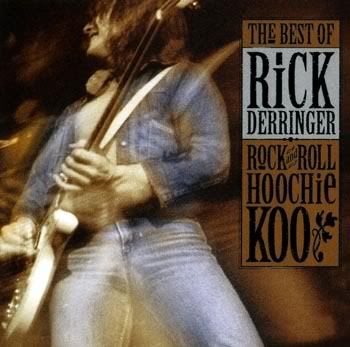
Rick Derringer - Rock and Roll Hoochie Koo, The Best of Rick Derringer - 1996 - Sony

One of the greatest American rock guitarists of modern times, Rick Derringer's amazing c.v is too long to list here. If you ever want to hear some of his greatest work, then buy his brilliant "Jackhammer Blues" album, and listen to his live album, the King Biscuit "Rick Derringer and Friends" which is simply outstanding. For an example of how blues guitar should be played, listen to his version of "Pride And Joy" on the "Hats Off To Stevie Ray" tribute album to SRV. If you want to hear some mean slide guitar, listen to Rick's playing on Steely Dan's "Show Biz Kids" from their "Countdown To Ecstacy" album. Rick also played on the Dan's classic "Katy Lied," and "Gaucho" albums, and on Donald Fagen's incredible "The Nightfly" album. He has also played with the great Todd Rundgren. We could be here all night talking about Rick Derringer's work, but suffice to say that "Rock and Roll Hoochie Koo" is a great compilation of Rick's most memorable tunes.

TRACKS

Rock & Roll, Hoochie Koo
I Didn't Ask to Be Born
Time Warp
Teenage Queen
Let Me In
Still Alive and Well
Let the Music Play
Modern Love
Everything
Sleepless
Need a Little Girl (Just Like You)
Hang on Sloopy
Sittin' by the Pool
Don't Ever Say Goodbye
Teenage Love Affair
Beyond the Universe

All songs composed by Rick Derringer, except "Let Me In" by Derringer/Cynthia Weil, "Sleepless" by Derringer/Patti Smith, "Hang On Sloopy" by Wes Farrell,/Bert Russell, & "Sittin' By The Pool" by Derringer/Larry Sloman

MUSICIANS

Rick Derringer (Guitar (Acoustic)), (Bass), (Guitar), (Guitar (Electric)), (Guitar (Rhythm)), (Maracas), (Tambourine), (Vocals), (Vocals (Background)), (Guitar (12 String)), (Sitar (Electric))
Dan Hartman (Organ), (Bass), (Guitar (Rhythm)), (Vocals (Background))
Joe Walsh (Guitar (Electric))
Danny Johnson (Guitar), (Vocals)
Randy Jo Hobbs (Bass)
Kenny Passarelli (Bass)
John Siegler (Bass)
Donnie Kisselbach (Bass), (Vocals)
Kenny Aaronson (Bass), (Vocals (Background))
Myron Grombacher (Drums), (Vocals)
Jimmy Wilcox (Drums), (Vocals)
Vinny Appice (Drums),(Vocals (Background))
Chuck Ruff (Percussion), (Drums), (Vocals (Background))
Bobby Caldwell (Drums)
John Siomos (Drums)
Joe Vitale (Drums)
Bobby Ramirez (Drums)
Edgar Winter (Organ), (Percussion), (Keyboards), (Piano (Electric)), (Saxophone), (Vocals (Background))
Benjy King (Keyboards), (Vocals (Background))
Roger Powell (Organ)
Neil Geraldo (Piano)
Paul Harris (Piano)
Jerry Lacroix (Saxophone)
Jon Smith (Saxophone),(Vocals (Background))
Tilly Lawrence (Trumpet)
Mike McLellan (Trumpet)
Joe Lala (Conga)
Todd Rundgren (Vocals (Background))
Jerry Lacroix (Vocals (Background))
Kasim Sulton (Vocals (Background))
Tasha Thomas (Vocals (Background))
Carl Hall (Vocals (Background))
Allen Nichols (Vocals (Background))
George I. Isaac (Vocals (Background))
Emmanuel Riley (Vocals (Background))

SHORT BIO

It seems like Rick Derringer has been on the rock & roll scene forever -- actually, it's only been since 1965, which makes him one of the more enduring veterans of his generation. Derringer's work with his band the McCoys in his midteens, highlighted by the bubblegum anthem "Hang On Sloopy," gave him a claim to low-level rock & roll immortality, and his subsequent playing with Johnny (and later Edgar) Winter provided him with a degree of credibility that a lot of guitar players can only envy, especially after the release of the Edgar Winter live double album Roadwork. Derringer began getting production experience with the McCoys, but they were never able to overcome their bubblegum rock image, and by the end of the 1960s, Derringer and his brother Randy were recruited by Johnny Winter into his band, with Derringer playing guitar and also producing. He emerged as a solo artist in the wake of his playing with Edgar Winter's White Trash. Derringer first became popular in his own right during the early/mid-'70s, beginning with a new version of his own "Rock & Roll, Hoochie Koo" (which Johnny Winter had covered for him a few years earlier) off Derringer's heavy metal-influenced debut album, All American Boy. Derringer soon had his own band, called Derringer, on the road -- although his guitarist and bassist, Danny Johnson and Kenny Aaronson, left in 1977 to form Axis -- and within a couple of years had established himself as a popular favorite. Derringer's recorded history was somewhat spotty, however, as his record sales never matched his favor with concert audiences -- a huge gap also existed between releases, which didn't bother him; even in the late '90s, Derringer played close to 200 shows a year. He spent most of the late '70s and 1980s, however, as a producer, working with artists as diverse as Bette Midler, Kiss, Meat Loaf, Cyndi Lauper, Barbra Streisand, and Weird Al Yankovic. Derringer is known for his hard-rocking live shows, which don't necessarily translate well to recordings, or lend themselves to much originality. As he neared age 50 in the 1990s, however, he had mellowed, and this showed when he began recording again for Shrapnel Records in 1993 with the albums Back to the Blues and Electra Blues. Years of fair to average rock and adult contemporary albums followed, but in 2002 Derringer did an about-face and tried his hands at jazz with the adventurous Free Ride. © Bruce Eder, All Music Guide

25.8.08

Lacy Gibson


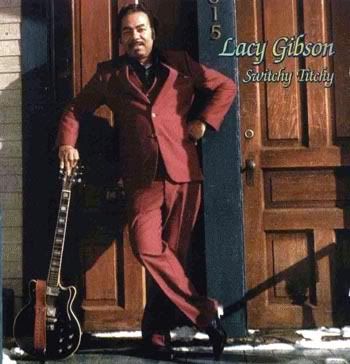
Lacy Gibson - Switchy Titchy - 1982 - Black Magic

Lacy Gibson has had a long and varied career, mainly as a sideman and/or musical director for bigger stars. An excellent instrumentalist, at home in blues, jazz, or rock, he has recorded with artists as varied as Sun Ra, Duke Ellington, Junior Wells, and Buddy Guy. He plays guitar with understated precision and rhythmic authority, very like the great Robert Cray. Although Lacy Gibson's recorded solo output is very sparse, "Switchy Titchy" is a well above average modern Chicago blues album, and a good example of Lacy's talents. The back up musicians are pure class, especially Abe Locke on horns. Buy his 1996 "Crying For My Baby" album.

TRACKS / COMPOSERS

1 Take My Love - John
2 Easy Woman - Gibson
3 Quaker City - Dogget
4 My Love Is Real - Gibson
5 Somebody Somewhere - Gibson
6 Come Back Baby - Trad
7 Switchy Titchy - Gibson
8 You Better Be Sure - McAdoo
9 Five Long Years - Boyd
10 Lucky Lou - Williams

MUSICIANS

Lacy Gibson (Guitar), (Vocals)
Snapper Mitchum (Bass (Electric)
Allen Batts (Piano)
Sunnyland Slim (Piano)
Abe Locke (Sax (Tenor))
Robert Covington (Drums)

REVIEWS

Lacy Gibson's Switchy Titchy is one of those compact discs that seemed unspectacular when it was first released on vinyl, but upon reissue proves to be a purer blues product than much of what initially overshadowed it. This 1982 session features the Chicago guitarist backed by a compact combo that included pianist Sunnyland Slim and reedman Abb Locke. Gibson's guitar style is rhythmic and chord-oriented, with rather hinky lead breaks. Anyone fond of the sort of playing that influenced Rusty Zinn and Rick Holmstrom will find him of interest. His voice isn't extremely strong, but it has an appealing burnish. Some cuts have a rock'n'roll zest to them, most notably "Somebody Somewhere," which is much in the style of Little Richard sans those trademark falsetto whoops. The opening "Take My Love" is similarly lively, with paint-peeling saxophone from Locke. The title track is too much on the cute side; better is "Easy Woman," low and slow, with appropriately mournful piano work from Sunnyland. Gibson's guitar break is jazzy, with a brief but tasty Wes Montgomery-type fillip in one of the choruses. Gibson also does two instrumentals, one a positively perky take on a Bill Doggett oldie, "Quaker State." It's good, but downright killer is his version of "Lucky Lou," an obscure but influential Jody Williams item. Otis Rush copied it rather flagrantly on "All Your Love," and it additionally foretold everything that ever happened in the genre of surf guitar. Gibson does it up in masterful guitar noir style, backed by rumbling tom-toms, speaker-rattling bass and sax that sounds like ripping leather. Sound quality is a bit bass-y, and the 36 minutes or so of playing time is a short count for those used to CD overkill. But all in all, it's good music from one of Chicago's seasoned sidemen in a rare role as bandleader. Liner notes by Dick Shurman are generous and informative. © Tim Schuller, © 1996 by Blues Access, Boulder, CO, USA.

Switchy Titchy is the best record Lacy Gibson has recorded to date. Gibson's variation on Chicago blues includes some horns pinched from Southern soul-blues records, and it's a little bit more laidback than the pile-driving sound often associated with the style. He makes up for the relaxed pace with his round, clean guitar tones and big, powerful vocals, both of which are spotlighted throughout Switchy Titchy. Best of all, that playing is married to a strong song selection, featuring a couple of originals and a lot of forgotten classics. That unpredictable song selection makes the entire album sound fresh and lifts the record above many of its modern blues peers. © Thom Owens, All Music Guide

SHORT BIO

Born 1 May 1936, Salisbury, North Carolina, USA. Gibson's family settled in Chicago in 1949 and he quickly became involved in the city's blues scene, receiving tips on blues guitar playing from musicians such as Muddy Waters and T-Bone Walker. Besides working with innumerable blues artists, he was also involved in the jazz scene. He recorded with Buddy Guy in 1963 and worked on many sessions. Gibson had two singles of his own on the Repeto label, and had material released on albums by the Alligator, Red Lightnin', El Saturn, and Black Magic labels. He is a strong vocalist and very talented blues guitarist who seems to be equally at home in small west-side Chicago bars or European concert halls. [ Source: Encyclopedia of Popular Music ]

MORE ABOUT LACY GIBSON

Slowly returning to musical action following major surgery, guitarist Lacy Gibson has been an underappreciated figure on the Windy City circuit for decades. Lacy and his family left North Carolina for Chicago in 1949. It didn't take long for Gibson to grow entranced by the local action -- he learned from veterans Sunnyland Slim and Muddy Waters and picked up pointers from immaculate axemen Lefty Bates, Matt "Guitar" Murphy, and Wayne Bennett. Gibson made a name for himself as a session player in 1963, assuming rhythm guitar duties on sides by Willie Mabon for USA, Billy "The Kid" Emerson for M-Pac!, and Buddy Guy on Chess. Gibson made his vocal debut on the self-penned blues ballad "My Love Is Real" at Chess the same year, though it wasn't released at the time (when it belatedly emerged, it was mistakenly attributed to Guy). A couple of bargain basement 45s for the remarkably obscure Repeto logo (that's precisely where they were done -- in Lacy Gibson's basement!) preceded Gibson's inconsistent album debut for then-brother-in-law Sun Ra's El Saturn label. Ralph Bass produced an album by Gibson in 1977, but the results weren't issued at the time (Delmark is currently releasing the set domestically). A stint as Son Seals's rhythm axeman (he's on Seals's Live and Burning LP) provided an entree to Alligator Records, which included four fine sides by Gibson on its second batch of Living Chicago Blues anthologies in 1980. Best of all was a Dick Shurman-produced album for the Dutch Black Magic logo in 1982, Switchy Titchy, that brilliantly spotlighted Gibson's clean fretwork and hearty vocals. After he regained his health in the mid-'90s, Lacy Gibson entered the studio and recorded Crying for My Baby, which was released in 1996. © 2008 GetBack Media Inc. All Rights Reserved.

Can


Can - Rite Time - 1989 - Mercury

This is the original German Mercury label 7-track vinyl LP version. The album was also released on CD with a bonus track "In The Distance Lies The Future" on the 1989 CD on Spoon & Mercury Records. A great album from the legendary Can, who return to their early/mid seventies style with some great polyrhythmic and nontraditional nusic. Can were light years ahead of their time and never conformed to any set rock patterns. Yet, they produced music of the highest calibre, exploring new musical territories that other rock bands were neither interested, nor musically capable of exploring. This album is HR by A.O.O.F.C. It is worth listening to two of their groundbreaking alnums, the brilliant "Tago Mago" and "Ege Bamyasi." There is info on Irmin Schmidt's " Impossible Holidays" album @ ISCHMIDT/IMPHOL


TRACKS / COMPOSERS

A1 On The Beautiful Side Of A Romance - Can, Irmin Schmidt, Holger Czukay, Michael Karoli, Malcolm Mooney, Jaki Liebezeit
A2 The Withoutlaw Man - Can, Irmin Schmidt, Holger Czukay, Michael Karoli, Malcolm Mooney, Jaki Liebezeit
A3 Below This Level (Patient's Song) - Can, Irmin Schmidt, Holger Czukay, Michael Karoli, Malcolm Mooney, Jaki Liebezeit
A4 Movin' Right Along - Can, Irmin Schmidt, Holger Czukay, Michael Karoli, Malcolm Mooney, Jaki Liebezeit

B1 Like A New Child - Can, Irmin Schmidt, Holger Czukay, Michael Karoli, Malcolm Mooney, Jaki Liebezeit
B2 Hoolah Hoolah - Can, Irmin Schmidt, Holger Czukay, Michael Karoli, Malcolm Mooney, Jaki Liebezeit
B3 Give The Drummer Some - Can, Irmin Schmidt, Holger Czukay, Michael Karoli, Malcolm Mooney, Jaki Liebezeit


BAND

Michael Karoli / chorus vocals, pocket organ, bass, guitar
Irmin Schmidt / keyboards, kimbele
Jaki Liebezeit / drums, percussion
Holger Czukay / French horn, dictaphone, bass, synthesizers
Malcom Mooney / vocals

REVIEW

An unexpected reunion from Can (made even more unexpected by the presence of original singer Malcolm Mooney, who left the band in 1969), 1989's Rite Time is in large part a return to form for the group, especially when one considers how weak Can's last few '70s albums were. Wisely, the quintet doesn't try to replicate the sound they created over two decades before on albums like Monster Movie. Instead, Mooney and company make Rite Time a document of where they're at musically at the time. In short, it's funkier ("Give the Drummer Some"), funnier ("Hoolah Hoolah," which takes that old schoolyard rhyme about how they don't wear pants on the other side of France as the jumping-off point for its melody and lyrics), and more abstractly ambient (the elliptical closer "In the Distance Lies the Future") than before. Rite Time doesn't have the rubbery, polyrhythmic intensity of classic Can albums like Ege Bamyasi or Future Days, but it's a solidly listenable album that, unlike the majority of reunion albums, doesn't soil the memory of the band. © Stewart Mason, All Music Guide

BIO [ © Gary Smith, © Spoon Records, All rights reserved ]

June 2003 marked the 35th anniversary of the founding of Can when Holger Czukay (bass), David Johnson (flute), jazz drummer Jaki Liebezeit and beat guitar player Michael Karoli met in classical conductor and piano player Irmin Schmidt's Cologne apartment in 1968. Their first gig, a collage of rock music and tape samples, took place at Schloss Nörvenich (Castle Nörvenich, near Cologne).The show is documented on the audio cassette Prehistoric Future. The nameless collective had established its first studio, Inner Space, at the castle when American sculptor Malcolm Mooney, visiting Irmin and Hildegard Schmidt, joined the band. His intuitive drive led the musicians toward a unique take on rock music and the track Father Cannot Yell originated from one of these early sessions. David Johnson, who by then had become the band's sound engineer, left at the end of 1968. Around this period, the lack of a name was solved by Mooney and Liebezeit who came up with The Can. The first Can album, Monster Movie (1969), defined Can music. Played and recorded spontaneously and driven by repetitive rhythms, the album was recorded directly on to a 2-track machine and then extensively edited. Soundtracks featuring film scores from 1969 and 1970, was the next album. Just after the record was released, Malcolm Mooney left the band and returned to the U.S. The Mooney era is extensively documented on Can - Delay, released in 1982. In May 1970, Japanese singer Kenji "Damo" Suzuki joined Can after being spotted by Holger Czukay and Jaki Liebezeit busking in Munich. The very same evening he performed with the band at the Blow Up club. In December 1971, Can founded the Can Studio - known as Inner Space until 1978 when Can soundman René Tinner took over running the operation - in a former cinema in Weilerswist, close to Cologne. All subsequent Can albums were produced there except Rite Time. The studio has now been painstakingly disassembled and is being reconstructed to scale as a working exhibit at the German Rock'n'Pop Museum in Gronau, near the Dutch border. The period 1970-2 was a breakthrough time for the band with Tago Mago (1971) impressing critics in England and France as well as Germany. Ege Bamyasi, released in 1972, featured the track Spoon, the theme tune for the crime thriller Das Messer and also the band's first chart success in Germany. The track, which was the first time that Can used an early version of a drum machine, led to a Goldene Europa TV award in recognition of Can's soundtrack work. Ege Bamyasi also included the music from another TV crime series in the form of Vitamin C. The success of Spoon inspired the band to try to reach a wider audience which led to the Can Free Concert. The event was filmed by Martin Schäfer, Robbie Müller and Egon Mann for director Peter Przygodda at the Cologne Sporthalle on February 3rd, 1972. British music weekly Melody Maker wrote: "Can are without doubt the most talented and most consistent experimental rock band in Europe, England included." French magazine Rock & Folk portrayed Can's music as "one of the most impressive musical experiments offered by contemporary bands." Future Days (1973) was the last Can album with Damo Suzuki. First Michael Karoli took over the vocal duties, followed by short interludes with a succession of singers, among them Tim Hardin. The recording of Soon Over Babaluma that same year marked the end of the era of recording straight onto 2-track. Landed (1975), was the first Can LP to be produced using multi-track technology. The album led Melody Maker to call them "the most advanced rock unit on the planet." Double album Unlimited Edition (1976) was an extended version of a release that had quickly sold out as Limited Edition two years earlier. Among the tracks were the multi-facetted experiments known as the Ethnological Forgery Series (EFS). Flow Motion, also released in 1976, featured the disco hit I Want More and saw the band performing on UK primetime hitshow Top Of The Pops. The following year Can was augmented by ex-Traffic rhythm duo Rosko Gee (bass) and Reebop Kwaku Baah on percussion. Holger Czukay had retired as a bass player and on Saw Delight was in charge of "special sounds". His new instrument was a shortwave radio receiver; while his idea to create new impulses for the musical process via radio signals didn't fit within the new Can structure, it became the basis for his first solo album, Movies (1979). The next Can album, Out of Reach (1978), was recorded without Czukay, who had left the band in May 1977, during the final Can tour. On the last show of the tour, in Lisbon at the end of May, Can performed in front of 10,000 fans. The double album Cannibalism (1978) was not just a "Best of ...." compilation, it was in fact, an early indication that Can's reputation would continue to grow. The British avant-garde and several punk acts were deeply inspired by Can. Speaking for many, Pete Shelley (Buzzcocks) is quoted on the Cannibalism cover: "I never would have played guitar if not for Marc Bolan and Michael Karoli of Can". At the end of 1978 the band released Can. Meanwhile Michael Karoli built the Outer Space Studio studio in France, close to Nice. It was there in November 1986 that the original Monster Movie line-up got together again, with vocalist Malcolm Mooney to record Rite Time. The album was released in 1988. The band assembled again at the Can Studio with the same line-up minus Holger to record the track Last Night Sleep for Wim Wenders' film Until the End of the World. In May 1997, the remix CD Sacrilege provided further evidence of the durability of Can's music. For this tribute, prominent representatives of the techno, dance and ambient scene reworked 15 classic Can tracks. Ironically, the importance of Can's contribution to the wider musical pantheon was summed up by Andrew Weatherall who refused an offer to remix a Can track for Sacrilege: "I love to remix other people's work. But Can? No way. You don't touch music that perfect. There is nothing to add or take away." The band's chosen means of celebrating its 30th anniversary in 1999 was characteristically original. Eschewing a reunion tour as too obvious, and, more importantly, as being against the spirit of the group, the Can Box and the Can-Solo-Projects tour were the ways in which the group marked the occasion.Can Box includes recordings from the period 1971-77, a tri-lingual book featuring a comprehensive group history, interviews, reviews and photos by Hildegard Schmidt and Wolf Kampmann plus a video with both the Can Free Concert film by Peter Przygodda, and the Can Documentary by DoRo-film. The Can-Solo-Projects tour, which featured Holger Czukay & U-She, Jaki Liebezeit's Club Off Chaos, Irmin Schmidt & Kumo plus Michael Karoli's Sofortkontakt!, started on March 19th 1999 in Berlin at the Columbia Halle. The tour was so well received that a second leg was organised for September 1999. This went ahead without Holger Czukay who was obliged to pull out at the last minute due to unforeseen circumstances. Can worked together for the last time in August 1999 at Irmin's studio in Provence with Jono Podmore, to record a cover-version of The Third Man theme (from the film of the same name) for the Pop 2000 compilation released on Herbert Grönemeyer's label Grönland/EMI. On November 17th, 2001, Michael Karoli died after a long fight against cancer. In March 2003 Can received the most prestigious prize that the German music industry can offer: the Echo award for lifetime achievement was presented at an awards ceremony in Berlin. Herbert Grönemeyer, one of Germany's most famous artists, made the official speech while Brian Eno sent in a short, witty film about the group. The prize was handed over by the Red Hot Chili Peppers whose guitarist John Frusciante also spoke of his appreciation and respect for Can's music. The remaining members of Can are all active as both solo artists and collaborators.

Ian Dury & The Blockheads


Ian Dury & The Blockheads - Mr Love Pants - 1998 - East Central One/Ronnie Harris Records

Combining streetwise humor with verbal cleverness, the late Ian Dury was a superb songwriter and a lyrical genius, who put his soul into his music. He was a giant of British Pub Rock and New Wave rock. Ian used a mock-threatening appearance on stage, looking like a street bum, and using his limp (resulting from having polio as a youngster), often in a humorously, menacing manner. He also had a shrunken arm. But his lasting popularity owed nothing to sickly sentimentalism—anyone seeking to patronise Dury would have been given short-shrift for indulging in such “a load of old bollo”.Always able to laugh at himself, he will always be remembered, not only as a great rock musician, but also as a true "peoples' champion. Dury did an immense amount of work for people with special needs, and the underprivileged in society.Together with his totally brilliant back up band, The Blockheads, Ian recorded some classic albums. Buy his brilliant "Warts 'N' Audience Live" album. It has all his best songs, is full of atmosphere, and his rapport with the audience is great to listen to. His "New Boots And Panties" is one of the great seventies rock albums. In Autumn, 1999, he was inducted into Q magazine's songwriting hall of fame. His contribution to rock music is immeasuarable. "Mr Love Pants"was Ian Dury's last recording, and it's a great album, even if the songs are not of the calibre of "Billericay Dickie," "Clever Trevor" or "Hit Me With Your Rhythm Stick." "Mr Love Pants" is posted here as a 128 bit edition, so try and buy the original album. There is info on Ian Dury's Kilburn and the High-Roads - "Handsome" album @ K&THR/Handsome

"Einstein can't be classed as witless. He claimed atoms were the littlest. When you did a bit of splitiness. Frightened everybody shitless." © Ian Dury, from his song "There Ain't Half Been Some Clever Bastards."

TRACKS

Jack Shit George (Dury, Merlin Rhys-Jones) - 4:23
The Passing Show - 4.24
You're My Baby - 3:30
Honeysuckle Highway - 4:49
Itinerant Child - 4:46
Geraldine (Dury, Mickey Gallagher) - 3:37
Cacka Boom (Dury, Merlin Rhys-Jones) - 4:49
Bed O. Roses No. 9 - 5:19
Heavy Living - 5:08
Mash It Up Harry - 5:55


Produced by the Blockheads, Engineered by Kevin Paul, Juw & Eon, Mixed by Laurie Latham with assistance from John Bailey. All tracks composed by Ian Dury and Chas Jankel; unless otherwise stated. N.B: A similar album, now very rare, was released in 2000 on UK 10th Planet as a 10-track advance promotional CD-R acetate including Mash It Up Harry, on custom printed disc & studio title inlay.

BAND

Ian Dury - Vocals
Chas Jankel - Guitar, Keyboards
Mick Gallagher - Keyboards
Davey Payne - Saxophones, Flute
John Turnbull - Guitar
Norman Watt-Roy - Bass
Steve Monti - Drums
The Breezeblocks - Backing Vocals

OFFICIAL ALBUM INFO (Wikipedia)

Mr. Love Pants is a 1998 album by Ian Dury and the Blockheads, released on East Central One under Dury's own label Ronnie Harris Records (named after his accountant). The album would be the last studio he would make before his death in 2000 of colorectal cancer. It was his first studio album for six years following The Bus Driver's Prayer & Other Stories in 1992 and his first studio album with The Blockheads for 18 years since Laughter in 1980 (though they had produced a live album Warts 'n' Audience in 1991) and is considered by many to be the true successor to his seminal 1977 album New Boots and Panties!! - on his BBC documentary Dury dismissed all of the albums between Do It Yourself and Mr. Love Pants as inferior. The album took around five years to complete and the writing commenced at Acre Farm, Twyford (near Reading, Berkshire) in 1993. Initially Chas Jankel worked with Ian Dury after returning from living in America for most of the eighties, but arguments between the two and soundman Ian Horne lead to Jankel leaving, at least two songs "Itinerant Child" and "Bed O' Roses No. 9" were written before he did however. Deserted Dury called Merlin Rhys-Jones who had been in the Music Students (Ian Dury's band for the album 4,000 Weeks' Holiday) they wrote ten songs together there, two would eventually make the album - "Jack Shit George" and "Cacka Boom" before arguments over money caused Rhys-Jones to leave. It is generally considered that Ian Dury's first bout with cancer is what prompted him to reform The Blockheads and work with them solely, which he would do for the rest of his life. Ian Dury's new minder Derek Hussey aka Derek the Draw who managed to get Jankel and Dury talking again only for a bizarre phonecall from Ian involving touring America and a fictitious uncle of Jankel's lead to Chas having his solicitor write to Dury and Mickey Gallagher saying he would never play with the band again, though he relented after discovering Dury had cancer. The album was recorded at Air Studios, which was also being used by Michael Jackson and was surprisingly trouble free compared to the troublesome recording sessions usually caused by Ian Dury, again his personality changes are attributed to his first bout with cancer - the only major incident being Dury randomly deciding to replace new drummer Steve Monti with Bernard Purdie but after constant opposition from his band Dury relented, it was unlikely Purdie would have joined anyway apparently he had a notorious reputation as 'Mr Bullshit' and always saying he wanted to join bands. "Itinerant Child" was to be released as Ian Dury & The Blockhead's first single in 18 years (since 1980's "Sueperman's Big Sister") and a video was recorded but East Central One nixed the idea, in the end "Mash it Up Harry" was released instead on both CD and 12" record. The album is named after a song written by a friend of Steve Monti called Dean, Dean was furious and thought that the band had stolen his song.

REVIEW

The most remarkable thing about Ian Dury's 1998 reunion with his legendary Blockheads is that it sounds like the 15 years separating Mr. Love Pants from their last album haven't happened at all. Sure, the production might be a little cleaner and modern, but, musically, they still kick out disco-ized funk grooves, mild new wave pop, and relaxed pub rock that provides the perfect setting for Dury's clever tales and character sketches. No, they don't rock nearly as hard as they did during the New Boots & Panties era, but it's not missed, because there's a genuine warmth to the performances that gives real resonance to this familiar sound. Better still, the songs are considerably better than those that made up the last proper Blockheads record, and they're better than those on Dury's solo records. There aren't any classics along the lines of "Sex & Drugs & Rock & Roll," "I'm Partial to Your Abracadabra," "Common as Muck," or "Hit Me with Your Rhythm Stick," but they're all charming examples of Dury's strengths as narrator and the band's supple musicianship. Sadly, Mr. Love Pants turned out to be Dury's last recording, but his body of work is much stronger with this as his final album. © Stephen Thomas Erlewine , All Music Guide


IAN DURY BIO [ © Stephen Thomas Erlewine , All Music Guide ]

Rock & roll has always been populated by fringe figures, cult artists that managed to develop a fanatical following because of their outsized quirks, but few cult rockers have ever been quite as weird, or beloved, as Ian Dury. As the leader of the underappreciated and ill-fated pub-rockers Kilburn & the High Roads, Dury cut a striking figure -- he remained handicapped from a childhood bout with polio, yet stalked the stage with dynamic charisma, spitting out music-hall numbers and rockers in his thick Cockney accent. Dury was 28 at the time he formed Kilburn, and once they disbanded, conventional wisdom would have suggested that he was far too old to become a pop star, but conventional wisdom never played much of a role in Dury's career. Signing with the fledgling indie label Stiff in 1978, Dury developed a strange fusion of music-hall, punk rock and disco that brought him to stardom in his native England. Driven by a warped sense of humor and a pulsating beat, singles like "Hit Me With Your Rhythm Stick," "Sex & Drugs & Rock & Roll" and "Reasons to Be Cheerful (Part 3)" became Top Ten hits in the U.K., yet Dury's most distinctive qualities -- his dry wit and wordplay, thick Cockney brogue, and fascination with music-hall -- kept him from gaining popularity outside of England. After his second album, Dury's style became formulaic, and he faded away in the early '80s, turning to an acting career instead. At the age of seven, Ian Dury was stricken with polio. After spending two years in hospital, he attended a school for the physically handicapped. Following high school, he attended to the Royal College of Art, and after his graduation, he taught painting at the Canterbury Art College. In 1970, when he was 28 years old, Dury formed his first band, Kilburn & the High Roads. The Kilburns played simple,'50s rock & roll, occasionally making a detour into jazz. Over the next three years, they became a fixture on England's pub-rock circuit. By 1973, their following was large enough that Dury could quit his teaching job. Several British critics became dedicated fans, and one of them, Charlie Gillett, became their manager. Gillett helped the band sign to the Warner subsidiary Raft, and the group recorded an album for the label in 1974. Warner refused to release the album, and after some struggling, the Kilburns broke away from Raft and signed with the Pye subsidiary Dawn in 1975. Dawn released Handsome in 1975, but by that point, the pub-rock scene was in decline, and the album was ignored. Kilburn & the High Roads disbanded by the end of the year. Following the dissolution of the Kilburns, Dury continued to work with the band's pianist/guitarist, Chaz Jankel. By 1977, Dury had secured a contract with Stiff Records, and he recorded his debut with Jankel and a variety of pub-rock veterans -- including former Kilburn Davey Payne -- and session musicians. Stiff had Dury play the 1977 package tour Live Stiffs in order to support his debut album New Boots and Panties!!, so he and Jankel assembled the Blockheads, recruiting guitarist John Turnbull, pianist Mickey Gallagher, bassist Norman Watt Roy and drummer Charley Charles. Dury and the Blockheads became a very popular act shortly after the Live Stiffs tour, and New Boots and Panties!! became a major hit, staying on the U.K. charts for nearly two years; it would eventually sell over a million copies worldwide. The album's first single, "What A Waste," reached the British Top Ten, while the subsequent non-LP single "Hit Me With Your Rhythm Stick" climbed all the way to number one. Ian Dury had unexpectedly become a superstar in Britain, and American record companies were suddenly very interested in him. Arista won the rights to distribute Dury's Stiff recordings in the U.S., but despite overwhelmingly positive reviews, New Boots and Panties!! stiffed in America, and the label instantly dropped him. Despite his poor U.S. sales, Dury was still riding high in his homeland, with his second album, Do It Yourself, entering the U.K. charts upon its summer release in 1979. Dury supported the acclaimed album, which saw him delving deeply into disco, with an extensive tour capped off by the release of the single "Reasons to Be Cheerful (Part 3)," which climbed to number three. Once the tour was completed, Jankel left the band and Dury replaced him with Wilko Johnson, former lead guitarist for Dr. Feelgood. With Johnson, Dury released his last Stiff album, Laughter, which received mixed reviews but respectable sales upon its 1980 release. The following year, he signed with Polydor Records and reunited with Jankel. The pair flew to the Bahamas to record his Polydor debut with reggae superstars Sly Dunbar and Robbie Shakespeare. The resulting album, Lord Upminster, received mixed reviews and poor sales upon its 1981 release; the album was notable for the inclusion of the single "Spasticus Autisticus," a song Dury wrote for the United Nations Year of the Disabled, but was rejected. Following the failure of Lord Upminster, Dury quietly backed away from a recording career and began to concentrate on acting; 1984's 4000 Weeks Holiday, an album recorded with his new band the Music Students, was his last major record of the '80s. He appeared in several plays and television shows, as well as the Peter Greenaway film The Cook, the Thief, His Wife and Her Lover and Roman Polanski's movie Pirates. He also began to write jingles for British commercials. In 1989, he wrote the musical Apples with Mickey Gallagher, and he also appeared in the stage production of the play. Dury returned to recording in 1992 with The Bus Driver's Prayer and Other Stories. In May 1998, Dury announced that he had be diagnosed with colon cancer in 1995 and that the disease had spread to his liver. He decided to release the information the weekend of his 56th birthday, in hopes of offering encouragement for others battling the disease. For the next year, he battled the disease while keeping a public profile -- in the fall of 1999, he was inducted into Q magazine's songwriting hall of fame, and he appeared at the ceremony. Sadly, it was his last public appearance. Dury succumbed to cancer on March 27, 2000. He left behind a truly unique, individual body of work.

MORE ABOUT IAN DURY

Born on May 12, 1942, in Harrow, west London, England, and raised in Upminster, Essex; died of cancer on March 27, 2000, in London, England; married Betty, 1985 (divorced); married Sophie Tilson, a sculptor, c. 1996; children: (first marriage) Jemima and Baxter; (second marriage) Bill and Albert. Education: Graduated from Walthamstow Art College and the Royal College of Art.
Pop icon Ian Dury, the man responsible for coining the expression "Sex and drugs and rock 'n' roll," succumbed to cancer on March 27, 2000. His songs, including the innuendo-laden number-one hit "Hit Me With Your Rhythm Stick," were instantly memorable, combining streetwise humor with verbal cleverness. Paying tribute to the life and career of his close friend, Madness frontman Suggs, also known as Graham McPherson, called Dury "the people's poet laureate, one of the finest lyricists this country has produced," as quoted in the Mirror, "he was still giving it his all to the end." In addition to his contributions to pop music, Dury was equally regarded for his warmth, humor, and charitable endeavors, despite all his efforts to remain the naughty cockney rocker in the eyes of his fans. He always maintained a positive outlook about his own physical limitations, resulting from a bout with childhood polio, as well as his later struggles with depression and colon cancer. Even while performing a charity concert at the London Palladium just one month before his death he remained upbeat. "I believe in the power of positive thinking. I think 51 percent of it is down to spirit, whatever you're fighting," he told the Daily Express, speaking bravely and matter-of-factly about facing his own death. "The polio has made me fatalistic, able to laugh at most things--I'm a pretty cheerful person in most of my doings." Aside from music and later acting, Dury spent much of his energy campaigning for the disabled, working with those with mental illnesses, and helping others stricken with polio and cancer, and actively supported charitable causes like the United Nations Children's Fund (UNICEF), and Cancer BACUP. Born on May 12, 1942, in Harrow, west London, England, and later moving with his family to Upminster, Essex, Dury contracted polio at the age of seven, leaving him partially crippled. In a strange way, he later told the Daily Express, the polio actually helped him deal with cancer later on. As a boy, he grew accustomed to dealing with pain and coping with periods of incapacitation, but refused to feel sorry for himself or allow a disability to disrupt his life's plans. In spite of teasing, stares, and physical limitations, he would become one of Great Britain's most beloved rock stars, never letting the fact that his left hand and leg were lacking in muscle tone stand in his way. According to Dury, who always felt uncomfortable when people pitied him, he never saw any point in being bitter. Likewise with cancer, he decided, "I'm not here to be remembered. I'm here to be alive." After spending two years in a hospital recovering from polio, Dury attended a school for disabled children for many years, leaving at the age of 16 to study art at Walthamstow Art College in London. Subsequently, he won admittance to the Royal College of Art. Upon graduation in 1967, he took a position lecturing and teaching painting at the Canterbury Art College. Around the same time, Dury also began writing and playing songs. In 1971 at the age of 28, he formed his first band, Kilburn and The High Roads, and embarked on the pub/college circuit in London playing simple, '50s-style rock and roll with an occasional detour into jazz. Over the next three years, the band became a fixture on the pub-rock circuit as Dury honed his lyrical prowess with songs like "Billy Bentley" and "Upminster Kid."By 1973, the group's success allowed Dury to quit his teaching job. Among Kilburn and The High Roads' legion of dedicated fans were several British music critics, and one of them, Charlie Gillett, signed on as the band's manager, helping them to secure a record deal with the Warner imprint Raft Records. In 1974, the group presented Warner with an album that the label refused to release, though it was later issued under the title Wotabunch after Dury became popular. After some struggling, Kilburn and The High Roads broke away from Warner and signed with Dawn, a subsidiary of Pye Records, who released the Warner-rejected material as Handsome in 1975. By now, however, the pub scene was in decline, and the record went largely unnoticed. Thus, after one album and many line-up changes, Kilburn and The High Roads called it quits at the end of the year. Afterward, guitarist Keith Lucas formed the band 999, while an undeterred Dury concentrated on a solo career. Continuing to work with Kilburn pianist and guitarist Chaz Jankel to write new songs, Dury in 1977 secured a contract with Jack Riviera's new indie label, Stiff Records. Joined by Jankel, whose compositions now suggested a move away from solid rock toward a lighter, jazzy style, Dury gathered a variety of session players and pub-rock veterans for studio work. Many of the participants--including former Kilburn saxophonist Davey Payne, drummer Charley Charles, and bassist Norman Watt-Roy--would become The Blockheads. During the recording sessions, Jankel's musical sophistication, along with Dury's earthy delivery and a skilled backing band, resulted in a formula that was to produce some of the singer's biggest hits. In August of 1977, Dury released his first solo record, "Sex and Drugs and Rock and Roll," a single that became the definitive statement on the rock 'n' roll lifestyle that also appeared on New Boots and Panties, released in November. Widely hailed as a brilliant debut LP, New Boots and Panties demonstrated Dury's talent for writing punchy couplets and music-hall parodies ("Billericay Dickie" and "Clever Trevor"), showing his street smarts and rougher edge ("Blockheads" and "Plaistow Patricia"), and creating the ultimate rock tribute ("Sweet Gene Vincent"). The album went gold, reaching number five on the United Kingdom charts thanks in large part to a punishing touring schedule. By this time, Dury had added keyboard player Mickey Gallagher and guitarist John Turnball to the Blockhead lineup. After playing the inaugural 1977 Stiff Records package tour dubbed "Stiff's Live Stiffs" alongside Elvis Costello, Nick Lowe, and others, followed by a headlining slot with the "Dirty Dozen Tour," Ian Dury and The Blockheads traveled to the United States as the opening act for Lou Reed. However, audiences in America met The Blockheads--decidedly a very British band--with a mixed reception. While songs off New Boots and Panties did receive some airplay on college radio stations and eventually breached the United States album charts at number 168, most mainstream listeners found Dury's clever wordplay and inherent "Englishness" incomprehensible. Moreover, Stiff failed to organize adequate distribution for the U.S. market. Therefore Dury, like so many of his contemporaries, most notably Dave Edmunds and Nick Lowe, never really had a chance to establish much more than a cult following in the States. But back home, Ian Dury and The Blockheads had evolved into one of the most powerful bands in Britain, touring almost constantly throughout Europe. Their sets, usually lasting two hours or more and featuring Dury decked out in all the fancy trappings of a pop star, delighted audiences. The band never played the same list twice, and during Dury's peak years, it is said that no band could follow up The Blockheads' atmospheric performances, no matter how hard they tried. Whether clad as a pearly king, prince of darkness, used car salesman, or a cockney wildman, Dury commanded attention. The combination of his onstage alter-egos, riveting performances, and stark balance of cheerful and dark material always made an emotional impact. But on the downside, Blockhead gigs were exhausting affairs and would eventually prove detrimental to Dury's health. In the meantime, Dury and his band landed on the United Kingdom singles chart for the first time in April of 1978 with "What A Waste," which peaked at number nine. An even bigger hit followed in December of 1978 with "Hit Me With Your Rhythm Stick," which rose to the number one position in January and remained at the top of the charts for two weeks. It was Stiff's first number one hit and first million-selling record and set the scene for a second LP, Do It Yourself, released in May of 1979. Although it made less of a long-term impact than New Boots, Do It Yourself was an instant success, rocketing to number two on the U.K. album chart within weeks of its release and climbing to number 126 in the United States later that summer. In addition, Ian Dury and The Blockheads, despite their undeniably English style, enjoyed increasing popularity throughout Europe, especially in Germany. "Rhythm Stick" charted at number 24 in March of 1979, New Boots and Panties followed on the German album charts at number 29, and Do It Yourself sold steadily as well, peaking at number 23. In September of 1979, Dury and his group arrived with another hit, the jazzy stream-of-consciousness single "Reasons To Be Cheerful (Part 3)," which climbed to number three in the United Kingdom. But after another tour in support of Do It Yourself, Dury's fortunes began to wane. Upon its conclusion, Jankel decided to move on to solo work, feeling that his contributions to the band had not been fully appreciated. This would prove a devastating blow because Jankel had served as the musical inspiration behind Dury's lyrics. Former Dr. Feelgood guitarist Wilko Johnson stepped in as Jankel's replacement in time to play on the next single, "I Want To Be Straight," a reflection of Dury's concerns about his worsening health. Although it was a minor hit, the song only reached number 22 on the United Kingdom charts. A follow-up single a couple months later titled "Superman's Big Sister" only reached the number 51 position, while the band's first album without Jankel, Laughter, released in November of that year, peaked at a disappointing number 48 and was met with only modest approval. In 1981, Dury signed with a major label, Polydor, and released the upbeat single "Spasticus Austicus," a song he had written for "The Year of the Disabled," a cause he had devoted much of his energies to that year. However, radio stations, misunderstanding Dury's direct, in-your-face sense of humor, refused to play the song, perceiving it as being in bad taste. Polydor reacted by deleting the single soon thereafter, though it would resurface on Dury's first album for the label. For the new LP, Dury reunited with Jankel, creating a sense of optimism among fans. But despite Jankel's involvement and good reviews, Lord Upminster, released in October of 1981 and recorded with a top-drawer rhythm section team of Sly Dunbar and Robbie Shakespeare, only reached the number 51 slot on the United Kingdom album chart. After this disappointment, Dury made only brief returns to the recording business. His subsequent records were always met with a warm reception, although they were never big sellers. In 1984, he released the optimistic 4,000 Weeks Holiday, credited to Ian Dury and The Music Students, which featured some of the Blockheads and charted at number 53. His last significant hit, 1985's "Profoundly in Love With Pandora," the theme for the television show The Secret Diaries of Adrian Mole written and recorded with Jankel, reached number 45. By the late 1980s, Dury had returned to his first love, painting, and also forged an acting career. In addition to landing spots for radio and television commercials, he also appeared in numerous television productions, including King of the Ghetto, for which he played the title character, in 1986, and Night Moves, for which he also wrote the musical score, in 1987, and acted in plays, most notably Talk of the Devils in 1986, Road in 1987, and Apples, a musical co-written with Mickey Gallagher, in 1989. In 1985, Dury acted in his first film, Number One, opposite Bob Geld, followed by roles in several more big screen productions, among them Roman Polanski's The Pirates in 1986 and Peter Greenway's The Cook, The Thief, His Wife And Her Lover in 1989. Although Dury's musical career appeared at rest for good, he suddenly reformed The Blockheads at the end of 1990 to play some reunion benefit gigs in memory of Charley Charles, a victim of cancer. These shows proved so successful as well as enjoyable that the group continued to perform on occasion, and Dury began collaborating again with Jankel. Their efforts resulted in the 1992 release The Bus Driver's Prayer and Other Stories, Dury's first new LP in nearly ten years. Hailed as one of his best since Do It Yourself, the album featured many of the old Blockheads, including Jankel, Gallagher, Turnbull, and Payne. In 1996, Dury was diagnosed with colon cancer. After an operation, secondary tumors appeared on his liver, signaling that his condition was terminal. In addition to Charles, Dury's first wife, Betty, had also died of the disease in 1994. Though they had separated in 1985, Dury was greatly grieved by her death. Rather than dwell on what was to come, Dury instead chose to make the most of his situation. "I haven't shaken my fists at the moon," he said, as quoted by the BBC Online. "I'm not that sort of geezer. I'm 56 and mustn't grumble. I've had a good crack, as they say." Soon after his diagnosis, Dury married Sophie Tilson, a sculptor and mother of his two youngest children, then decided to record a new album. Mr. Lovepants, issued on Ronnie Harris Records in 1998, was met with praise from critics and fans alike. Dury maintained a high profile even while his condition worsened. His health progressively deteriorating, Dury toured in support of Mr. Lovepants beginning in the fall and made a trip with UNICEF, for whom he served as an official ambassador, to Sri Lanka promoting polio vaccination with pop star Robbie Williams. In 1999, he started recording material for a new album with The Blockheads. Sadly, however, Dury passed away on March 27, 2000, before the material saw the light of day. One of the songs, "You Are the Way," was played at his funeral. He was survived by Tilson, the couple's two young sons, five-year-old Bill and two-year-old Albert, and Dury's two grown children from his first marriage, 29-year-old Jemima and 26-year-old Baxter. In memory of Dury's contributions to the music business, The Blockheads, along with several celebrities including Robbie Williams, Madness, Neneh Cherry, The Clash, and others, played a special "Tribute to Ian" gig on June 16, 2000, at the Brixton Academy. Dury dies on March 27, 2000, at his home in London, England, at the age of 57 following a battle with liver cancer. © Laura Hightower, © 2007 Net Industries - All Rights Reserved